Related Research Articles

The Uganda People's Defence Force (UPDF), previously known as the National Resistance Army, is the armed forces of Uganda. From 2007 to 2011, the International Institute for Strategic Studies estimated the UPDF had a total strength of 40,000–45,000, consisting of land forces and an air wing. Recruitment to the forces is done annually.

The History of Uganda from 1979 to 1986 comprises the history of Uganda since the end of the dictatorship of Idi Amin. This period has seen the second rule of Milton Obote and the presidency of Yoweri Museveni since 1986, in which Ugandan politics have been dominated by the National Resistance Movement.
Salim Saleh is a retired Ugandan military officer who served in the Uganda People's Defence Force (UPDF), the armed forces of Uganda. He is a brother to the President of Uganda, Yoweri Museveni, and an adviser to the President on military matters. He served as Minister of State for microfinance from 2006 to 2008. Saleh's name has surfaced in controversies regarding corruption, including being implicated by the UN Security Council for plundering natural resources in Democratic Republic of the Congo.
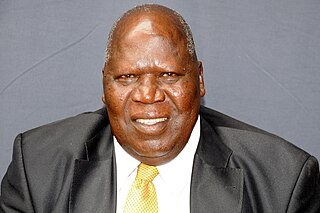
Moses Ali is a Ugandan politician and retired military general. He is the Second Deputy Prime Minister and Deputy Leader of Government Business in Parliament. He previously served in the Cabinet of Uganda as Third Deputy Prime Minister and Deputy Leader of Government Business from May 2011 until June 2016. He also served as the first First Deputy Prime Minister from June 2016 to May 2021. He has served as the elected Member of Parliament for East Moyo County in Adjumani District since 2011.
Lieutenant General Charles Lwanga Lutaaya, is a senior Ugandan military officer in the Uganda People's Defence Forces (UPDF). He is a presidential advisor on matters of Airforce. Before that, he was the Commander of the UPDF Air Force after having served as Deputy Commander of the UPDF Air Force.
Major General Kasirye Ggwanga, was a Ugandan military officer in the Uganda People's Defence Force. He was previously incarcerated as a prisoner of war for 897 days, inside both Uganda and Tanzania. He was a presidential advisor on Buganda Kingdom affairs. He was well respected for his fight towards environmental protection.
Brigadier Rebecca Mpagi, is a Ugandan military officer and Aircraft Maintenance Engineer, who serves as the Director of Personnel and Administration in the UPDF Air Force. She is credited as the first female in Uganda to qualify as a military aircraft maintenance engineer.
Yusuf Gowon was a Ugandan military officer who served as chief of staff for the Uganda Army during the dictatorship of Idi Amin. Originally a farmer, Gowon quickly rose through the ranks of the military due to a combination of happenstance and his political skills. Compared with other high-ranking officials of Amin's regime, he was regarded as humane; nevertheless, he was probably involved in some political murders. His appointment as chief of staff was mostly owed to the fact that President Amin regarded him as loyal, not ambitious, and no threat to his own rule. Gowon's lack of talent for tactics and strategy came to the fore when the Uganda–Tanzania War broke out in 1978, and his leadership of the Uganda Army during this conflict was extensively criticised. Many of his comrades and subordinates even blamed him for Uganda's defeat in the conflict with Tanzania. When Amin's regime began collapsing in 1979 and his own soldiers intended to murder him, Gowon fled Uganda.
The Uganda–Tanzania War of 1978–79 included an air campaign, as the air forces of Uganda and Tanzania battled for air superiority and launched bombing raids. In general, the conflict was focused on air-to-ground attacks and ground-based anti-aircraft fire; only one dogfight is known to have occurred.
Andrew Joet Mukooza was a Ugandan military officer who served as the last head of the Uganda Army Air Force before its destruction during the Uganda–Tanzania War of 1978–79. Born in eastern Uganda, Mukooza joined the air force during the presidency of Milton Obote. In 1971, army commander Idi Amin assumed power in Uganda. Mukooza stayed firmly loyal to Amin's regime, and consequently rose in the ranks. He possibly helped Amin to defeat a coup attempt in 1977, drawing the ire of Uganda's opposition. When the Uganda–Tanzania War broke out, Mukooza initially flew missions as fighter pilot and became head of the Uganda Army Air Force when the latter began to disintegrate amid combat losses, defections, and desertions. Following the defeat of Amin, Mukooza surrendered to the new Tanzanian-backed government of Uganda, but was murdered under uncertain circumstances.
Zeddy Maruru was a Ugandan military pilot and military officer. He served in all of Uganda's post-independence armies, from 1964 until 2002. He was the commander of the Uganda Army Air Force during the 1970s. He also served as the Chief of Army Staff after Tito Okello overthrew Milton Obote's second administration in 1985.
Lieutenant General Charles Okidi, is a senior Ugandan military officer in the Uganda People's Defence Force (UPDF). He is the Commander of the UPDF Air Force, effective November 2022. He replaced Lieutenat General Charles Lutaaya who was appointed a presidential advisor. Before that, from 11 December 2019 until 7 November 2022, he was the Chief of Staff of the UPDF Air Force. Prior to that, he was the Director Operations at the UPDF Air Force Headquarters at Entebbe.
Naomi Karungi was a Ugandan helicopter pilot who, at the time of her death, was the Squadron Commander of Augusta Bell Squadron in the UPDF Air Force.
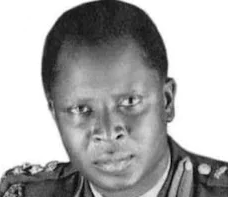
Ali Fadhul was a Ugandan military officer and convicted criminal who served as governor, minister and army chief of staff during the dictatorship of President Idi Amin. In course of his career, he also commanded the Simba Battalion of the Uganda Army (UA). He was one of Amin's last loyal followers during the Uganda–Tanzania War of 1978–1979. Following the conflict, Fadhul was arrested by the new Ugandan government, and convicted of murder. Sentenced to death, he spent 22 years in prison until he was pardoned by President Yoweri Museveni in 2009.

Uganda People's Defence Force Air Force, more commonly known as the Ugandan Air Force, is a branch of the Uganda People's Defence Force. Its headquarters are located at Entebbe, Uganda. The current air force commander is Charles Lutaaya, while Emmanuel Kwihangana serves as chief of air staff.

The 1972 invasion of Uganda was an armed attempt by Ugandan insurgents, supported by Tanzania, to overthrow the regime of Idi Amin. Under the orders of former Ugandan President Milton Obote, insurgents launched an invasion of southern Uganda with limited Tanzanian support in September 1972. The rebel force mostly consisted of the "People's Army" whose forces were mainly loyal to Obote, but also included guerillas led by Yoweri Museveni. The operation was hampered by problems from the start, as a planned rebel commando raid had to be aborted, Amin was warned of the impending invasion, and the rebels lacked numbers, training, and equipment. Regardless, the militants occupied a few towns in southern Uganda at the invasion's start. However, no major popular uprising erupted as Obote had hoped.
Operation Mafuta Mingi was a coup d'état attempt on 18 June 1977 which aimed at killing Ugandan President Idi Amin and overthrowing his government. The operation was organized by the "Uganda Liberation Movement", a group consisting of dissident Uganda Army soldiers and pilots, backed by business owners in Kampala and Entebbe.

Bernard Rwehururu was a Ugandan military officer and author. He served in various Ugandan militaries from 1965 until 2013, including under the governments of Milton Obote, Idi Amin, Tito Okello, and Yoweri Museveni.
Stephen Kiggundu, was a Ugandan military officer, military pilot, paratrooper, military flight instructor and military commander in the Uganda People's Defence Force. At the time of his death, he was the Deputy Commander of the UPDF Air Force. He served in that role from September 2022 until March 2024.
References
- 1 2 3 4 5 6 7 8 9 10 11 12 Paul Murungi (8 December 2018). "General Kiiza: Chief Pilot For Six Presidents". Daily Monitor . Kampala. Retrieved 22 April 2019.
- 1 2 "Air Force officers (Editorial report)". Summary of World Broadcasts: Non-Arab Africa. No. 5777. BBC Monitoring. 1978.
- ↑ Malaba, Tom (28 December 2018). "11 Retired Generals Get Shs7 Billion Package". Daily Monitor . Kampala. Retrieved 22 April 2019.
- ↑ UPDF (4 July 2018). "Commander In Chief Retires Senior Officers". Mbuya, Kampala, Uganda: Uganda People's Defence Forces (UPDF). Retrieved 22 April 2019.