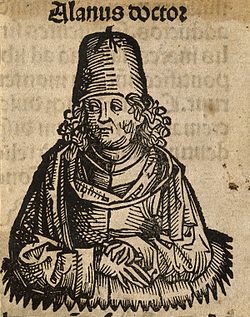
"All roads lead to Rome" is a proverb[a] meaning the same outcome can be reached by many ways.[2][3] It was first written in Medieval Latin in 1175 by Alain de Lille and first written in English in 1391 by Geoffrey Chaucer. It references that in the Roman Empire, all major roads led to Rome.
Alain de Lille, the proverb: "all roads lead to Rome," originates from him.
Origin
The origin comes from the Medieval Latin proverb: "Mille viae ducunt homines per saecula Romam," the proverb translated into Modern English being: "A thousand roads lead men forever to Rome." The proverb was written in 1175 by Alain de Lille in the Liber Parabolarum (English: Book of Proverbs).[4][5]
↑Although some of the sources refer to it as an idiom, an idiom has figurative language in its components, while a proverb’s figurative meaning is an extension of its literal meaning.[1] The proverb references the fact that in the Roman Empire, all major roads led to Rome, so therefore by definition, all roads lead to Rome is a proverb. Although some experts may refer to proverbs as a type of idiom, this is an explanation why the article uses the word: "proverb," instead of the word: "idiom."
References
↑Lexicography: Critical Concepts (2003) R. R. K. Hartmann, Mick R K Smith, ISBN0-415-25365-9, p. 303 Retrieved November 23, 2025
↑Alanus ab Insulis (Alain de Lille), Boston Public Library (1493), Liber Parabolarum (line 591) Retrieved November 14, 2025
↑Samuel Singer; Kuratorium Singer (1995), Walter de Gruyter, editor, Thesaurus Proverbiorum Medii Aevi: Lexikon der Sprichwörter des Romanisch-germanischen Mittelalters Retrieved November 26, 2025
↑Linda Flavell; Roger Flavell (1993), Dictionary of Proverbs and their Origins Retrieved November 14, 2025
↑ Gregory Y. Titelman (1996), Random House Dictionary of Popular Proverbs and Sayings, page 8. Retrieved November 26, 2025
↑Schaaf, P. (1867/1886), Ante-nicene fathers: The Apostolic fathers, Justin Martyr, Irenaeus, electronic reprint edition, volume 1, Grand Rapids, MI, USA: CCEL: Roberts, A. & Donaldson, J, Eds., page 1. Retrieved November 14, 2025
This page is based on this Wikipedia article Text is available under the CC BY-SA 4.0 license; additional terms may apply. Images, videos and audio are available under their respective licenses.