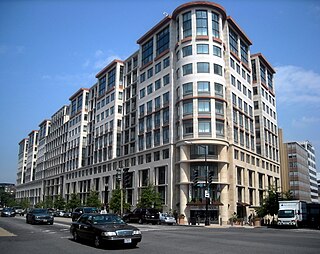
The International Finance Corporation (IFC) is an international financial institution that offers investment, advisory, and asset-management services to encourage private-sector development in less developed countries. The IFC is a member of the World Bank Group and is headquartered in Washington, D.C. in the United States.

Recycling is the process of converting waste materials into new materials and objects. The recovery of energy from waste materials is often included in this concept. The recyclability of a material depends on its ability to reacquire the properties it had in its original state. It is an alternative to "conventional" waste disposal that can save material and help lower greenhouse gas emissions. It can also prevent the waste of potentially useful materials and reduce the consumption of fresh raw materials, reducing energy use, air pollution and water pollution.

Although PET is used in several applications,, as of 2022 only bottles are collected at a substantial scale. The main motivations have been either cost reduction or recycle content of retail goods. An increasing amount is recycled back into bottles, the rest goes into fibres, film, thermoformed packaging and strapping. After sorting, cleaning and grinding, 'bottle flake' is obtained, which is then processed by either:
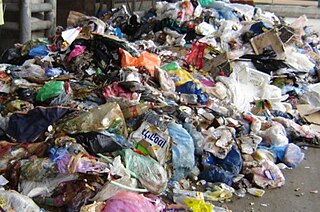
Municipal solid waste (MSW), commonly known as trash or garbage in the United States and rubbish in Britain, is a waste type consisting of everyday items that are discarded by the public. "Garbage" can also refer specifically to food waste, as in a garbage disposal; the two are sometimes collected separately. In the European Union, the semantic definition is 'mixed municipal waste,' given waste code 20 03 01 in the European Waste Catalog. Although the waste may originate from a number of sources that has nothing to do with a municipality, the traditional role of municipalities in collecting and managing these kinds of waste have produced the particular etymology 'municipal.'
Terra Firma Capital Partners Ltd. (TFCP) is a UK-based private equity firm. Financier Guy Hands founded the firm in 2002 through the spin-off of Nomura Principal Finance Group. The firm, which traces its roots to the formation of its predecessor in 1994, has invested over €14 billion since inception.
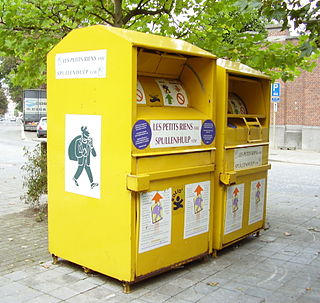
Textile recycling is the process of recovering fiber, yarn or fabric and reprocessing the textile material into useful products. Textile waste products are gathered from different sources and are then sorted and processed depending on their condition, composition, and resale value. The end result of this processing can vary, from the production of energy and chemicals to new articles of clothing.

In 2015, 43.5% of the United Kingdom's municipal waste was recycled, composted or broken down by anaerobic digestion. The majority of recycling undertaken in the United Kingdom is done by statutory authorities, although commercial and industrial waste is chiefly processed by private companies. Local Authorities are responsible for the collection of municipal waste and operate contracts which are usually kerbside collection schemes. The Household Waste Recycling Act 2003 required local authorities in England to provide every household with a separate collection of at least two types of recyclable materials by 2010. Recycling policy is devolved to the administrations of Scotland, Northern Ireland and Wales who set their own targets, but all statistics are reported to Eurostat.
RUSNANO Group is a Russian innovation development institution created in the frame of Presidential Initiative termed "Strategy for Development of Nanotechnology Industry". The RUSNANO Group's mission is to create a competitive nanotechnology-based hi-tech industry in Russia. RUSNANO invests directly and through indirect funds into all major knowledge-based areas where nanotechnology is widely implemented: electronics, optics, telecom, classic and renewable energy, healthcare and biotechnology, materials and metallurgy, engineering and chemistry.
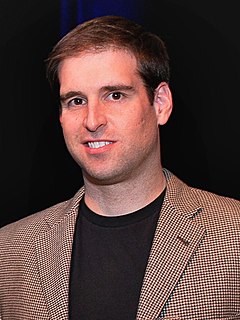
Jeffrey Brian ("JB") Straubel is an American businessman. He spent 15 years at Tesla, as chief technical officer until moving to an advisory role in July 2019.
Coller Capital is one of the largest global investors in the private equity secondary market ("secondaries"). It was founded in 1990 by the UK-based investor and philanthropist Jeremy Coller.
AlpInvest Partners is a dutch private equity asset manager with over $47 billion of assets under management as of September 30, 2017. The firm invests on behalf of a broad range of institutional investors from North America, Asia, Europe, South America and Africa.

Actis is a global investment firm focused on the private equity, energy, infrastructure, and real estate asset classes. It has a growing portfolio of investments across Asia, Africa, and Latin America and US$19 billion in assets under management. Since its inception in 2004, the firm has raised US$24 billion in capital, executing over 200 transactions in 40+ countries across all four asset classes.
Global Infrastructure Partners (GIP) is an infrastructure investment fund making equity and selected debt investments. GIP is headquartered in New York City and its equity investments are in infrastructure assets in the energy, transport and water/waste sectors. GIP employs approximately 150 investment and operational professionals and has offices in New York, London and Sydney and operational headquarters in Stamford, Connecticut. In total as at 2018, its portfolio companies employ approximately 21,000 people.

Robeco Schweiz is an international investment company with a specific focus on sustainability investments. The company is based in Zurich, Switzerland, and considers economic, environmental and social criteria in its investment strategies. In addition to asset management, the company has an indexes and private equity portion of the business. In 2006 RobecoSAM introduced a division called sustainability services that provides sustainability benchmarking reports to companies. In 2001, the then-RobecoSAM became the first carbon neutral company in Switzerland.
E+Co is a non-governmental organization based in Bloomfield, New Jersey, United States, that from its founding in 1994 to its restructuring in 2012 made over 250 clean energy investments in developing countries. Over these 18 years, E+Co maintained field offices in San Jose, Costa Rica, Bangkok, Thailand, Dar es Salaam, Tanzania and Accra, Ghana. The company's name is pronounced, "E and Co".
Iona Capital Ltd is a fund management company, managing equity and debt for private and institutional investors. The fund manager seeks to invest in start-up companies that contribute to the UK Government target of reducing waste sent to landfill and places emphasis on strong management teams.

MBA Polymers is a recycling company with operations globally that recovers plastics from waste electrical and electronic equipment (WEEE) and auto-shredder residue from end-of-life automobiles (ELV).
American Realty Advisors (ARA) is an investment advisor registered with the SEC and a provider of real estate investment management services to institutional investors. As of December 2021, the company had USD$12.2 billion in gross assets under management. The company specializes in acquiring assets and providing equity, preferred equity, mezzanine debt, debt, and hybrid debt to primary investors and developers operating throughout the United States, for commercial office, industrial, multi-family, retail and other properties. ARA's company headquarters is in Los Angeles, California, and the firm has eight additional offices across the country.

CDH Investments is a major Chinese alternative asset management firm based in Beijing, China. It specializes in private equity, venture capital and credit products. CDH invests across a range of sectors and regions. As of March 2015, CDH manages over RMB 100 billion of investor capital across its various investment platforms.

Waste management in South Korea involves waste generation reduction and ensuring maximum recycling of the waste. This includes the appropriate treatment, transport, and disposal of the collected waste. South Korea's Waste Management Law was established in 1986, replacing the Environmental Protection Law (1963) and the Filth and Cleaning Law (1973). This new law aimed to reduce general waste under the waste hierarchy in South Korea. This Waste Management Law imposed a volume-based waste fee system, effective for waste produced by both household and industrial activities.
