
Bukhara is the seventh-largest city in Uzbekistan, with a population of 280,187 as of 1 January 2020, and the capital of Bukhara Region. The mother tongue of the majority of people of Bukhara is the Tajik dialect of the Persian language, although Uzbek is spoken as a second language by most residents.
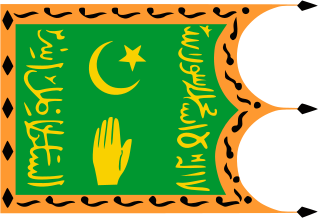
The Emirate of Bukhara was a Muslim polity in Central Asia that existed from 1785 to 1920 in what is now Uzbekistan, Tajikistan, Turkmenistan and Kazakhstan. It occupied the land between the Amu Darya and Syr Darya rivers, known formerly as Transoxiana. Its core territory was the fertile land along the lower Zarafshon river, and its urban centres were the ancient cities of Samarqand and the emirate's capital, Bukhara. It was contemporaneous with the Khanate of Khiva to the west, in Khwarazm, and the Khanate of Kokand to the east, in Fergana. In 1920, it ceased to exist with the establishment of the Bukharan People's Soviet Republic.

Emir Sayyid Mir Muhammad Alim Khan was the last emir of the Uzbek Manghit dynasty, rulers of the Emirate of Bukhara in Central Asia. Although Bukhara was a protectorate of the Russian Empire from 1873, the Emir presided over the internal affairs of his emirate as an absolute monarch and reigned from 3 January 1911 to 30 August 1920. He was the last of Genghis Khan’s direct descendant to rule a state.
Muhammad Umar Khan was the Khan of Kokand from c. 1810 until his subsequent illness and death in c. 1822. He studied at a madrassa after completing his primary education before seizing power from his brother Alim Khan. His poetry written under the pen name "Amir" touched on subjects spanning from humanism, culture, and enlightenment in diwans covering twelve genres. His teenage son Muhammad Ali Khan was given the title of Khan after his death.

Seyid Islam Khodja was the Grand Vizier of the Khiva Khanate from 1898 until his death in 1913.

Kalabad Madrasah is the original name of the Bukhara Madrasah, which operated in the 9th-20th century and has not been preserved. In historical sources, it is called Arslon Khan Madrasah, Khan Madrasah, and Abdurahimhoja Madrasah. At the current time, it is called "Gulabad Madrasa" or "Kalabad Madrasa". Many famous historical people like Imom al-Bukhari have studied there.

Jandi Turki Mausoleum is situated on Namozgoh Street, in the old city section of Bukhara, Uzbekistan. It is associated with one of the famous imams from Bukhara's history in the middle centuries, Turki Jandi. There is said to be a tombstone in the mausoleum located in the southern part of Bukhara. This mausoleum has been listed in the national registry of intangible cultural heritage sites in Uzbekistan.
Talib Makhsum Madrasah is an architectural monument in Khiva, Khorazm Region, Republic of Uzbekistan. The madrasa was built in 1910 at the expense of Talib Makhsum (Makhdum), a member of khan family of Khiva Khanate. Today, the monument is located at 22, Islam Khoja Street, "Itchan Kala" neighborhood.

Khoja Kurban Madrasah is a two-story madrasa located on the Abdulhaliq Gijduvani street, Abdulhaliq Gijduvani neighborhood, Bukhara city, Bukhara Region, Republic of Uzbekistan. It is included in the national list of real estate objects of material and cultural heritage of Uzbekistan.
Abduhafizboy Madrasah is a two-story madrasah located in the historical center of the city of Bukhara in the Bukhara Region, Republic of Uzbekistan. It is included in the national list of real estate objects of material and cultural heritage of Uzbekistan. The madrasah is named Abduhafizboy (Abdulhafizboy) in historical and foundation documents. Currently, it is registered under the names Hotam Hindu or Hotam Hundi in the official documents of the state. Despite the allocation of funds under the 2010 state program for the restoration and repair of the madrasah, it remains in a deplorable state.

A'lam madrasah is a two-story madrasah located in the historical center of the city of Bukhara, Bukhara Region, Republic of Uzbekistan. It is included in the national list of real estate objects of material and cultural heritage of Uzbekistan.
Khalifa Khudoidod Madrasah is an architectural monument located in Bukhara. It is included in the national list of real estate objects of material and cultural heritage of Uzbekistan. Khalifa Khudoidod madrasah was built by Khalifa Khudoidod in 1796-1797, during the reign of Amir Shah Murad, who ruled the Emirate of Bukhara.

Chuqur madrasah is a one-story madrasa building located in the historical center of the city of Bukhara, Bukhara Region, Republic of Uzbekistan. It is included in the national list of real estate objects of material and cultural heritage of Uzbekistan.

Domulla Hasan madrasah is a two-storey madrasah building located in the historical center of the city of Bukhara, Bukhara Region, Republic of Uzbekistan. It is included in the national list of real estate objects of material and cultural heritage of Uzbekistan. Now it is put into modern use as a tourist service facility.

Ibrahim Akhund madrasah is a two-story madrasah located in the historical center of Bukhara city, Bukhara Region, Republic of Uzbekistan. It is included in the national list of real estate objects of material and cultural heritage of Uzbekistan. The Varakhsha Archaeological Museum is located in the building.

Istehza madrasah is a two-story madrasah building located in the historical center of the city of Bukhara, Bukhara Region, Republic of Uzbekistan. The smallest madrasah in Central Asia. It is included in the national list of real estate objects of material and cultural heritage of Uzbekistan.
The Husayni Madrasa is a one-story madrasa building located in the historical center of Bukhara city, Bukhara region, Republic of Uzbekistan. It is included in the National Register of Immovable Cultural Heritage of Uzbekistan.

The Turkman Madrasa is a two-story madrasa building located in the historical center of Bukhara city, Bukhara region, Republic of Uzbekistan. It is included in the national register of immovable property objects of Uzbekistan's material and cultural heritage.

Rashid madrasah is a two-story madrasah building located in the historical center of the city of Bukhara, Bukhara Region, Republic of Uzbekistan. It is included in the national list of real estate objects of material and cultural heritage of Uzbekistan.

The Asiriy Madrasa is a one-story madrasa building located in the historical center of Bukhara city, Bukhara region, Republic of Uzbekistan. It is included in the national register of immovable property objects of Uzbekistan's material and cultural heritage.


 Uzbekistan