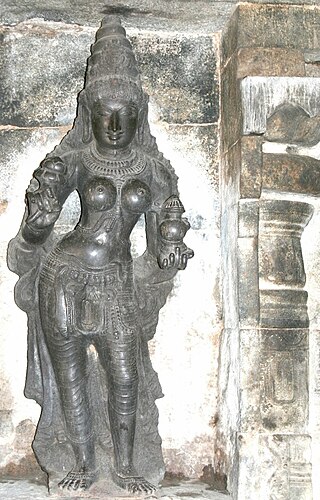
Amrita, Amrit or Amata in Pali, is a Sanskrit word that means "immortality". It is a central concept within Indian religions and is often referred to in ancient Indian texts as an elixir. Its first occurrence is in the Rigveda, where it is considered one of several synonyms for soma, the drink of the devas. Amrita plays a significant role in the Samudra Manthana, and is the cause of the conflict between devas and asuras competing for amrita to obtain immortality.
Lal is an Indo-Iranian surname and given name, which means "darling", "precious", or "beloved", from the Sanskrit lala ("cajoling"). In addition, Lal means "garnet" or "ruby" in Persian, "ruby" in Pashto, and "red" in Hindustani and Bengali. The name Lal may refer to mainly Kayastha as well as used by other communities:
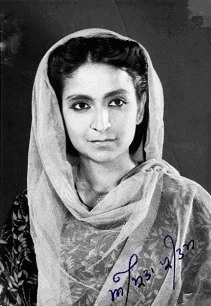
Amrita Pritam was an Indian novelist, essayist and poet, who wrote in Punjabi and Hindi. A prominent figure in Punjabi literature, she is the recipient of the 1956 Sahitya Akademi Award. Her body of work comprised over 100 books of poetry, fiction, biographies, essays, a collection of Punjabi folk songs and an autobiography that were all translated into several Indian and foreign languages.
Cheema is a Punjabi Jatclan of India and Pakistan.
Bhupinder Singh may refer to:
Chaudhary is a title of honour and a common surname in the Indian subcontinent, originally derived from an Indian hereditary title.
Puri is an Indian Punjabi surname of Kshatriya Varna derived from a Chandravanshi Indo Aryan Puru tribe of King Porus.
Anup is an Indian masculine given name. The Sanskrit word anūpa has the following meanings: 'watery', 'situated near the water', 'bank of a river', 'pond', 'lagoon'. The meaning of the name “Anup” is: "Incomparable, unequalled; unique; pond.
Sahni, Sawhney, Sahani, or Sahney is a Punjabi Khatri surname found among the Hindus and Sikhs of Punjab, India. It is also used by people from Bihar, Uttar Pradesh, Bengal and other parts of Central India.
Ajj Aakhaan Waris Shah Nu is a famous dirge by the renowned Punjabi writer and poet Amrita Pritam (1919-2005) about the horrors of the partition of the Punjab during the 1947 Partition of India. The poem is addressed to the historic Punjabi poet Waris Shah, who had written the most popular version of the Punjabi love tragedy, Heer Ranjha. It appeals to Waris Shah to arise from his grave, record the Punjab's tragedy and turn over a new page in Punjab's history.
Chopra is a surname of Ror and Khatri communities mainly based in Haryana and Punjab.
Maharaja Ranjit Singh of Punjab (1780–1839) was the founder of the Sikh Empire.
Anurag Singh may refer to:
Amrita literally means "immortality" and is often referred to in ancient Indian texts as nectar or ambrosia and carries the same meaning.
This page is based on this
Wikipedia article Text is available under the
CC BY-SA 4.0 license; additional terms may apply.
Images, videos and audio are available under their respective licenses.

