Andorran local elections, 1983

Last updated
Coat of arms of Andorra.svg
This article is part of a series on the
politics and government of
Andorra
Constitution
Foreign relations

The 1983 Andorran local elections were held on 12 December. Voters elected the council members of the seven parishes of Andorra. For first time since 1867, local elections were not hold on the same day as parliamentary elections. This was also the first time that the totality of the council seats were up for election (between 1867 and 1979 only half of the seats were renewed in each election). [1]

Parishes of Andorra

Andorra consists of seven communities known as parishes. Until relatively recently, it had only six parishes; the seventh, Escaldes-Engordany, was created in 1978.

Andorra European microstate between France and Spain

Andorra, officially the Principality of Andorra, also called the Principality of the Valleys of Andorra, is a sovereign landlocked microstate on the Iberian Peninsula, in the eastern Pyrenees, bordering France to the north and Spain to the south. Believed to have been created by Charlemagne, Andorra was ruled by the Count of Urgell until 988, when it was transferred to the Roman Catholic Diocese of Urgell, and the present principality was formed by a charter in 1278. It is known as a principality as it is a diarchy headed by two Princes: the Catholic Bishop of Urgell in Catalonia, Spain, and the President of France.

Contents

Electoral system

A referendum was held in 1982 to choose a new election system, but any option had a majority of the votes, and therefore the traditional majoritary system remained. [2]

Candidates were elected using a two-round plurality-at-large voting system with open lists. As parties were not legalised until 1993, all the lists were officially labelled as independent, although media classified them as officialist (if the list was supported by the outgoing government) or opposition (if candidates were part of the opposition). After the elections, the parish councils elected the consol major (mayor) and the cònsol menor (deputy mayor), which normally were the top candidates of the winning list.

Plurality-at-large voting, also known as block vote or multiple non-transferable vote (MNTV), is a non-proportional voting system for electing several representatives from a single multimember electoral district using a series of check boxes and tallying votes similar to a plurality election. Multiple winners are elected simultaneously to serve the district. Block voting is not a system for obtaining proportional representation; instead the usual result is that where the candidates divide into definitive parties the most popular party in the district sees its full slate of candidates elected, resulting in a landslide.

Open list describes any variant of party-list proportional representation where voters have at least some influence on the order in which a party's candidates are elected. This as opposed to closed list, which allows only active members, party officials, or consultants to determine the order of its candidates and gives the general voter no influence at all on the position of the candidates placed on the party list. Additionally, an open list system allows voters to select individuals rather than parties. Different systems give voter different amounts of influence. Voter's choice is usually called preference vote.

In many countries, a mayor is the highest-ranking official in a municipal government such as that of a city or a town.

Candidates

In Canillo and Sant Julià de Lòria only one list was running. In la Massana, the top candidate of both lists was the same person.

Candidates by parish. The two top candidates are listed for each list: [3]

Canillo Place in Andorra

Canillo is one of the parishes of Andorra. Canillo is also the name of the main town of the parish. The parish is considered the religious center of Andorra with the Sanctuary and Chapel of Our Lady of Meritxell, patron saint of Andorra, and contains one of the most well preserved romanesque church in the Pyrenees, Sant Joan de Caselles. It has a population of 4,826, as of 2011. Despite having a tourist vocation, the parish of Canillo still retains many livestock and agricultural traits.

Encamp Place in Andorra

Encamp is one of the parishes of Andorra, located on the Valira d'Orient river. It is also the name of the main town in the parish. Other settlements include Vila, El Pas de la Casa, Grau Roig, el Tremat, la Mosquera and Les Bons. As of 2004, it has about 11,800 inhabitants. The center of the municipality lies 1,300 metres (4,270 ft) above sea level. The highest mountain in the parish is Pic dels Pessons.

Ordino Place in Andorra

Ordino is the most northerly parish in the Principality of Andorra. It's mostly the main area of Valira del Nord or Valira d'Ordino river valley. Ordino is also the name of the main town of the parish. Other settlements in the parish are El Serrat, Ansalonga, Sornàs, La Cortinada, Llorts, Segudet, Arans, Les Salines and Arcalís. It is home to the Sorteny National Park, the largest nature area of Andorra. It has a population of 4,858, as of 2017. The town preserves a vast medieval center, mainly linked to the culture of the country.

Results

Turnout was 77.7%, 14.6 pp higher than in the previous election. Turnout was lower in the parishes with only one candidacy (59% in Encamp and 66% in Sant Julià de Lòria). All candidates were elected on the first round. [1] [4]

Results by parish: [5]

Parish Winning list
Canillo No overall control
Encamp Enric Pujal (officialist)
Ordino Joan Solana
La Massana No overall control
Andorra la Vella Manuel Pons (officialist)
Sant Julià de Lòria Josep Maria Felipó
Escaldes-Engordany José María Beal (opposition)

Related Research Articles

Demographics of Andorra

This article is about the demographic features of the population of Andorra, including population density, ethnicity, education level, health of the populace, economic status, religious affiliations and other aspects of the population.

Politics of Andorra

The politics of Andorra take place in a framework of a parliamentary constitutional diarchy, and a multi-party system. Executive power is exercised by the government, with the Head of Government of Andorra as chief executive. Legislative power is vested in both the government and parliament. The judiciary is independent of the executive and the legislature.

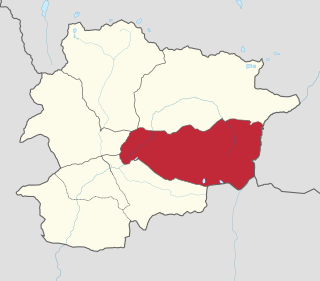
Escaldes-Engordany Place in Andorra

Escaldes-Engordany is one of the parishes of Andorra. The parish is composed of the areas of les Escaldes, Engordany, Els Vilars d'Engordany, Engolasters, and El Fener. As of 2014 it has a population of 13,634. Notable events include the town's annual jazz festival. It borders Encamp to the north and northeast, Sant Julià de Lòria in the southwest, Andorra la Vella in the west, La Massana in the northwest and Catalonia, Spain in the east, south and southest.

Sant Julià de Lòria Place in Andorra

Sant Julià de Lòria is one of the parishes of Andorra, in the far south of that country. It is also the name of the main town of the parish, which at 908 m is the lowest settlement in Andorra. Other settlements in the parish include Bixessarri, Aixàs, Aixovall, Certers, Llumeneres, Nagol, Aixirivall, Auvinyà, Juberri, Fontaneda, and Canòlic. It is bordered by Andorra la Vella in the north, Escaldes-Engordany in the northeast and Catalonia, Spain in the south, east, west, northwest, southwest and southeast.

Catholic Church in Andorra

The Catholic Church in Andorra is part of the worldwide Catholic Church, under the spiritual leadership of the Pope in Rome.
Outline of Andorra Wikimedia list article

The following outline is provided as an overview of and topical guide to Andorra:

Listed below are articles about or related to Andorra, arranged alphabetically:

2011 Andorran parliamentary election election

Early parliamentary elections were held in Andorra on 3 April 2011 after the General Council of Andorra was dissolved over problems in passing important laws, including the budget and laws related to a value added tax.

1985 Andorran parliamentary election

Parliamentary elections were held in Andorra on 12 and 19 December 1985. As political parties were not legalised until 1993, all candidates ran as independents. Following the election, Josep Pintat-Solans remained Prime Minister.

1989 Andorran parliamentary election

Parliamentary elections were held in Andorra on 10 December 1989, with a second round of voting on 17 December. Following the elections, Òscar Ribas Reig became Prime Minister, elected on 12 January 1990 by a vote of 23−5.

1992 Andorran parliamentary election

Parliamentary elections were held in Andorra on 5 April 1992, with a second round of voting on 12 April. Following the elections, Òscar Ribas Reig remained Prime Minister.

The Cultural Heritage of Andorra is an organization in Andorra which protects national buildings and monuments considered of cultural and historical value.

2015 Andorran parliamentary election

Parliamentary elections were held in Andorra on 1 March 2015. Despite losing five seats, the Democrats for Andorra retained their majority in the General Council, winning 15 of the 28 seats.

Spain has 1953 kilometers of borders, with 5 different countries.

1987 Andorran local elections

The 1987 Andorran local elections were held on 13 and 20 December. Voters elected the council members of the seven parishes of Andorra. Following the election, the communal councils elected the mayors and deputy mayors.

The 1991 Andorran local elections were held on 15 and 22 December. Voters elected the council members of the seven parishes of Andorra. Following the election, the communal councils elected the mayors and deputy mayors.

The Principality of Andorra's honours system started developing very recently and it is still in development.

References