
This timeline of computer viruses and worms presents a chronological timeline of noteworthy computer viruses, computer worms, Trojan horses, similar malware, related research and events.
Linux malware includes viruses, Trojans, worms and other types of malware that affect the Linux family of operating systems. Linux, Unix and other Unix-like computer operating systems are generally regarded as very well-protected against, but not immune to, computer viruses.
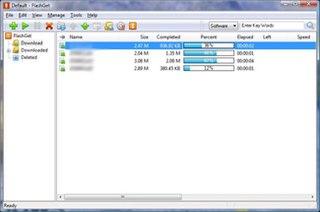
FlashGet was a freeware download manager for Microsoft Windows. It was originally available in either paid or ad-supported versions, the latter of which included an Internet Explorer Browser Helper Object (BHO).

Ransomware is a type of malware from cryptovirology that threatens to publish the victim's personal data or permanently block access to it unless a ransom is paid off. While some simple ransomware may lock the system without damaging any files, more advanced malware uses a technique called cryptoviral extortion. It encrypts the victim's files, making them inaccessible, and demands a ransom payment to decrypt them. In a properly implemented cryptoviral extortion attack, recovering the files without the decryption key is an intractable problem – and difficult to trace digital currencies such as paysafecard or Bitcoin and other cryptocurrencies are used for the ransoms, making tracing and prosecuting the perpetrators difficult.
Mobile malware is malicious software that targets mobile phones or wireless-enabled Personal digital assistants (PDA), by causing the collapse of the system and loss or leakage of confidential information. As wireless phones and PDA networks have become more and more common and have grown in complexity, it has become increasingly difficult to ensure their safety and security against electronic attacks in the form of viruses or other malware.
Watering hole is a computer attack strategy in which an attacker guesses or observes which websites an organization often uses and infects one or more of them with malware. Eventually, some member of the targeted group will become infected. Hacks looking for specific information may only attack users coming from a specific IP address. This also makes the hacks harder to detect and research. The name is derived from predators in the natural world, who wait for an opportunity to attack their prey near watering holes.
Rogue security software is a form of malicious software and internet fraud that misleads users into believing there is a virus on their computer and aims to convince them to pay for a fake malware removal tool that actually installs malware on their computer. It is a form of scareware that manipulates users through fear, and a form of ransomware. Rogue security software has been a serious security threat in desktop computing since 2008. An early example that gained infamy was SpySheriff and its clones, such as Nava Shield.

Kaspersky Anti-Virus was a proprietary antivirus program developed by Kaspersky Lab. It is designed to protect users from malware and is primarily designed for computers running Microsoft Windows and macOS, although a version for Linux is available for business consumers.
Koobface is a network worm that attacks Microsoft Windows, Mac OS X, and Linux platforms. This worm originally targeted users of networking websites like Facebook, Skype, Yahoo Messenger, and email websites such as GMail, Yahoo Mail, and AOL Mail. It also targets other networking websites, such as MySpace, Twitter, and it can infect other devices on the same local network. Technical support scammers also fraudulently claim to their intended victims that they have a Koobface infection on their computer by using fake popups and using built-in Windows programs.
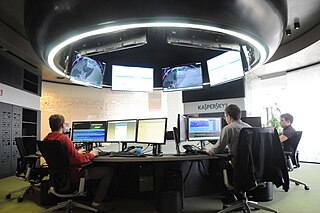
Kaspersky Lab is a Russian multinational cybersecurity and anti-virus provider headquartered in Moscow, Russia, and operated by a holding company in the United Kingdom. It was founded in 1997 by Eugene Kaspersky, Natalya Kaspersky, and Alexey De-Monderik; Eugene Kaspersky is currently the CEO. Kaspersky Lab develops and sells antivirus, internet security, password management, endpoint security, and other cybersecurity products and services.
Clampi is a strain of computer malware which infects Windows computers. More specifically, as a man-in-the-browser banking trojan designed to transmit financial and personal information from a compromised computer to a third party for potential financial gain as well as report on computer configuration, communicate with a central server, and act as downloader for other malware. Clampi was first observed in 2007 affecting computers running the Microsoft Windows operating system.
Alureon is a trojan and rootkit created to steal data by intercepting a system's network traffic and searching for banking usernames and passwords, credit card data, PayPal information, social security numbers, and other sensitive user data. Following a series of customer complaints, Microsoft determined that Alureon caused a wave of BSoDs on some 32-bit Microsoft Windows systems. The update, MS10-015, triggered these crashes by breaking assumptions made by the malware author(s).
Flame, also known as Flamer, sKyWIper, and Skywiper, is modular computer malware discovered in 2012 that attacks computers running the Microsoft Windows operating system. The program is used for targeted cyber espionage in Middle Eastern countries.

Seculert is a cloud-based cyber security technology company based in Israel. The company's technology is designed to detect breaches and Advanced Persistent Threats (APTs), attacking networks. Seculert's business is based on malware research and the ability to uncover malware that has gone undetected by other traditional measures.
DarkHotel is a targeted spear-phishing spyware and malware-spreading campaign that appears to be selectively attacking business hotel visitors through the hotel's in-house WiFi network. It is characterized by Kaspersky Lab as an advanced persistent threat.
Regin is a sophisticated malware and hacking toolkit used by United States' National Security Agency (NSA) and its British counterpart, the Government Communications Headquarters (GCHQ). It was first publicly revealed by Kaspersky Lab, Symantec, and The Intercept in November 2014. The malware targets specific users of Microsoft Windows-based computers and has been linked to the US intelligence-gathering agency NSA and its British counterpart, the GCHQ. The Intercept provided samples of Regin for download, including malware discovered at a Belgian telecommunications provider, Belgacom. Kaspersky Lab says it first became aware of Regin in spring 2012, but some of the earliest samples date from 2003. Among computers infected worldwide by Regin, 28 percent were in Russia, 24 percent in Saudi Arabia, 9 percent each in Mexico and Ireland, and 5 percent in each of India, Afghanistan, Iran, Belgium, Austria, and Pakistan.
A Trojan.WinLNK.Agent is the definition from Kaspersky Labs of a Trojan downloader, Trojan dropper, or Trojan spy.
Xafecopy Trojan is a malware software targeting the Android operating system, first identified in September 2017 by cybersecurity and antivirus provider Kaspersky Lab. According to Kaspersky Lab, Xafecopy infected at least 4,800 users within a month in approximately 47 countries. Users in India were its primary victims, followed by users from Russia, Turkey, and Mexico.

CamScanner is a Chinese mobile app first released in 2011 that allows iOS and Android devices to be used as image scanners. It allows users to 'scan' documents and share the photo as either a JPEG or PDF. This app is available free of charge on the Google Play Store and the Apple App Store. The app is based on freemium model, with ad-supported free version and a premium version with additional functions.
Titanium is a very advanced backdoor malware APT, developed by PLATINUM, a cybercrime collective. The malware was uncovered by Kaspersky Lab and reported on 8 November 2019. According to Global Security Mag, "Titanium APT includes a complex sequence of dropping, downloading and installing stages, with deployment of a Trojan-backdoor at the final stage." Much of the sequence is hidden from detection in a sophisticated manner, including hiding data steganographically in a PNG image. In their announcement report, Kaspersky Lab concluded: "The Titanium APT has a very complicated infiltration scheme. It involves numerous steps and requires good coordination between all of them. In addition, none of the files in the file system can be detected as malicious due to the use of encryption and fileless technologies. One other feature that makes detection harder is the mimicking of well-known software. Regarding campaign activity, we have not detected any current activity [as of 8 November 2019] related to the Titanium APT."

