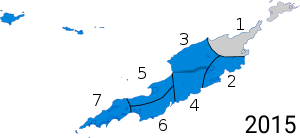
Politics of Anguilla takes place in a framework of a parliamentary representative democratic dependency, whereby the Chief Minister is the head of government, and of a multi-party system. Anguilla, the most northerly of the Leeward Islands in the Lesser Antilles, is an internally self-governing overseas territory of the United Kingdom. The United Nations Committee on Decolonization includes Anguilla on the United Nations list of Non-Self-Governing Territories. The territory's constitution is Anguilla Constitutional Order 1 April 1982. Executive power is exercised by the Chief Minister and the Executive Council. Legislative power is vested in both the Executive Council and the House of Assembly. The Judiciary is independent of the executive and the legislature. Military defence is the responsibility of the United Kingdom.
Elections in Botswana take place within the framework of a multi-party democracy and a parliamentary system. The National Assembly is mostly directly elected, and in turn elects the President and some of its own members. The Ntlo ya Dikgosi is a mixture of appointed, hereditary and indirectly elected members.
Elections in Malaysia exist at two levels: federal level and state level. Federal level elections are those for membership in the Dewan Rakyat, the lower house of Parliament, while state level elections are for membership in the various State Legislative Assemblies. The heads of executive branch at both the federal and state levels, the Prime Minister and Menteri Besar/Chief Ministers respectively, are indirectly elected, usually filled by a member of the majority party/coalition in the respective legislatures.
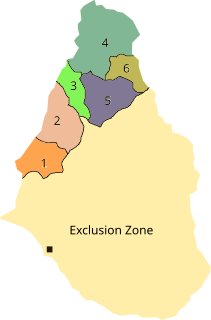
Elections in Montserrat take place within the framework of a multi-party democracy and a parliamentary system. The Legislative Assembly is directly elected, and a Chief Minister is selected by the party or coalition with the most seats in the Assembly.

Elections in Zambia take place within the framework of a multi-party democracy and a presidential system. The President and National Assembly are simultaneously elected for five-year terms.

Parliamentary elections were held in Hungary on 9 April 2006, with a second round of voting in 110 of the 176 single-member constituencies on 23 April. The Hungarian Socialist Party emerged as the largest party in the National Assembly with 186 of the 386 seats, and continued the coalition government with the Alliance of Free Democrats. It marked the first time a government had been re-elected since the end of Communist rule.

The Zimbabwe Rhodesia general election of April 1979 was held under the Internal Settlement negotiated by the Rhodesian Front government of Ian Smith intended to provide a peaceful transition to majority rule on terms not harmful to Rhodesians of white descent. The internal settlement was not approved internationally but the incoming government under Bishop Abel Muzorewa did decide to participate in the Lancaster House talks which led to the end of the dispute and the creation of Zimbabwe.

A general election for the Constituent Assembly was held in Nepal on 10 April 2008 after having been postponed from earlier dates of 7 June 2007 and 22 November 2007. The Nepalese Constituent Assembly will draft a new constitution; it will therefore decide, amongst other things, on the issue of federalism. The number of eligible voters was around 17.5 million. The Constituent Assembly will have a term of two years.
The 2005 Anguillan general election was held in Anguilla on 21 February 2005 to elect the seven elected seats in the House of Assembly. The Anguilla United Front, an alliance of the Anguilla National Alliance and the Anguilla Democratic Party, won the election retaining four of the elected seats.

Ram Baran Yadav is a Nepalese politician and physician who served as the First President of Nepal following the declaration of a republic in 2008. He served as a Nepalese President from 23 July 2008 to 29 October 2015. Previously he served as Minister of Health from 1999 to 2001 and General Secretary of the Nepali Congress. Yadav was Minister of State for Health in the 1991–1994 Nepali Congress government. He was elected to the House of Representatives in the 1999 election as a candidate of the Nepali Congress. After that election, he became Minister of Health.

The first legislative assembly Election to the Madras state on the basis of universal adult suffrage was held in March 1952. This was the first election held in Madras state after the Indian Independence. This election was officially known as 1951 Madras State Election, even though through delays, actual voting didn't take place until early 1952.

The 2011 election to the Northern Ireland Assembly took place on Thursday, 5 May, following the dissolution of the Northern Ireland Assembly at midnight on 24 March 2011. It was the fourth election to take place since the devolved assembly was established in 1998.
General elections were held in Tanzania on 31 October 2010. The presidential elections were won by the incumbent President Jakaya Kikwete of the Chama Cha Mapinduzi party (CCM), who received 63% of the vote. The parliamentary elections resulted in a victory for the CCM, which won 186 of the 239 elected seats.
The Anguillan general election was held on 15 February 2010. Seven seats in the Anguilla House of Assembly were contested in the election.
The first elections to the Arunachal Pradesh Legislative Assembly were held in on February 25, 1978.

General elections were held in Tuvalu on 31 March 2015. The state of emergency created by Cyclone Pam resulted in the election being delayed twice. The election was originally scheduled for 19 March, then after Cyclone Pam caused damage to the islands, the election was rescheduled for 26 March.
Jiva Pandu Gavit is an Indian politician from the state of Maharashtra. Gavit is a seven term member of the Maharashtra Legislative Assembly representing Surgana and Kalwan constituencies. Jiva Pandu Gavit was elected the Pro-tem Speaker of the Maharashtra Legislative Assembly in 2014. Gavit belongs to the Communist Party of India (Marxist) and is the only leftist member of the 13th Legislative Assembly in Maharashtra.
Elections in the Republic of India in 2018 included by-elections to the Lok Sabha, elections to the Rajya Sabha, elections to legislative assemblies of eight states and numerous other by-elections to state legislative assemblies, councils and local bodies.

Early general elections were held in Lesotho on 3 June 2017 to elect all 120 seats of the National Assembly, the lower house of the Parliament. The elections were called more than three years ahead of schedule due to a successful vote of no confidence against the incumbent Prime Minister Pakalitha Mosisili.