 | Look up angular in Wiktionary, the free dictionary. |
Angular may refer to:
| Look up angular in Wiktionary, the free dictionary. |
Angular may refer to:


The blood vessels are the components of the circulatory system that transport blood throughout the human body. These vessels transport blood cells, nutrients, and oxygen to the tissues of the body. They also take waste and carbon dioxide away from the tissues. Blood vessels are needed to sustain life, because all of the body's tissues rely on their functionality.

The neck is the part of the body on many vertebrates that connects the head with the torso and provides the mobility and movements of the head. The structures of the human neck are anatomically grouped into four compartments; vertebral, visceral and two vascular compartments. Within these compartments, the neck houses the cervical vertebrae and cervical part of the spinal cord, upper parts of the respiratory and digestive tracts, endocrine glands, nerves, arteries and veins. Muscles of the neck are described separately from the compartments. They bound the neck triangles.

In human anatomy, the arm is the part of the upper limb between the glenohumeral joint and the elbow joint. In common usage, the arm extends through the hand. The arm can be divided into the upper arm, which extends from the shoulder to the elbow, the forearm which extends from the elbow to the hand, and the hand. Anatomically the shoulder girdle with bones and corresponding muscles is by definition a part of the arm. The Latin term brachium may refer to either the arm as a whole or to the upper arm on its own.

The parietal bones are two bones in the skull which, when joined together at a fibrous joint, form the sides and roof of the cranium. In humans, each bone is roughly quadrilateral in form, and has two surfaces, four borders, and four angles. It is named from the Latin paries (-ietis), wall.
Palmar may refer to:
In anatomy and osteology, a foramen is an open hole that is present in extant or extinct amniotes. Foramina inside the body of animals typically allow muscles, nerves, arteries, veins, or other structures to connect one part of the body with another.

The scalp is the anatomical area bordered by the human face at the front, and by the neck at the sides and back.
The angular diameter, angular size, apparent diameter, or apparent size is an angular distance describing how large a sphere or circle appears from a given point of view. In the vision sciences, it is called the visual angle, and in optics, it is the angular aperture. The angular diameter can alternatively be thought of as the angular displacement through which an eye or camera must rotate to look from one side of an apparent circle to the opposite side. Angular radius equals half of the angular diameter. Humans can recognizable diameters with their naked eye of up to about 1 arcminute, approximately 0.017° or 0.0003 radians, which corresponds to 0.3 m at a 1 km distance, or at astronomical scales Venus can be identified as a disc at times.

The renal arteries are paired arteries that supply the kidneys with blood. Each is directed across the crus of the diaphragm, so as to form nearly a right angle.
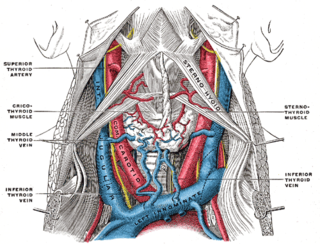
The internal jugular vein is a paired jugular vein that collects blood from the brain and the superficial parts of the face and neck. This vein runs in the carotid sheath with the common carotid artery and vagus nerve.
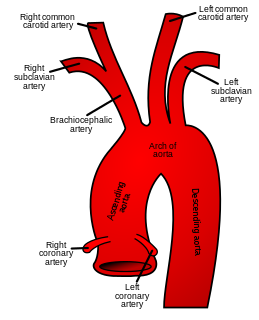
In anatomy, the left and right common carotid arteries (carotids) are arteries that supply the head and neck with oxygenated blood; they divide in the neck to form the external and internal carotid arteries.
Lingual may refer to:
Tibial may refer to:
Innominate may refer to:
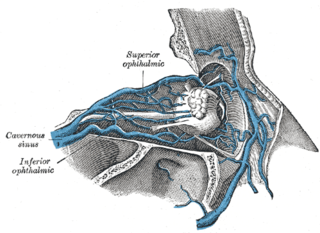
The superior ophthalmic vein is a vein of the orbit around the eye. It begins from the angular vein and the supraorbital vein, and passes through the superior orbital fissure to drain into the cavernous sinus. It drains the ethmoidal veins, the lacrimal vein, the central retinal vein, some vorticose veins, and veins from two rectus muscles. It can be a path for the spread of infection from the danger triangle of the face to the cavernous sinus and the pterygoid plexus. It may also be affected by an arteriovenous fistula of the cavernous sinus, treated with embolization.
Iliac can refer to one of the following:

The petrous part of the temporal bone is pyramid-shaped and is wedged in at the base of the skull between the sphenoid and occipital bones. Directed medially, forward, and a little upward, it presents a base, an apex, three surfaces, and three angles, and houses in its interior, the components of the inner ear. The petrous portion is among the most basal elements of the skull and forms part of the endocranium. Petrous comes from the Latin word petrosus, meaning "stone-like, hard". It is one of the densest bones in the body.

The angular artery is the terminal part of the facial artery; it ascends to the medial angle of the eye's orbit, imbedded in the fibers of the angular head of the quadratus labii superioris, and accompanied by the angular vein.

The following outline is provided as an overview of and topical guide to human anatomy:

An erection is a physiological phenomenon in which the penis becomes firm, engorged, and enlarged. Penile erection is the result of a complex interaction of psychological, neural, vascular, and endocrine factors, and is often associated with sexual arousal or sexual attraction, although erections can also be spontaneous. The shape, angle, and direction of an erection varies considerably in humans.