Related Research Articles

Adrienne Cecile Rich was an American poet, essayist and feminist. She was called "one of the most widely read and influential poets of the second half of the 20th century", and was credited with bringing "the oppression of women and lesbians to the forefront of poetic discourse". Rich criticized rigid forms of feminist identities, and valorized what she coined the "lesbian continuum", which is a female continuum of solidarity and creativity that impacts and fills women's lives.

Audre Lorde was an American writer, professor, philosopher, intersectional feminist, poet and civil rights activist. She was a self-described "Black, lesbian, feminist, socialist, mother, warrior, poet" who dedicated her life and talents to confronting different forms of injustice, as she believed there could be "no hierarchy of oppressions" among "those who share the goals of liberation and a workable future for our children."

Bobbi Lee Maracle was an Indigenous Canadian writer and academic of the Stó꞉lō nation. Born in North Vancouver, British Columbia, she left formal education after grade 8 to travel across North America, attending Simon Fraser University on her return to Canada. Her first book, an autobiography called Bobbi Lee: Indian Rebel, was published in 1975. She wrote fiction, non-fiction, and criticism and held various academic positions. Maracle's work focused on the lives of Indigenous people, particularly women, in contemporary North America. As an influential writer and speaker, Maracle fought for those oppressed by sexism, racism, and capitalist exploitation.
Judy Grahn is an American poet and author.
Second-wave feminism was a period of feminist activity that began in the early 1960s and lasted roughly two decades, ending with the feminist sex wars in the early 1980s and being replaced by third-wave feminism in the early 1990s. It occurred throughout the Western world and aimed to increase women's equality by building on the feminist gains of the late 19th and early 20th centuries.

Lesbian feminism is a cultural movement and critical perspective that encourages women to focus their efforts, attentions, relationships, and activities towards their fellow women rather than men, and often advocates lesbianism as the logical result of feminism. Lesbian feminism was most influential in the 1970s and early 1980s, primarily in North America and Western Europe, but began in the late 1960s and arose out of dissatisfaction with the New Left, the Campaign for Homosexual Equality, sexism within the gay liberation movement, and homophobia within popular women's movements at the time. Many of the supporters of Lesbianism were actually women involved in gay liberation who were tired of the sexism and centering of gay men within the community and lesbian women in the mainstream women's movement who were tired of the homophobia involved in it.
The women's liberation movement (WLM) was a political alignment of women and feminist intellectualism. It emerged in the late 1960s and continued til the 1980s, primarily in the industrialized nations of the Western world, which resulted in great change throughout the world. The WLM branch of radical feminism, based in contemporary philosophy, comprised women of racially and culturally diverse backgrounds who proposed that economic, psychological, and social freedom were necessary for women to progress from being second-class citizens in their societies.
W.I.T.C.H., originally the acronym for Women's International Terrorist Conspiracy from Hell, was the name of several related but independent feminist groups active in the United States as part of the women's liberation movement during the late 1960s. The W.I.T.C.H. moniker was sometimes alternatively expanded as "Women Inspired to Tell their Collective History", or "Women Interested in Toppling Consumer Holidays", among other variations.

Anna Pauline "Pauli" Murray was an American civil rights activist, advocate, legal scholar and theorist, author and – later in life – an Episcopal priest. Murray's work influenced the civil rights movement and expanded legal protection for gender equality.
Black feminism is a branch of feminism that focuses on the African-American woman's experiences and recognizes the intersectionality of racism and sexism. Black feminism philosophy centers on the idea that "Black women are inherently valuable, that liberation is a necessity not as an adjunct to somebody else's but because of our need as human persons for autonomy."
Lucy Komisar is a New York City-based investigative journalist and drama critic.
The men's liberation movement is a social movement critical of the restraints which society imposes on men. Men's liberation activists are generally sympathetic to feminist standpoints.
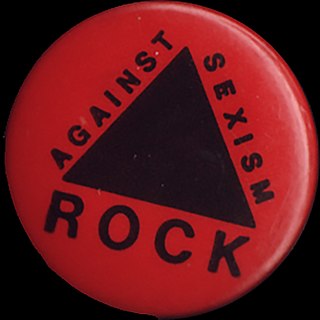
Rock Against Sexism (RAS) was a political and cultural movement dedicated to promoting women in music, and challenging sexism in the rock music community, pop culture and in the world at large. It was primarily a part of the punk rock music and arts scene.
The Combahee River Collective (CRC) was a Black feminist lesbian socialist organization active in Boston, Massachusetts, from 1974 to 1980. The Collective argued that both the white feminist movement and the Civil Rights Movement were not addressing their particular needs as Black women and more specifically as Black lesbians. Racism was present in the mainstream feminist movement, while Delaney and Manditch-Prottas argue that much of the Civil Rights Movement had a sexist and homophobic reputation. The Collective was a group that met to discuss the intersections of oppression based on race, gender, heteronormativity, and class and argued for the liberation of Black women on all fronts.
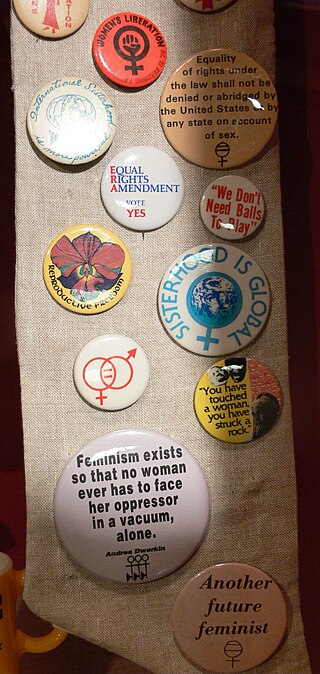
A variety of movements of feminist ideology have developed over the years. They vary in goals, strategies, and affiliations. They often overlap, and some feminists identify themselves with several branches of feminist thought.
Chude Pamela Parker Allen, also known as Pamela Parker, Chude Pamela Allen, Chude Pam Allen, Pamela Allen, and Pam Allen is an American activist of the civil rights movement and women's liberation movement. She was a founder of New York Radical Women.

Lise Vogel is a feminist sociologist and art historian from the United States. An influential Marxist-feminist theoretician, she is recognised for being one of the main founders of the Social Reproduction Theory. She also participated in the civil rights and the women's liberation movements in organisations such as the Student Nonviolent Coordinating Committee (SNCC) in Mississippi and Bread & Roses in Boston. In her earlier career as an art historian, she was one of the first to try to develop a feminist perspective on Art History.
Multiracial feminist theory refers to scholarship written by women of color (WOC) that became prominent during the second-wave feminist movement. This body of scholarship "does not offer a singular or unified feminism but a body of knowledge situating women and men in multiple systems of domination."
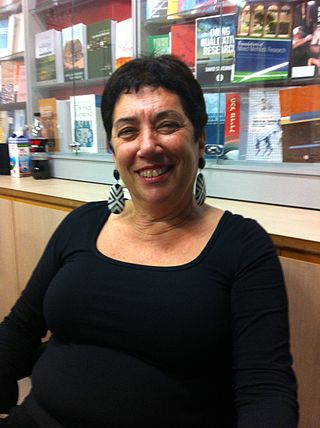
Shulamit Reinharz was the Jacob Potofsky Professor of Sociology at Brandeis University until 2017. During her tenure at Brandeis, she was director of the women's studies program from 1991 to 2001 and launched The Scholars Program, the first graduate program to focus on Jewish women. She was the founding director of the Hadassah-Brandeis Institute in 1997 and founder and director of the Women's Studies Research Center in 2001.
Bread and Roses was a socialist women's liberation collective active in Boston in the 1960s and 1970s. The group is named after the slogan of the 1912 Lawrence textile strike, with Bread signifying decent wages and Roses meaning shorter hours and more leisure time. The overarching theme of the original Bread and Roses movement pertained to gaining economic stability and dignity for women across the workforce.
References
- ↑ Poinsett, Alexander (September 1964). "Crusade in Mississippi". Ebony. 19 (11 (page 25-36)).
- ↑ Popkin, Ann (1979). "The Personal is Political: The Women's Liberation Movement" in They Should Have Served That Cup of Coffee, edited by Dick Cluster. Boston, MA: South End Press. pp. 181–222.
- ↑ Popkin, Ann (1978). "Bread and Roses: An Early Movement in the Development of Socialist-Feminism," PhD Dissertation, Sociology, Brandeis University.
- ↑ "Popkin, Ann Hunter. Papers, 1968-1977: A Finding Aid". Harvard University Library. Archived from the original on 2014-03-03. Retrieved 2014-03-03.
- ↑ Olson, Lynne (2001). Freedom's Daughters: The Unsung Heroines of the Civil Rights Movement from 1830-1970. New York: Scribner's. p. 354.
- ↑ Cluster, Dick (1979). They Should Have Served That Cup of Coffee. Boston: South End. pp. 181–222.
- ↑ Morrison, Joan and Robert K (1987). From Camelot to Kent State: The Sixties Experience in the Words of Those Who Lived It. New York. pp. 181–185.
{{cite book}}: CS1 maint: location missing publisher (link) - ↑ Evans, Sarah (March 2, 2004). Tidal Wave: How Women Changed America at Century's End. Free Press.
