Related Research Articles
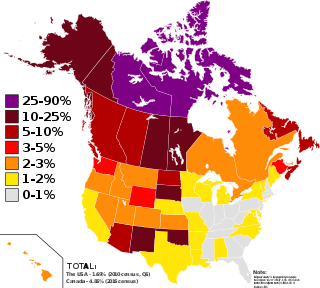
Indigenous peoples in Canada are the Indigenous peoples within the boundaries of Canada. They comprise the First Nations, Inuit, and Métis, representing roughly 5.0% of the total Canadian population. There are over 600 recognized First Nations governments or bands with distinctive cultures, languages, art, and music.

First Nations is a term used to identify Indigenous peoples in Canada who are neither Inuit nor Métis. Traditionally, First Nations in Canada were peoples who lived south of the tree line, and mainly south of the Arctic Circle. There are 634 recognized First Nations governments or bands across Canada. Roughly half are located in the provinces of Ontario and British Columbia.

Edgar Dewdney, was a Canadian surveyor, road builder, Indian commissioner and politician born in Devonshire, England. He emigrated to British Columbia in 1859 in order to act as surveyor for the Dewdney Trail that runs through the province. In 1870, Dewdney decided to take up a role in Canadian government. In this year, he was elected to the Legislative Council of British Columbia as a representative from the Kootenay region. In 1872, he was elected as a Member of the Parliament of Canada for the Yale region representing the Conservative party. He was reelected to this position in 1874 and again in 1878. Dewdney served as Lieutenant Governor of the North-West Territories from 1879 to 1888, and the fifth Lieutenant-Governor of British Columbia from 1892 to 1897. Additionally, he served as the Indian commissioner in the North-West Territories from 1879 until 1888. In 1897, Dewdney retired from politics and began working as a financial agent until his death in 1916.
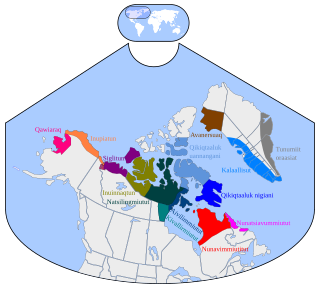
Inuktitut, also known as Eastern Canadian Inuktitut, is one of the principal Inuit languages of Canada. It is spoken in all areas north of the North American tree line, including parts of the provinces of Newfoundland and Labrador, Quebec, to some extent in northeastern Manitoba as well as the Northwest Territories and Nunavut. It is one of the aboriginal languages written with Canadian Aboriginal syllabics.
Crown–Indigenous Relations and Northern Affairs Canada is the department of the Government of Canada responsible for Canada's northern lands and territories, and one of two departments with responsibility for policies relating to Indigenous peoples in Canada.
Inuit Tapiriit Kanatami, previously known as the Inuit Tapirisat of Canada, is a nonprofit organization in Canada that represents over 65,000 Inuit across Inuit Nunangat and the rest of Canada. Their mission is to "serve as a national voice protecting and advancing the rights and interests of Inuit in Canada."

Canadian Aboriginal law is the body of law of Canada that concerns a variety of issues related to Indigenous peoples in Canada. Canadian Aboriginal Law is different from Canadian Indigenous law: In Canada, Indigenous Law refers to the legal traditions, customs, and practices of Indigenous peoples and groups. Aboriginal peoples as a collective noun is a specific term of art used in legal documents, including the Constitution Act, 1982, and includes First Nations, Inuit and Métis people. Canadian Aboriginal law provides certain constitutionally recognized rights to land and traditional practices. Canadian Aboriginal Law enforces and interprets certain treaties between the Crown and Indigenous people, and manages much of their interaction. A major area of Aboriginal law involves the duty to consult and accommodate.
The association between the monarchy of Canada and Indigenous peoples in Canada stretches back to the first interactions between North American Indigenous peoples and European colonialists and, over centuries of interface, treaties were established concerning the monarch and Indigenous nations. First Nations, Inuit, and Métis peoples in Canada have a unique relationship with the reigning monarch and, like the Māori and the Treaty of Waitangi in New Zealand, generally view the affiliation as being not between them and the ever-changing Cabinet, but instead with the continuous Crown of Canada, as embodied in the reigning sovereign.
Leonie Sandercock is an urban planner and academic focusing on community planning and multiculturalism. Her work spans the interdisciplinary fields of urban studies, urban policy and planning and elucidates issues of difference, social justice and possibility. She has been teaching at the School of Community & Regional Planning at University of British Columbia, Vancouver, Canada, since 2001.

Inuit are a group of culturally and historically similar Indigenous peoples traditionally inhabiting the Arctic and subarctic regions of North America, including Greenland, Labrador, Quebec, Nunavut, the Northwest Territories, Yukon (traditionally), Alaska, and Chukotsky District of Chukotka Autonomous Okrug, Russia. Inuit languages are part of the Eskimo–Aleut languages, also known as Inuit-Yupik-Unangan, and also as Eskaleut. Inuit Sign Language is a critically endangered language isolate used in Nunavut.

Over the course of centuries, many Indigenous Canadians have played a critical role in shaping the history of Canada. From art and music, to law and government, to sports and war; Indigenous customs and culture have had a strong influences on defining Canadian culture. The Indspire Awards are the annual awards presented by Indspire, formerly the National Aboriginal Achievement Foundation. The awards were first established in 1993 in conjunction with the United Nations declaring the 1990s "International Decade of the World's Indigenous peoples". June 21 is Canada's National Aboriginal Day, in recognition of the cultural contributions made by Canada's indigenous population. The day was first celebrated in 1996 following Governor General of Canada Roméo LeBlanc's proclamation.

Inuit Nunangat, formerly Inuit Nunaat, refers to the land, water, and ice of the homeland of Inuit in Canada. This Arctic homeland consists of four northern Canadian regions called the Inuvialuit Settlement Region, the territory Nunavut (ᓄᓇᕗᑦ), Nunavik (ᓄᓇᕕᒃ) in northern Quebec, and Nunatsiavut of Newfoundland and Labrador.
This is a bibliography of works on Canada.
The Arctic policy of Canada includes both the foreign policy of Canada in regard to the Arctic region and Canada's domestic policy towards its Arctic territories. This includes the devolution of powers to the territories. Canada's Arctic policy includes the plans and provisions of these regional governments. It encompasses the exercise of sovereignty, social and economic development, the protection of the environment, and the improving and devolving of governance.

This is a bibliography of works on the Provinces and territories of Canada.
Gail Guthrie Valaskakis (1939-2007) was a media studies scholar who taught in the Department of Communication Studies at Concordia University, where she also served as Dean in the Faculty of Arts and Sciences (1992-1997). After leaving Concordia, Valaskakis served as Director of Research at the Aboriginal Healing Foundation in Ottawa.
Verna Jane Kirkness, is a Cree scholar, pioneer and lifelong proponent of indigenous language, culture and education who has been influential in Canadian indigenous education policy and practice. She is an associate professor emeritus at the University of British Columbia and resides in Winnipeg. Kirkness has received numerous awards for her outstanding contributions spanning five decades including the Order of Canada in 1998. Kirkness had an important impact on Canadian indigenous education policy and practice. She is the author of "numerous books and articles on the history of Indigenous education." The University of Manitoba's Verna J. Kirkness Science and Engineering Education Program was established in 2009 and in November 2013 a native studies colloquium honoured her as a national leader in education.
Bruce Rigsby was an American-Australian anthropologist specializing in the languages and ethnography of native peoples on both continents. He was professor emeritus at Queensland University, and a member of both the Australian Anthropological Society and the American Anthropological Association.
Nicola McEwen, FRSE is Professor of Public Policy and Governance at the University of Glasgow, Director of the Centre for Public Policy, and senior fellow at the UK in a Changing Europe. She became a Fellow of the Royal Society of Edinburgh in 2021. She leads research on devolution and inter-institutional relations. She provides advice to governments and public bodies and gives media expert perspectives internationally. McEwen's research and insights are sought for public engagement and political or business briefings during major events like the 2014 Scottish Independence Referendum, and the Smith Commission, UK BREXIT and recent elections such as to the Scottish Parliament. She has a reputation for being authoritative and trustworthy in engaging with senior politicians, civil service and civic society and has regular media engagements on various topics. McEwen is consulted on aspects such as potential impact on welfare of Scottish independence, or informing parliament on the impact of Brexit on intra-UK relations and communicating her findings and explanations to public media.
References
- 1 2 University of Edinburgh Archived 23 July 2011 at the Wayback Machine , University of Edinburgh, centre for canadian studies, retrieved 31 August 2010
| International | |
|---|---|
| National | |
| Other | |
