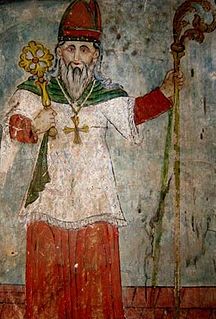
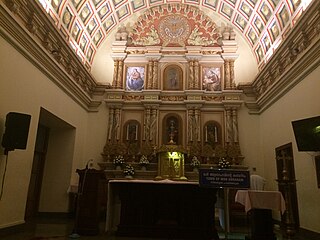
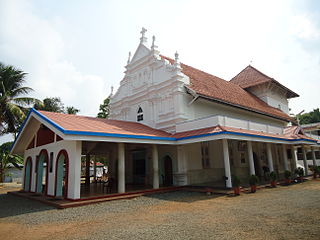
One of the most famous archdeacons in the history of St Thomas Christians is the Archdeacon Geevarghese of Christ (died 1585 AD). He was a biblical expert and a master of Syriac language and literature. He was considered a holy person but extremely efficient in administration. He was contemporary to Bishop Mar Abraham of Persia who lived in Angamaly. He is credited with the new construction of Marth Maryam church Angamaly [1]
An archdeacon is a senior clergy position in the Syriac Orthodox Church, Church of the East, Chaldean Catholic Church, Anglican Communion, St Thomas Christians, Eastern Orthodox churches and some other Christian denominations, above that of most clergy and below a bishop. In the High Middle Ages it was the most senior diocesan position below a bishop in the Catholic Church. An archdeacon is often responsible for administration within an archdeaconry, which is the principal subdivision of the diocese. The Oxford Dictionary of the Christian Church has defined an archdeacon as "A cleric having a defined administrative authority delegated to him by the bishop in the whole or part of the diocese." The office has often been described metaphorically as that of oculus episcopi, the "bishop's eye".
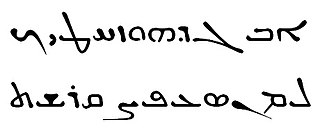
Syriac, also known as Syriac/Syrian Aramaic or Classical Syriac, is a dialect of Middle Aramaic. Having first appeared in the early first century CE in Edessa, classical Syriac became a major literary language throughout the Middle East from the 4th to the 8th centuries, preserved in a large body of Syriac literature. Indeed, Syriac literature comprises roughly 90% of the extant Aramaic literature. Syriac was once spoken across much of the Near East as well as Anatolia and Eastern Arabia.
Abraham of Angamaly was the last in the long line of Nestorian bishops sent from the Church of the East to Saint Thomas Christians of Kerala. He was sent by the Nestorian Patriarch Shemon VII Ishoyahb. In spite of the express approbation of the Pope, he was not welcomed by the Portuguese ecclesiastical authorities.
The archdeacon during the first part of the reign of Mar Abraham was George of Christ, who was on friendly terms with the Latin missionaries and was to be appointed the successor of Mar Abraham as metropolitan of India. Thus he should have become, according to the plans of Mar Abraham, supported by the Jesuits, the first indigenous Chaldaean Metropolitan of the St Thomas Christians. However, the last letter of Mar Abraham, where his requisition letter to the Pope to confirm George’s ordination as bishop of Palur and as his successor is dated January 13, 1584; While from another letter of the same Mar Abraham, we are informed that the consecration of George failed because of the latter’s death. [2] Great mural paintings in the Angamaly Church are viz. "Hell" , "Last Judgement" , also of mural paintings of the Bishops and the Archdeacon .
In Christian churches with episcopal polity, the rank of metropolitan bishop, or simply metropolitan, pertains to the diocesan bishop or archbishop of a metropolis.
India, also known as the Republic of India, is a country in South Asia. It is the seventh largest country by area and with more than 1.3 billion people, it is the second most populous country as well as the most populous democracy in the world. Bounded by the Indian Ocean on the south, the Arabian Sea on the southwest, and the Bay of Bengal on the southeast, it shares land borders with Pakistan to the west; China, Nepal, and Bhutan to the northeast; and Bangladesh and Myanmar to the east. In the Indian Ocean, India is in the vicinity of Sri Lanka and the Maldives, while its Andaman and Nicobar Islands share a maritime border with Thailand and Indonesia.
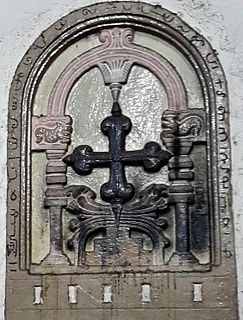
The Chaldean Syrian Church of India is an Eastern Christian Church based in Thrissur, India. It is an archbishopric of the Holy Apostolic Catholic Assyrian Church of the East and is in full communion with Patriarch Gewargis III, the Catholicos-Patriarch of the Assyrian Church of the East.
The Indian Church History Classics, Vol.I, The Nazranies (1998) and the Thomas Encyclopaedia Vol. II(1973).
Geevarghese of Christ died in Angamaly. He was buried in the St Mary's Church Angamaly. His brother Yohannan was Archdeacon (1585–93) & Another brother Jacob Became Archdeacon in 1596. [1]
Angamaly (Aṅkamāli) is a municipality and the northernmost suburb of the city of Kochi in Kerala, India. Situated about 30 km (19 mi) north of the city centre, the area is the northern gateway to the commercial capital of Kerala and is an integral part of the Kochi metropolitan area. The town lies at the intersection of Main Central Road and National Highway 544. MC Road, which starts from Thiruvananthapuram ends at Angamaly at its intersection with NH 544.
Christianity is India's third-most followed religion after Hinduism and Islam, with approximately 28 million followers, constituting 2.3 percent of India's population. The Christian faith was introduced to India by Thomas the Apostle, who supposedly reached the Malabar Coast (Kerala) in 52 AD. According to another tradition Bartholomew the Apostle is credited with simultaneously introducing Christianity along the Konkan Coast. There is a general scholarly consensus that Christian communities were firmly established in India by the 6th century AD, including some communities who used Syriac liturgies. It is possible for Christianity to have existed in the Indian Subcontinent as far back as the first century AD, in keeping with the belief of St Thomas's arrival.
The Church of the East, also known as the Nestorian Church and the Persian Church, was an Eastern Christian denomination that in 410 organised itself within the Sasanian Empire and in 424 declared its leader independent of other Christian leaders. From the Persian Empire it spread to other parts of Asia in late antiquity and the Middle Ages.
The Malankara Orthodox Syrian Church, also known as the Indian Orthodox Church, is an autocephalous church centered in the Indian state of Kerala. It is one of the churches of India's Saint Thomas Christian community, which has its origin in the evangelical activity of Thomas the Apostle in the 1st century. The church is headed by the autocephalous Catholicos of the East and the Malankara Metropolitan, presently Baselios Mar Thoma Paulose II.

The Syro-Malankara Catholic Church also known as the Malankara Syrian Catholic Church is an Eastern Catholic sui iuris particular church in full communion with the Pope and the worldwide Catholic Church, with self-governance under the Code of Canons of the Eastern Churches. The Church is headed by Major Archbishop Cardinal Moran Mor Baselios Cleemis Catholicos of the Major Archdiocese of Trivandrum based in Kerala, India. The Church follows the West Syriac Rite liturgy of Saint James, which is also used in the Maronite Church, the Syriac Catholic Church, the Syriac Orthodox Church, and the Malankara Orthodox Syrian Church. The Church traces its origins to the evangelistic activity of Thomas the Apostle in the 1st century. It is one of the two Eastern Catholic Churches from India, the other one being the Syro-Malabar Catholic Church which uses the East Syriac Rite liturgy.
The Syro-Malabar Catholic Church or Church of Malabar Syrian Catholics is an Eastern Catholic Major Archiepiscopal Church based in Kerala, India. It is a sui iuris particular church in full communion with the Pope and the worldwide Catholic Church, with self-governance under the Code of Canons of the Eastern Churches.
The Mar Thoma Church, often shortened from Malankara Mar Thoma Syrian Church, is a Western Syriac Christian. The Mar Thoma Church believes that they are the successors of the Saint Thomas Christian community of Malabar (Malankara), which originated from the missionary activity of Thomas the Apostle in Malankara. The Church in Malankara flourished under various ecclesiastical faith streams from time to time.
Malankara Metropolitan was a legal title given to the head of the Malankara Syrian Church, by the Government of Travancore and Cochin in South India. This title was awarded by a proclamation from the King of Travancore & the King of Cochin.
The Synod of Diamper, held at Udayamperoor, was a diocesan synod or council that laid down rules and regulations for the ancient Saint Thomas Christians of the Malabar Coast, formally uniting them with the Catholic Church. This led to the creation of the Eastern Catholic Syro-Malabar Church, which follows a Latinized East Syriac Rite liturgy.
The Coonan Cross Oath, taken on 3 January 1653, was a public avowal by members of the Saint Thomas Christian community of Kerala, India that they would not submit to Roman Catholic dominance in ecclesiastical and secular life. The swearing of the oath at Mattancherry was a major event in the history of the Saint Thomas Christian community and marked a major turning point in its relations with the Roman Catholics. The oath resulted in the breaking up of 54 years of Roman Catholic Padroado (Patronage) Jurisdiction over the St Thomas Christians, started with the synod of Diamper in the year 1599 A.D. convoked by the Roman Catholic Archbishop Dom Alexio De Menezes.
The Malabar Independent Syrian Church, also known as the Thozhiyur Church, is a Independent Oriental Orthodox Christian church centred in Kerala, India. It is one of the churches of the Saint Thomas Christian community, which traces its origins to the evangelical activity of Thomas the Apostle in the 1st century.
Mar Thoma I, also known as "Valiya Mar Thoma", is the first native democratically elected/selected Metropolitan bishop of the St Thomas Christians or Malankara Church. He was the last Archdeacon of the undivided St.Thomas Christians of Malabar. After the death of Archdeacon George of the Cross(കുരിശിങ്ങൽ ജോർജ്)( Kurisingal being his house name), on 25 July 1640, Parambil Thoma kathanar was elected and enthroned as new Archdeacon, when he was less than 30 years old. He led the Church to the Coonan Cross Oath on 3 January 1653 and to the subsequent schism in Saint Thomas Christians Church. After the Coonen Cross Oath, he was elected as a Bishop by Malankara (Yogam) Association and consecrated as a Bishop at St. Mary's Church Alangad, by laying hands of 12 priests on 22 May 1653. Only two Southist churches of Kaduthuruthy and Udayamperoor and a very few people elsewhere refused to recognise him as Bishop. Any how, the archdeacon began to exercise powers of episcopal order, though he openly tried to regularize his episcopal consecration as a Bishop from the Church of Antioch. His episcopal consecration as a Bishop was regularized in the year 1665 by Mar Gregorios Abdal Jaleel the Patriarchal delegate of the Syriac Orthodox Patriarch of Antioch.(The exact date and place of this event is anonymous).
The Jacobite Syrian Christian Church also known as the Malankara Jacobite Syrian Christian Church or the Jacobite Syrian Christain Church of India, is an autonomous Oriental Orthodox Church based in the Indian state of Kerala, and is an integral branch of the Syriac Orthodox Church of Antioch. It recognizes the Syriac Orthodox Patriarch Of Antioch and all the East, currently Moran Mor Ignatius Aphrem II seated in the Cathedral of Saint George, Bab Tuma, Damascus, Syria, as its Supreme Head. It functions as a largely autonomous unit within the church, under the authority of the Catholicos of India, currently Aboon Mor Baselios Thomas I. Currently, this is the only church in Malankara which has a direct relationship with the Syriac Christians of Antioch, which has continued from after the schism and they continue to use West Syriac Rite.
This is a timeline of the history of the Syro-Malabar Catholic Church in India.
Christianity is the third-most practised religion in Kerala, accounting for 18% of the population according to the Indian census. Although a minority, the Christian population of Kerala is proportionally much larger than that of India as a whole. A significant portion of the Indian Christian population resides in the state.
Palliveettil Chandy is the first known person to be appointed in India as a Metropolitan from among the native Saint Thomas Christians of Kerala by the Roman Catholic Church. He was appointed as a rebel bishop against the Mar Thoma I, who was the then head of Malankara Nasranis..
The Saint Thomas Christian denominations are traditional Christian denominations from Kerala, India, who trace their origins to the evangelistic activity of Thomas the Apostle in the 1st century. They are also known as "Nasranis" as well. The Syriac term "Nasrani" is still used by St. Thomas Christians in Kerala.
Archdeacon George (Geevarghese) of the Cross was the son of the elder brother of Archdeacon Geevarghese of Christ. By the last year of Bishop Mar Abraham, he became the Archdeacon. After the Bishop's death in 1597, he led the Indian Church. He led the church amidst Portuguese intervention. The Synod of Diamper (1599) was held during his time. In 1601, Francis Ros became Bishop appointed by the Archbishop of Goa, Aleixo de Menezes. In the beginning there was cordiality, but the deliberate downgradation of Angamaly and the inertia of Bishop Ros frustrated him. When the Archdeacon protested, Ros ex-communicated him. In 1615 Bishop and Archdeacon reconciled each other, but again fell out later. The next Bishop, Etienne de Brito, also did not recognize the Archdeacon's ecclesiastical status. He led the church in a period of severe stress and turmoil, and held it together. After his time and his brother's time the root family of Pakalomattam became heirless. The only son shifted residence to Alappatt house. He is believed to have been buried in the forefront of Pakalomattam Thravadu (Kuravilangadu).
Mar Hormizd Syro-Malabar Catholic Church, Angamaly is a church located in Angamaly, Kerala, India. It was established in 1570 by Mar Abraham, the last Chaldean Metropolitan to reach Malabar Coast. It is dedicated to Mar Hormizd, a seventh-century Chaldean saint.
Dom Francis Ros, S.J (1559–1624) was the first Latin Archbishop of East Syriac Archdiocese of Angamaly-Cranganore, the See of Saint Thomas Christians. He was the successor of Mar Abraham of Angamaly, the Metropolitan of All-India.
Second Synod of Angamaly was convoked by Dom Francis Ros, S.J., the first Latin bishop of Angamaly, the See of Saint Thomas Christians on 7 December 1603. Francis Ros was the successor of Mar Abraham of Angamaly, the Metropolitan of All-India. The Second Synod of Angamaly had primarily three tasks to undertake. The context of the diocese of Angamaly, immediately after the Synod of Diamper, necessitated another Synod in the fourth year of the governance of Ros.
St Mary's Jacobite Syrian Church, Angamaly is believed to be built in AD 409 and is the first church built in Angamaly. It is an ancient church and one of the most prominent churches in Kerala. It was the seat of the Archdeacon, the local head of the Malankara Church and hence held an important position in Malankara for many centuries.