Related Research Articles
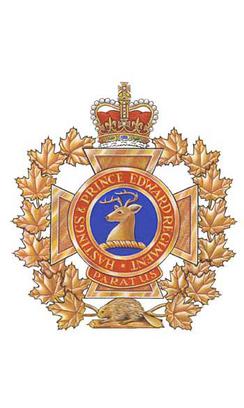
The Hastings and Prince Edward Regiment is a Primary Reserve infantry regiment of the Canadian Army. The regiment is part of 33 Canadian Brigade Group, one of four brigade groups of 4th Canadian Division. The regimental headquarters and one company are at 187 Pinnacle Street in Belleville and on Willmott Street in Cobourg, with another rifle company in Peterborough. The Peterborough Armoury houses what was traditionally B Company or Moro Company. Moro Company also serves as the headquarters for the regiment’s Assault Pioneer Platoon. Normally, the regiment deploys as a composite, Ortona Company, while the headquarters and administration form Somme Company.
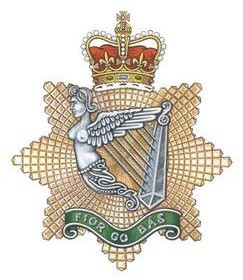
The Irish Regiment of Canada is a Primary Reserve infantry regiment of the Canadian Army based in Sudbury, Ontario. It is part of the 4th Canadian Division's 33 Canadian Brigade Group. Currently one battalion of the regiment exists.
49th Field Artillery Regiment, RCA, is a Canadian Forces Primary Reserve regiment based in Sault Ste. Marie, Ontario. The regiment is part of 4th Canadian Division's 33 Canadian Brigade Group.
The Edmonton Fusiliers was an infantry regiment of the Non-Permanent Active Militia of the Canadian Militia and later the Canadian Army. First raised in 1908 as part of the 101st Regiment Edmonton Fusiliers, it became a separate regiment in 1924 when The Edmonton Regiment was split into two separate regiments. In 1946, the regiment was Amalgamated with the 19th Alberta Dragoons.
The 56th Field Artillery Regiment, Royal Canadian Artillery is a Canadian Army Reserve artillery regiment based in Brantford, Ontario. The regiment is currently part of 4th Canadian Division's 32 Canadian Brigade Group.
The Oxford Rifles were an infantry regiment of the Non-Permanent Active Militia of the Canadian Militia. In 1954, the regiment was amalgamated with The Canadian Fusiliers to form The London and Oxford Fusiliers.
The Lorne Rifles (Scottish) was an infantry regiment of the Non-Permanent Active Militia of the Canadian Militia (now the Canadian Army). First raised in the 1860s, the regiment was known for most of its existence as The Halton Rifles until 1931 when the regiment was renamed as The Lorne Rifles (Scottish). In 1936, the regiment was amalgamated with The Peel and Dufferin Regiment to form The Lorne Scots (Peel, Dufferin and Halton Regiment).
The Manitoba Mounted Rifles was a cavalry regiment of the Non-Permanent Active Militia of the Canadian Militia and later the Canadian Army. In 1946, the regiment was converted to artillery.
The Victoria and Haliburton Regiment was an infantry regiment of the Non-Permanent Active Militia of the Canadian Militia. In 1936, the regiment was converted from infantry to artillery to become the 45th Field Battery RCA and now forms part of the 50th Field Artillery Regiment, RCA.
The Peterborough Rangers was an infantry regiment of the Non-Permanent Active Militia of the Canadian Militia. In 1936, the regiment was amalgamated with the 3rd Prince of Wales' Canadian Dragoons to form The Prince of Wales Rangers.
The Haldimand Rifles was an infantry regiment of the Non-Permanent Active Militia of the Canadian Militia. In 1936, the regiment was Amalgamated with The Dufferin Rifles of Canada to form The Dufferin and Haldimand Rifles of Canada.
The Dufferin and Haldimand Rifles of Canada was an infantry regiment of the Non-Permanent Active Militia of the Canadian Militia and later the Canadian Army. The regiment was formed in 1936, when The Haldimand Rifles was Amalgamated with The Dufferin Rifles of Canada. In 1946, the regiment was converted from Infantry to Artillery and now forms part of the 56th Field Artillery Regiment, RCA.
The Norfolk Regiment of Canada was an infantry regiment of the Non-Permanent Active Militia of the Canadian Militia. First raised in the 1860’s as The Norfolk Rifles, the regiment was converted to a Line Regiment in 1928. In 1936, the regiment was converted from infantry to artillery and now forms part of the 56th Field Artillery Regiment, RCA.
The Northumberland Regiment was an infantry regiment of the Non-Permanent Active Militia of the Canadian Militia. In 1936, the regiment was amalgamated with The Durham Regiment to form The Midland Regiment.
The Sherbrooke Regiment was a regiment of the Canadian Militia and later the Canadian Army Reserve that existed from 1866 to 1965. Originally an infantry regiment, during the Second World War the regiment helped form the 27th Armoured Regiment (The Sherbrooke Fusilier Regiment) which served as an armoured (tank) unit in the 2nd Canadian Armoured Brigade. In 1946, the regiment itself was converted to an armoured regiment was redesignated as The Sherbrooke Regiment (RCAC). In 1965, the regiment was amalgamated with the 7th/11th Hussars to form The Sherbrooke Hussars.
The Wentworth Regiment was an infantry regiment of the Non-Permanent Active Militia of the Canadian Militia. In 1936, the regiment was Amalgamated with The Royal Hamilton Light Infantry to form The Royal Hamilton Light Infantry.
The Middlesex and Huron Regiment was an infantry regiment of the Non-Permanent Active Militia of the Canadian Militia. It was formed in 1936, as a result of the Amalgamation of The Middlesex Light Infantry and The Huron Regiment. In 1946, the regiment was disbanded.
The Midland Regiment was an infantry regiment of the Non-Permanent Active Militia of the Canadian Militia and later the Canadian Army. The regiment was formed in 1936 by the Amalgamation of The Northumberland Regiment and The Durham Regiment. In 1954, The Midland Regiment was amalgamated into The Hastings and Prince Edward Regiment.
The Grey Regiment was an infantry regiment of the Non-Permanent Active Militia of the Canadian Militia. In 1936, the regiment was amalgamated with the Simcoe Foresters to form the Grey and Simcoe Foresters.
The Lincoln Regiment was an infantry regiment of the Non-Permanent Active Militia of the Canadian Militia. In 1936, the regiment was Amalgamated with The Lincoln and Welland Regiment to form a new regiment also named The Lincoln and Welland Regiment.
References
- 1 2 3 4 5 6 "Guide to Sources Relating to the Canadian Militia (Infantry, Cavalry, Armored)" (PDF). Library and Archives Canada .: 678
- 1 2 3 4 5 6 7 National Defence (25 October 2018). "The Hastings and Prince Edward Regiment". www.canada.ca. Retrieved 18 December 2021.
- 1 2 3 4 5 6 7 "The Argyll Light Infantry". www.canadiansoldiers.com. Retrieved 18 December 2021.
- 1 2 3 4 5 6 "The Argyll Light Infantry [Canada]". 30 November 2007. Archived from the original on 30 November 2007. Retrieved 10 January 2022.
- 1 2 3 "Guide to Sources Relating to the Canadian Militia (Artillery)" (PDF). Library and Archives Canada .
- 1 2 3 Barnes, Major R.M. (1972). The Uniforms and History of the Scottish Regiments. London: Sphere Books Limited.
- 1 2 "15th Regiment "Argyll Light Infantry"". www.canadiansoldiers.com. Retrieved 18 December 2021.
- ↑ Luscombe, Stephen. "The British Empire, Imperialism, Colonialism, Colonies". www.britishempire.co.uk. Retrieved 26 December 2021.
- ↑ "1st Canadian Division". www.canadiansoldiers.com. Retrieved 23 August 2022.
- ↑ "2nd Canadian Division". www.canadiansoldiers.com. Retrieved 23 August 2022.
- ↑ "Otter Committee". www.canadiansoldiers.com. Retrieved 18 December 2021.
- ↑ "1936 Reorganization of the Militia". www.canadiansoldiers.com. Retrieved 18 December 2021.
- ↑ "Infantry Battalion". www.canadiansoldiers.com. Retrieved 18 December 2021.
- ↑ "A Dicey Situation – Headdress for the Argyll Light Infantry". MilArt. 27 August 2013. Retrieved 18 December 2021.
- ↑ "Kennedy Board". www.canadiansoldiers.com. Retrieved 18 December 2021.
- ↑ National Defence (22 July 2019). "WWI - Arras, 1917". www.canada.ca. Retrieved 27 December 2021.
- ↑ National Defence (22 July 2019). "WWI - Arras, 1918". www.canada.ca. Retrieved 27 December 2021.
- ↑ National Defence (22 July 2019). "WWI - Hill 70". www.canada.ca. Retrieved 27 December 2021.
- ↑ National Defence (23 July 2019). "WWI - Ypres, 1917". www.canada.ca. Retrieved 27 December 2021.
- ↑ National Defence (22 July 2019). "WWI - Amiens". www.canada.ca. Retrieved 27 December 2021.
- ↑ "Biography – Bowell, Sir MacKenzie – Volume XIV (1911–1920) – Dictionary of Canadian Biography". www.biographi.ca. Retrieved 11 February 2022.
- Barnes, RM, The Uniforms and History of the Scottish Regiments, London, Sphere Books Limited, 1972.