
Glasgow Central is one of two principal mainline rail terminals in Glasgow, Scotland. The railway station was opened by the Caledonian Railway on 1 August 1879 and is one of 20 managed by Network Rail. It is the northern terminus of the West Coast Main Line. As well as being Glasgow's principal inter-city terminus for services to England, Central also serves the southern suburbs of the Greater Glasgow conurbation, as well as the Ayrshire and Clyde coasts. The other main station in Glasgow is Glasgow Queen Street.

The Glasgow and South Western Railway (G&SWR) was a railway company in Scotland. It served a triangular area of south-west Scotland between Glasgow, Stranraer and Carlisle. It was formed on 28 October 1850 by the merger of two earlier railways, the Glasgow, Paisley, Kilmarnock and Ayr Railway and the Glasgow, Dumfries and Carlisle Railway. Already established in Ayrshire, it consolidated its position there and extended southwards, eventually reaching Stranraer. Its main business was mineral traffic, especially coal, and passengers, but its more southerly territory was very thinly populated and local traffic, passenger and goods, was limited, while operationally parts of its network were difficult.

The London, Tilbury and Southend line, also known as Essex Thameside, is a commuter railway line on the British railway system. It connects Fenchurch Street station, in central London, with destinations in east London and Essex, including Barking, Upminster, Basildon, Grays, Tilbury, Southend and Shoeburyness.

The Inverclyde Line is a railway line running from Glasgow Central station through Paisley and a series of stations to the south of the River Clyde and the Firth of Clyde, terminating at Gourock and Wemyss Bay, where it connects to Caledonian MacBrayne ferry services. The line has been in operation since the 1840s between Glasgow and Greenock and was the first passenger service to follow the River Clyde to the coast. The line was electrified in 1967.
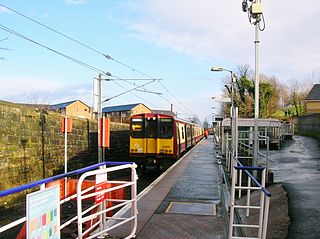
The Paisley Canal line is a branch railway line in Scotland running between Glasgow and Paisley. The line currently terminates at Paisley Canal railway station, although it previously continued through Paisley West station, near Ferguslie, to Elderslie junction where it met and crossed under the main Glasgow and South Western Railway line running from Paisley Gilmour Street station to Johnstone, and beyond. After Elderslie, the line terminated at North Johnstone, however another junction allowed services from the Paisley Canal line to continue onto the Bridge of Weir Railway and Greenock and Ayrshire Railway to the latter's terminus at Greenock Princes Pier.
The Scottish Region (ScR) was one of the six regions created on British Railways (BR) and consisted of ex-London, Midland and Scottish Railway (LMS) and ex-London and North Eastern Railway (LNER) lines in Scotland. It existed from the creation of BR in 1948, and was renamed to ScotRail in the mid-1980s.
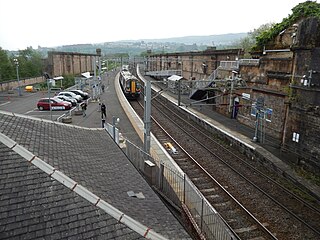
Greenock Central station is one of eight railway stations serving the town of Greenock in western Scotland, and is the nearest to the town centre. This station, which is staffed, is on the Inverclyde Line, 37 km (23 mi) west of Glasgow Central towards Gourock. It has three platforms, two of which are in use, with one disused bay platform. This disused platform is still connected to the main line.

Port Glasgow railway station is on the Inverclyde Line, serving the town of Port Glasgow, Scotland. It is located in the town centre with the main entrance at the junction of Princes Street and John Wood Street.

Paisley Gilmour Street railway station is the largest of the four stations serving the town of Paisley, Renfrewshire, Scotland, and acts as the town's principal railway station. The station is managed by ScotRail and serves the Ayrshire Coast Line and Inverclyde Line, 7+1⁄4 miles (11.7 km) west of Glasgow Central. The station is protected as a category B listed building.

The Glasgow Airport Rail Link (GARL) is a proposed link between Glasgow City Centre and Glasgow Airport. The original plans for an airport rail link were proposed during the 2000s to directly link Glasgow Central station with Glasgow Airport in Scotland. The link was intended for completion by 2013 and would have had a service of four trains per hour via Paisley Gilmour Street railway station.

The Paisley Gilmour Street rail accident occurred on 16 April 1979 at 19:50. The 19:40 Inverclyde Line service from Glasgow Central to Wemyss Bay, operated by two Class 303 trains, crossed from the Down Fast Line to the Down Gourock Line under clear signals at Wallneuk Junction immediately to the east of Paisley Gilmour Street railway station. It collided head-on with the 18:58 Ayrshire Coast Line special service from Ayr to Glasgow Central, formed of two Class 126 diesel multiple units, which had left Platform 2 against a red signal P31.
The Glasgow and Paisley Joint Railway was the section of railway line between Glasgow Bridge Street railway station and Paisley, in the west of Scotland. It was constructed and operated jointly by two competing railway companies as the stem of their lines to Greenock and Ayr respectively, and it opened in 1840. The Joint Committee, which controlled the line, built a branch to Govan and later to Cessnock Dock, and then Prince's Dock.

Railway electrification in Great Britain began in the late 19th century. A range of voltages has been used, employing both overhead lines and conductor rails. The two most common systems are 25 kV AC using overhead lines, and the 750 V DC third rail system used in Southeast England and on Merseyrail. As of March 2020, 3,758 miles (6,048 km) (38%) of the British rail network was electrified.
The Paisley and Renfrew railway was an early Scottish railway company that constructed and operated a line between Paisley and the River Clyde at Renfrew Wharf, enabling journeys between Glasgow and Paisley by connecting river boat. The railway was built to the track gauge of 4 ft 6 in on stone block sleepers.

The Glasgow, Paisley, Kilmarnock and Ayr Railway (GPK&AR) was a railway in Scotland that provided train services between Glasgow, Kilmarnock and Ayr. It opened its first line, between Glasgow and Ayr, in stages from 1839 to 1840. The section between Glasgow and Paisley was made jointly with the Glasgow, Paisley and Greenock Railway. Later it built a line from Dalry via Kilmarnock to Cumnock, linking there with the Glasgow, Dumfries and Carlisle Railway, and together forming a through route from Glasgow to Carlisle. The two companies merged to form the Glasgow and South Western Railway.
The Glasgow, Paisley and Greenock Railway (GP&GR) was an early Scottish railway, opened in 1841, providing train services between Greenock and Glasgow. At the time the River Clyde was not accessible to sea-going ships, and the intention was to compete with river boats that brought goods to and from the city. In fact passenger traffic proved surprisingly buoyant, and connecting steamer services to island resorts in the Firth of Clyde provided a very great source of business.
The Greenock and Wemyss Bay Railway was a railway owned by the Caledonian Railway, providing services between Greenock and Wemyss Bay.
The Largs Branch is a railway line in Scotland, serving communities on the north Ayrshire Coast, as well as the deep water ocean terminal at Hunterston. It branches from the Glasgow to Ayr line at Kilwinning.
The Paisley and Barrhead District Railway was a railway in Scotland that ran between the towns of Paisley and Barrhead. It was intended to serve industrial premises and develop local passenger and goods business.
Paisley railway station was an early railway station in Paisley, Renfrewshire, Scotland. It was built in 1837 by the Paisley and Renfrew Railway; and, together with the station at Renfrew Wharf, was one of two terminal stations on the line. Both stations offered passengers and goods facilities.
