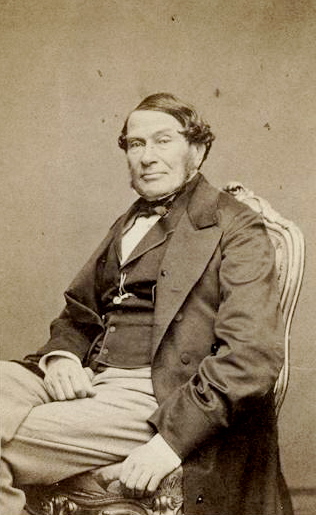
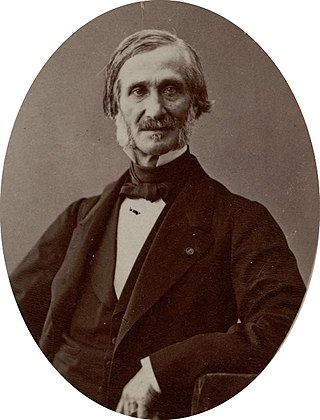
Pierre-Armand Donon was the son of merchant Pierre-Amédée Donon (1792-1880) and his wife Marie-Caroline-Armande, née Morand. He studied in Paris at the Collège Sainte-Barbe.[citation needed]
By 1845, Donon was a partner at Calon jeune & Cie, a private banking house. On 23 December 1851, immediately after the 1851 coup d'état, he co-founded the new bank Donon, Aubry, Gautier & Cie together with partners Maurice Aubry[fr] and Jules Gautier.[2]
On 5 April 1853, Donon married Henriette-Félicité Staub, the daughter of a prominent Parisian taylor.[2] They had a son, Jacques-Pierre (1854-1913), and two daughters, Thérèse-Jeanne-Marie (1857-1897) and Jeanne-Mathilde-Elisabeth (1860-1919).
Donon served as consul-general of the Ottoman Empire from 1853 to 1880, when his son succeeded him in that capacity. By 1868 he had been awarded the honor of Grand Officer of the Ottoman Order of the Medjidie, elevated to Grand Cross by 1881.[3]
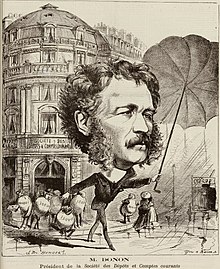
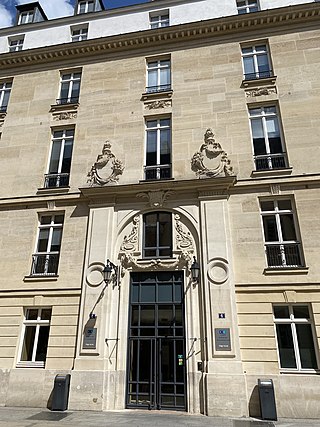
In 1859, Donon was instrumental in the creation of the Crédit Industriel et Commercial (CIC), which was supported by the politically influential Duke of Morny, as a competitor to the Pereire brothers's Crédit Mobilier on the model of successful British depository banks such as the London and Westminster Bank.[4]:8–14 In 1863, feeling a loss of direct control over the CIC, he created the Société des Dépôts et Comptes Courants (SDCC) and became the new institution's chairman.[5] As the SDCC and CIC were effectively competitors, Donon stopped attending board meetings of the CIC in August 1866 and formally left the board in 1871.[4]:35–38
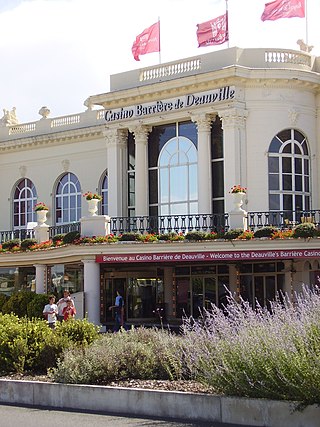
In 1859, together with Morny's physician Joseph Francis Olliffe and Morny himself, Donon bought 177 hectares of seafront land west of the Touques river in Normandy, which formed the basis for the later development of Deauville.[1][6]
From 1868, Donon was mayor of the village of Lonrai in the Orne department, where in 1863 he had acquired a large, newly built country house.[7] He ran unsuccessfully for deputy of Orne in the legislative elections of 1871 and 1876.
From the late 1870s, Donon engaged in increasingly reckless risk-taking at the Société des Dépôts et Comptes Courants and withheld the relevant information from his board. In 1887, the private bank Donon, Aubry, Gautier & Cie which Donon had created in 1851 went into liquidation. The SDCC's situation became untenable and developed into a panic in 1891, when the Bank of France provided emergency liquidity and eventually liquidated the bank on 7 April 1891. The SDCC was subsequently absorbed in 1892 by the Comptoir national d'escompte de Paris.[8]:7 In 1892, Donon relinquished his role of mayor of Lonrai and sold his mansion there.[7] On 22 July 1893, Donon was convicted and sentenced to six months imprisonment, which he served at the La Santé Prison, and a fine of three thousand francs. On 12 March 1894, he was stripped of the Legion of Honour that had been awarded to him on 7 February 1855.
1 2 Christiane Demeulenaere-Douyère (1986), "De fil en aiguille ou l'irrésistible ascension du tailleur Staub", Bulletin de la Société de l'histoire de Paris et de l'Île-de-France: 158–162
Charles Auguste Louis Joseph de Morny, 1st Duc de Morny was a French statesman.
Deauville is a commune in the Calvados department, Normandy, northwestern France. Major attractions include its harbour, race course, marinas, conference centre, villas, Grand Casino, and hotels. The first Deauville Asian Film Festival took place in 1999. As the closest seaside resort to Paris, Deauville is one of the most notable seaside resorts in France. The city and its region of the Côte Fleurie have long been home to the French upper class's seaside houses and is often referred to as the Parisian riviera.
Achille Marcus Fould was a French financier and politician who was four times minister of finance between 1849 and 1867. A major figure of the Second French Empire, his politics have been described as "conservative by instinct, liberal by reflection."
Émile Pereire and his brother Isaac Pereire were major figures in the development of France's finance and infrastructure during the Second French Empire. The Pereire brothers challenged the dominance of the Rothschilds in continental European finance, known at the time as haute finance. Their attempt was temporarily successful, and even though it collapsed in the late 1860s, it contributed to a more developed and vibrant economic landscape. Like the Rothschilds, the Pereires were Jews, but unlike them, they were Sephardi of Portuguese origin.
Banque Commerciale du Maroc was a bank founded in 1911, shortly ahead of the establishment of the French protectorate in Morocco. The bank was initially controlled by France's Banque Transatlantique, then from 1941 by the Crédit Industriel et Commercial, and from 1988 by Morocco's ONA Group. In 2004, it merged with Wafa bank to form Attijariwafa Bank.
The Crédit Industriel et Commercial is a bank and financial services group in France, founded in 1859. It has been majority owned by Crédit Mutuel, one of the country's top five banking groups, since 1998, and fully owned since 2017.
The Banque Transatlantique is a French bank that was founded by Eugène Péreire in 1881, and remains as one of France's oldest private banks. Its ownership was acquired in 1941 by Crédit Industriel et Commercial (CIC) in the context of the Vichy anti-Jewish legislation. Today, it serves as CIC's wealth management arm, which is itself part of the Crédit Mutuel Group.
Société générale means "general company" or "general society" in French, and was included in the name of many legal entities, particularly in the 19th and early 20th centuries, starting with the Société Générale de Belgique in 1822. In contemporary usage, it generally refers to Société Générale, a French banking group, unless context indicates otherwise.
The Banque de Tunisie is a bank in Tunisia, the first established in the country in modern times. It has been listed in the Bourse de Tunis since 1990.
The Comptoir national d'escompte de Paris (CNEP), from 1854 to 1889 Comptoir d'escompte de Paris (CEP), was a major French bank active from 1848 to 1966.
The Comptoirs d'Escompte or Comptoirs Nationaux d'Escompte, literally "[national] discount counters", were 65 local banks created in a hurry in March 1848 by the government of the Second French Republic to maintain financial stability in the turmoil following the February Revolution. Most of them disappeared when the government withdrew its support in May 1852, except the following:
The Compagnie du chemin de fer Grand-Central de France, commonly known as the Compagnie du Grand-Central, or more simply the Grand-Central, was a railway company which operated in France from 1853 to 1857.
Antoine Odier was a French banker and politician. He was born in the Republic of Geneva but moved to France and was naturalized during the French Revolution (1789–99). He was involved in the Indian cotton trade before founding a banking house in Paris during the Bourbon Restoration. He was politically liberal, supported the July Revolution of 1830 and opposed the seizure of power by Louis-Napoléon Bonaparte in 1851. He favoured protectionist economic policies, and led a lobby group to oppose lowering of tariffs.
Raphaël-Georges Lévy was a French banker, economist and politician. He taught for many years at the École libre des sciences politiques. He had liberal economic beliefs, including support for free trade and central bank independence. He was a Senator of Seine from 1920 to 1927.
The Compagnie française des métaux (CFM) was a French metallurgy company founded in 1892 that acquired the assets of a predecessor that had gone into liquidation. The company operated a number of plants in different locations in France, mainly making copper and aluminum products. In 1962 it was merged with Tréfileries et Laminoirs du Havre to form Tréfimétaux.
Georges Vésier was a French engineer who for many years headed the Compagnie française des métaux, a major metallurgy company in France specializing in copper and aluminum products.
Louis Frémy was a French civil servant, politician and banker.
The Société des Dépôts et Comptes Courants (SDCC) was a French bank, created in 1863 and liquidated in 1891. Its business was subsequently taken over by the recently restructured Comptoir d'Escompte de Paris.
The Société Belge de Banque was a medium-sized Belgian bank, established in 1901 as the Banque Générale Belge, renamed in 1932, and eventually merged in 1965 into the Société Générale de Banque.
The Banca di Credito Italiano was a significant investment bank in late 19th-century Italy. It was founded in Turin on 24 April 1863 as the Italian affiliate of Paris-based Crédit Industriel et Commercial, itself recently established in 1859. As such, it was one of the earliest joint-stock banks established in the new Kingdom of Italy. In 1865 it relocated its head office to Florence, the kingdom's temporary capital, and in 1874 to Milan. In 1892, it was acquired by the Credito Mobiliare, which however went bankrupt the next year. Its shares were quoted on the Milan Stock Exchange from 1863 to 1893.
This page is based on this Wikipedia article Text is available under the CC BY-SA 4.0 license; additional terms may apply. Images, videos and audio are available under their respective licenses.