

Arthur-Stanislas Diet (5 April 1827, Saint-Denis-Hors, near Amboise - 17 January 1890, Paris) was a French architect and watercolorist.
Arthur-Stanislas Diet (5 April 1827, Saint-Denis-Hors, near Amboise - 17 January 1890, Paris) was a French architect and watercolorist.
He entered the École Nationale Supérieure des Beaux-Arts in 1846, where he studied in the workshop of Félix Duban. In 1853, on his third try, he won the Prix de Rome, with his design for a museum. [1] However, that same year, he married Léonie Maria Gilbert, adopted daughter of the architect Émile Jacques Gilbert, which disqualified him from being a resident at the Académie de France à Rome. [2] Their son, Edmond-Marie (1854-1924), was a composer, who studied with César Franck. Shortly after, he was appointed a government architect, with responsibility for several official buildings in Paris.
From 1862 to 1866, together with Henri Parent, he created designs in the Second Empire style for the new Musée de Picardie in Amiens. As a reward for his contributions, he was named a Knight in the Legion of Honor in 1867. [3] This was followed by assisting his father-in-law, Gilbert, on a work-in-progress: rebuilding the Hôtel-Dieu, which was part of Haussmann's renovation of Paris. This project occupied him until 1878, due in part to the interruptions caused by the Franco-Prussian War, and Gilbert's death in 1874. Work on other health facilities would follow, notably an expansion of the Charenton Asylum (now known as the Esquirol Hospital), originally designed by Gilbert in 1845, and the construction of new buildings at the National Veterinary School of Alfort.
In 1879, [4] Diet redesigned the Villa des Vergers in Rimini, Italy, which was owned by the family of Adolphe Noël des Vergers. [4] [5]
In 1884, he was elected to the Académie des Beaux-Arts, where he took Seat #6 for architecture; succeeding Paul Abadie (deceased). Two years later, he was a recipient of the Ordre des Palmes Académiques [6]

Pierre-François-Henri Labrouste was a French architect from the famous École des Beaux-Arts school of architecture. After a six-year stay in Rome, Labrouste established an architectural training workshop, which soon became known for rationalism. He became noted for his use of iron-frame construction and was one of the first to realize the importance of its use.

The Académie Julian was a private art school for painting and sculpture founded in Paris, France, in 1867 by French painter and teacher Rodolphe Julian (1839–1907) that was active from 1868 through 1968. It remained famous for the number and quality of artists who attended during the great period of effervescence in the arts in the early twentieth century. After 1968, it integrated with ESAG Penninghen.

The Académie royale de peinture et de sculpture was founded in 1648 in Paris, France. It was the premier art institution of France during the latter part of the Ancien Régime until it was abolished in 1793 during the French Revolution. It included most of the important painters and sculptors, maintained almost total control of teaching and exhibitions, and afforded its members preference in royal commissions.
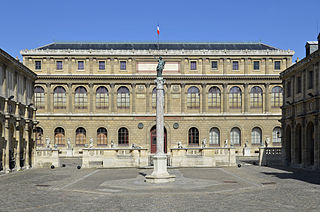
The Beaux-Arts de Paris, formally the École nationale supérieure des beaux-arts, is a French grande école whose primary mission is to provide high-level fine arts education and training. The art school, which is part of the Paris Sciences et Lettres University, is located on two sites: Saint-Germain-des-Prés in Paris, and Saint-Ouen.

Pierre-Narcisse, baron Guérin was a French painter born in Paris.

Pierre Louis Rodolphe Julian born in Lapalud southeastern France was a French painter, etcher and professor, founder and director of the Académie Julian in Paris. The writer André Corthis (1882–1952), winner of the 1906 edition of the Prix Femina was his niece.
Jean Léon Marie Delumeau was a French historian specializing in the history of the Catholic Church, and author of several books regarding the subject. He held the Chair of the History of Religious Mentalities (1975–1994) at the Collège de France and was a member of the Académie des inscriptions et belles-lettres.

Adrien Goetz is a French Art History Professor, art critic and novelist. He graduated from the École Normale Supérieure. His work appeared in Zurban, and Beaux-Arts Magazine. He is Lecturer in Art History at the Sorbonne., and the Editor of Grande Galerie, the magazine published by the Louvre Museum. Adrien Goetz was elected to the Académie des Beaux-Arts - Institut de France in December 2018.

The Académie Royale d'Architecture was a French learned society founded in 1671. It had a leading role in influencing architectural theory and education, not only in France, but throughout Europe and the Americas from the late 17th century to the mid-20th.
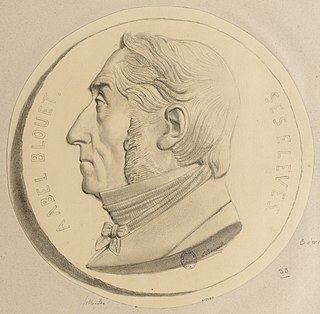
Guillaume-Abel Blouet was a French architect who specialised in prison design.

Henri van Dievoet was a Belgian architect.

Merry-Joseph Blondel was a French history painter of the Neoclassical school. He was a winner of the prestigious Prix de Rome in 1803. After the salon of 1824, he was bestowed with the rank of Knight in the order of the Legion d'Honneur by Charles X of France and offered a professorship at the École nationale supérieure des Beaux-Arts: a position in which he remained until his death in 1853. In 1832, he was elected to a seat at the Académie des Beaux-Arts in Paris.
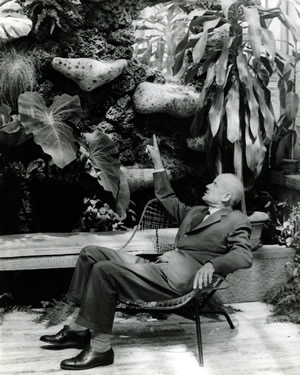
Pietro Porcinai is renowned as one of the most outstanding Italian landscape architects of the twentieth century. He designed a wide variety of projects on the most diverse scales: gardens and public parks, industrial districts, hotels and tourist villages, motorways and agricultural areas. The hundreds of projects implemented in Italy and abroad comprise the most extraordinary “landscaped” gardens, perfectly integrated within the surroundings and so natural as to appear untouched by human hand.

Jules-Joseph Guiffrey was a 19th-century French art historian, a member of the Académie des beaux-arts.

Joseph-Marin-Adolphe Noël des Vergers was a 19th-century French archaeologist, historian, etruscologist, orientalist and epigrapher.

Stanislas-Louis Bernier was a French architect.
Armand Alfred Patusset was a French composer, conductor and musical arrangeur.

Paul-René-Léon Ginain was a French architect.

Mathieu-Prosper Morey was a French architect born on December 27, 1805, in Nancy. He died in the same city on July 5, 1886. He played a major role in modernizing the capital city of Lorraine during the 19th century. Prosper Morey contributed mainly in Nancy with several civil and religious buildings such as Saint-Epvre basilica. Beyond architecture, Prosper Morey was also a historian and a scholar man, member of the Académie de Stanislas.
The Villa des Vergers is a countryside villa in San Lorenzo in Correggiano, a frazione of Rimini, in the region of Emilia-Romagna, northern Italy. Dating to the 17th century, the villa was purchased by Adolphe Noël des Vergers in 1843, and substantially redesigned in 1879 by Arthur-Stanislas Diet. Between 1938 and 1946, it was owned by Mario Ruspoli, 2nd Prince of Poggio Suasa, who employed Pietro Porcinai to design the villa's gardens. The villa was used as a military headquarters by German forces in the Second World War, and has since been owned by a series of local entrepreneurs.
 Media related to Arthur-Stanislas Diet at Wikimedia Commons
| International | |
|---|---|
| Artists | |
| People | |
| Other | |
