Related Research Articles

Donatism was a heresy leading to schism in the Church of Carthage from the fourth to the sixth centuries AD. Donatists argued that Christian clergy must be faultless for their ministry to be effective and their prayers and sacraments to be valid. Donatism had its roots in the long-established Christian community of the Roman Africa province in the persecutions of Christians under Diocletian. Named after the Berber Christian bishop Donatus Magnus, Donatism flourished during the fourth and fifth centuries.

Pelagius was a theologian who advocated free will and asceticism. He was accused by Augustine of Hippo and others of denying the need for divine aid in performing good works. They understood him to have said that the only grace necessary was the declaration of the law; humans were not wounded by Adam's sin and were perfectly able to fulfill the law without divine aid. Pelagius denied Augustine's theory of original sin. Adherents of Pelagius cited Deuteronomy 24:16 in support of their position. Pelagius was declared a heretic by the Council of Ephesus in 431. His interpretation of a doctrine of free will became known as Pelagianism.

Tozeur is a city in southwest Tunisia. The city is located northwest of Chott el Djerid, in between this Chott and the smaller Chott el Gharsa. It is the capital of Tozeur Governorate. It was the site of the ancient city and former bishopric Tusuros, which remains a Latin Catholic titular see.
Marcellinus of Carthage was a Christian martyr and saint who died in 413. He was secretary of state of the Western Roman Empire under Roman emperor Honorius and a close friend of Augustine of Hippo, as well as a correspondent of Saint Jerome's. Saint Augustine dedicated the first books of his landmark The City of God to Marcellinus in 413.
Possidius was a friend of Augustine of Hippo who wrote a reliable biography and an indiculus or list of his works. He was bishop of Calama in the Roman province of Numidia.
Fussala was a town in the Roman province of Numidia that became a Christian bishopric. The town and bishopric disappeared after the Muslim conquest of the Maghreb, but the bishopric has been revived as a titular see of the Catholic Church,
Paulinus the Deacon, also Paulinus of Milan was the notary of Ambrose of Milan, and his biographer. His work is the only life of Ambrose based on a contemporary account, and was written at the request of Augustine of Hippo; it is dated to 422.

Quiza, which Pliny the Elder called Quiza Xenitana, was a Roman–Berber colonia, located in the former province of Mauretania Caesariensis. The town is identified with ruins at Sidi Bellater, Algiers.
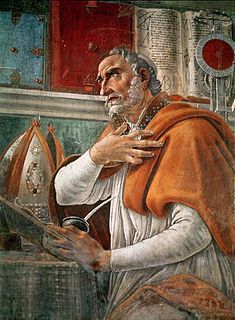
The Augustine of Hippo bibliography contains a list of works published by fourth-century Christian bishop and theologian Augustine of Hippo.
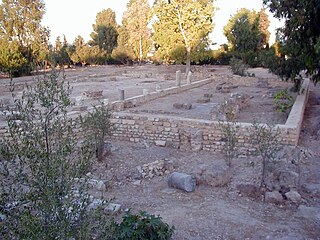
The Archdiocese of Carthage, also known as the Church of Carthage, was a Latin Catholic diocese established in Carthage, Roman Empire, in the 2nd century. Agrippin was the first named bishop, around 230 A.D. The temporal importance of the city of Carthage in the Roman Empire had previously been restored by Julius Caesar and Augustus. When Christianity became firmly established around the Roman province of Africa Proconsulare, Carthage became its natural ecclesiastical seat. Carthage subsequently exercised informal primacy as an archdiocese, being the most important center of Christianity in the whole of Roman Africa, corresponding to most of today's Mediterranean coast and inland of Northern Africa. As such, it enjoyed honorary title of patriarch as well as primate of Africa: Pope Leo I confirmed the primacy of the bishop of Carthage in 446: "Indeed, after the Roman Bishop, the leading Bishop and metropolitan for all Africa is the Bishop of Carthage."

Thiava was an ancient Roman-Berber civitas in Numidia, Africa Proconsulare and in the Vandal Kingdom. It was a Latin Catholic diocese.
Zattara was an ancient Roman and Byzantine town in the Africa province. It was located in present-day Kef ben-Zioune, south-east of Calama, Algeria. The city was a titular see of the Roman Catholic Church.

Avensa was a Roman and Byzantine-era civitas (city), in Roman North Africa.
Felix, Bishop of Aptunga, in proconsular Africa was a 4th-century churchman, at the center of the Donatist controversy.
Maximian of Bagai was a 5th century bishop of Bagai in Roman North Africa. His life shows the extent that the religious schism in Roman North Africa could become violent.

Vescera, also known as Ad Piscinam, was an ancient titular see and Roman colony in Roman North Africa. It has been identified as a site near Biskra in Algeria. It remains as a titular see of the Roman Catholic Church in the Province of Numidia.

Abthugni was an ancient city in Roman North Africa at present day Suwar (Henchir-es-Souar) in Tunisia. It was in Roman times in the province of Africa Proconsularis, Africa, and latter in Byzacena. In late antiquity Abthugni was also the seat of a bishop, and the diocese is a titular see of the Roman Catholic Church to this day.
Primian (Primianus) was an early Christian Bishop of Carthage, and leader of the Donatist movement in Roman North Africa. Seen as a moderate by some in his faction, he was a controversial figure in a time of fragmentation of the Donatists, a reactionary branch of Christianity.
Cabarsussi, was an ancient civitas (municipality) and bishopric in the Roman province of Byzacena, that is tentatively identifiable with ruins at Drâa-Bellouan in modern Tunisia. The current bishop is Terence Robert Curtin, auxiliary bishop of Melbourne.
Anapsychia was a late Roman letter-writer and correspondent of Jerome of Striden.
References
- ↑ Brent D. Shaw, Sacred Violence: African Christians and Sectarian Hatred in the Age of Augustine (Cambridge University Press, 1 Sep. 2011 ) p271.
- ↑ Titular Episcopal See of Tusuros, Tunisia - GCatholic.org.
- ↑ Anthony Dupont, Gratia in Augustine's Sermones Ad Populum During the Pelagian Controversy (BRILL, 2012) p385.
- ↑ Strabo, Geography 2.5.33.
- ↑ Anthony Dupont, Gratia in Augustine's Sermones Ad Populum During the Pelagian Controversy (BRILL, 2012) p385.
- ↑ Serge Lancel, Saint Augustine (Hymns Ancient and Modern Ltd, 2002)
- ↑ Serge Lancel, Saint Augustine (Hymns Ancient and Modern Ltd, 2002) p356.
- ↑ François Decret, Early Christianity in North Africa (Wipf and Stock Publishers, 2009)
- ↑ Saint Augustine, Letters 156-210: Epistulae II (New City Press, 2004) p310.