Related Research Articles

The Daily of the University of Washington, usually referred to in Seattle simply as The Daily, is the student newspaper of the University of Washington in Seattle, Washington, USA. It is staffed entirely by University of Washington students, excluding the publisher, advertising adviser, accounting staff, and delivery staff.

The Michigan Review is a news publication in Ann Arbor, Michigan. The Review, published biweekly, is funded primarily by grants from the conservative/libertarian Collegiate Network, donations, and by advertising revenue.
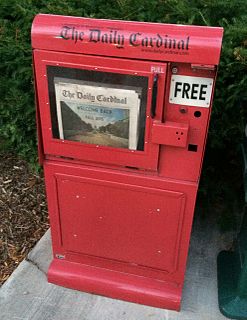
The Daily Cardinal is a student newspaper that serves the University of Wisconsin–Madison community. One of the oldest student newspapers in the country, it began publishing on Monday, April 4, 1892. The newspaper is financially and editorially independent of the university.

Robert Anthony Snow was an American journalist, political commentator, anchor, columnist, musician, and the 25th White House Press Secretary under President George W. Bush, from May 2006 until his resignation in September 2007. Snow also worked for the President George H. W. Bush as chief speechwriter and Deputy Assistant of Media Affairs, from 1991 to 1993. Between his two White House stints, Snow was a broadcaster and newspaper columnist. After years of regular guest-hosting for The Rush Limbaugh Show and providing news commentary for National Public Radio, he launched his own talk radio program, The Tony Snow Show, which went on to become nationally syndicated. He was also a regular personality on Fox News Channel beginning in 1996, hosting Fox News Sunday and Weekend Live, and often substituting as host of The O'Reilly Factor. In April 2008, Snow briefly joined CNN as a commentator. He also made several notable speeches, including keynote addresses at the Conservative Political Action Conference in 2007 and 2008. In his journalistic and governmental capacities, Snow generally supported conservative causes.
The Orion is the student newspaper of California State University, Chico and produces 32 issues every year, 16 each semester. Its offices are in the basement of Plumas Hall on the Chico State campus. It has won numerous state and national awards, including several National Pacemakers. Its name is taken from the constellation Orion, as the newspaper is meant to be a "hunter of truth."

The Hoya, founded in 1920, is the oldest and largest student newspaper of Georgetown University in Washington, D.C., serving as the university’s newspaper of record. The Hoya is a student-run paper that prints every Friday and publishes online daily throughout the year, with a print circulation of 4,000 during the academic year. The newspaper has four main editorial sections: News, Opinion, Sports and The Guide, a weekly arts and lifestyle magazine. It also publishes several annual special issues including a New Student Guide, a basketball preview and a semesterly fashion issue.
Michael Patrick Ramirez is an American cartoonist for the Las Vegas Review-Journal. His cartoons present mostly conservative viewpoints. He is a two-time Pulitzer Prize winner.
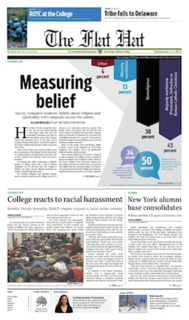
The Flat Hat is the official student newspaper at the College of William and Mary in Williamsburg, Virginia. It prints Tuesdays during the College's academic year. It began printing twice-weekly in 2007; since its inception in 1911, The Flat Hat had printed weekly. It returned to weekly printing in 2015. In fall 2020, The Flat Hat began printing biweekly due to restrictions associated with the COVID-19 pandemic. The Flat Hat staff operates out of the office located in the basement of William and Mary's Campus Center.
The Daily Bruin is the student newspaper at the University of California, Los Angeles. It began publishing in 1919, the year UCLA was founded.
Portland State Vanguard, formerly known as the Daily Vanguard and Vet's Extended, is an independent student newspaper for Portland State University, in Portland, Oregon, United States.
The GW Hatchet is the student newspaper of the George Washington University. Founded in 1904, The Hatchet is the second-oldest continuously-running newspaper in Washington, DC, only behind The Washington Post. The Hatchet is often ranked as one of the best college newspapers in the United States and has consistently won awards from the Society of Professional Journalists and from the Associated Collegiate Press. Alumni of the GW Hatchet include numerous Pulitzer Prize winners, Emmy Award winners, politicians, news anchors, and editors of major publications.

The Collegiate Times is an independent, student-run newspaper serving Virginia Tech since 1903. The Educational Media Company at Virginia Tech (EMCVT), a non-profit student media consortium, owns the publication. Based in Blacksburg, Virginia, the Collegiate Times publishes local news, sports, features and opinions for 5,000 print readers every Tuesday of the academic year and prints weekly summer editions. The Collegiate Times represents the only daily newspaper produced in Blacksburg and also provides its content online via its website, mobile app, and various social media outlets.

John Bertram Oakes was an iconoclastic and influential U.S. journalist known for his early commitment to the environment, civil rights, and opposition to the Vietnam War.
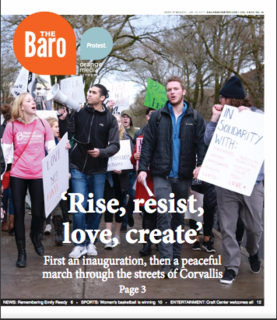
The Daily Barometer is an independent campus newspaper of Oregon State University, in Corvallis, Oregon. It is published weekly during the fall, winter, and spring quarters, and monthly during the summer.

The Diamondback is an independent student newspaper associated with the University of Maryland, College Park. It began in 1910 as The Triangle and became known as The Diamondback in 1921. Now a weekly online journal, The Diamondback was published as a daily print newspaper on weekdays until 2013. It is published by Maryland Media, Inc., a non-profit organization. The newspaper receives no university funding and derives its revenue from advertising.
The Rocky Mountain Collegian is the daily student newspaper of Colorado State University. Founded in 1891, the paper is one of the oldest daily student newspapers west of the Mississippi River and is the only student-run daily newspaper in the state of Colorado. In 2010, the Collegian was ranked one of the top three daily student newspapers in the nation by the Society of Professional Journalists.
The FSView & Florida Flambeau is a for-profit newspaper owned by the Gannett Company that covers the on-campus events, happenings, and trends of the Florida State University as well as concerts, museum and art exhibits, movies, literature and poetry readings, and other events from the larger Tallahassee community. In early August 2006, the FSView made national news as being the first privately owned, college-oriented newspaper to be bought by a major newspaper chain.
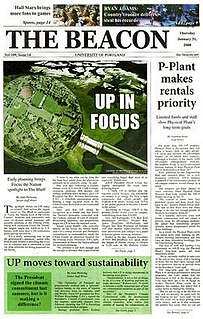
The Beacon is the student-run newspaper of the University of Portland in Portland, Oregon, United States. The current name of the paper at the private, Catholic school was adopted in 1935. The weekly paper is published each Thursday and is a member of the College Publisher Network.
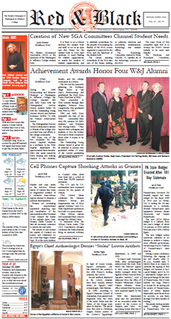
The Red & Black is the student newspaper for Washington & Jefferson College. The student staff handles all aspects of the production, including writing, editing, graphic design, layout, and advertising sales. The Red & Black features campus events and happenings, student and faculty art, student opinion, college athletic coverage, and local and world news. Founded in 1909, the paper goes to press every Thursday with a weekly circulation of 1,250 copies.

The CU Independent is the student-run news publication for the University of Colorado Boulder. It has been digital-only since 2006, when it became one of the first major college newspapers to drop its print edition.
References
- ↑ Kitaura, Cody (2004-01-21). "Prepare your Magic Markers for the masquerade party". The State Hornet. Archived from the original on 2007-09-27. Retrieved 2007-03-02.
- ↑ "California College Media Association 2008 Award Winners". California College Media Association. 2008-03-01. Archived from the original on 2008-04-02. Retrieved 2008-03-03.
- ↑ "Associated Collegiate Press 2007 Award Winners Winners". Associated Collegiate Press. 2007-03-11. Archived from the original on March 24, 2013. Retrieved 2008-03-03.
- ↑ "USATODAY.com - Dean scream gaining cult-like status on Web". usatoday30.usatoday.com.
- ↑ "George Bush singing "Sunday Bloody Sunday"". Google Video. 2006-06-13. Retrieved 2007-03-02.