 | Look up axillary in Wiktionary, the free dictionary. |
Axillary means "related to the axilla (armpit)" or "related to the leaf axils".
"Axillary" may refer to:
| Look up axillary in Wiktionary, the free dictionary. |
Axillary means "related to the axilla (armpit)" or "related to the leaf axils".
"Axillary" may refer to:


In botany, a bud is an undeveloped or embryonic shoot and normally occurs in the axil of a leaf or at the tip of a stem. Once formed, a bud may remain for some time in a dormant condition, or it may form a shoot immediately. Buds may be specialized to develop flowers or short shoots, or may have the potential for general shoot development. The term bud is also used in zoology, where it refers to an outgrowth from the body which can develop into a new individual.
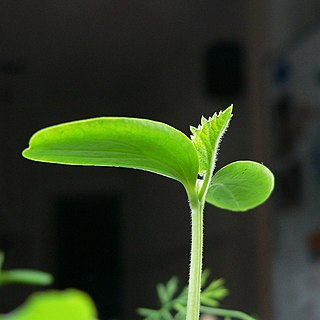
In botany, a plant shoot consists of any plant stem together with its appendages, leaves and lateral buds, flowering stems, and flower buds. The new growth from seed germination that grows upward is a shoot where leaves will develop. In the spring, perennial plant shoots are the new growth that grows from the ground in herbaceous plants or the new stem or flower growth that grows on woody plants.

Commelinaceae is a family of flowering plants. In less formal contexts, the group is referred to as the dayflower family or spiderwort family. It is one of five families in the order Commelinales and by far the largest of these with about 731 known species in 41 genera. Well known genera include Commelina (dayflowers) and Tradescantia (spiderworts). The family is diverse in both the Old World tropics and the New World tropics, with some genera present in both. The variation in morphology, especially that of the flower and inflorescence, is considered to be exceptionally high amongst the angiosperms.

The axillary bud is an embryonic or organogenic shoot located in the axil of a leaf. Each bud has the potential to form shoots, and may be specialized in producing either vegetative shoots or reproductive shoots (flowers). Once formed, a bud may remain dormant for some time, or it may form a shoot immediately.
Auxiliary may refer to:

Epacris is a genus of about forty species of flowering plants in the family Ericaceae. It was formerly treated in a closely related but separate family Epacridaceae, but the various genera within Epacridaceae including Epacris have been revised in their relationships to each other and brought under the common umbrella of the Ericaceae. The genus Epacris is native to eastern and southeastern Australia, New Caledonia and New Zealand. The species are known as heaths or Australian heaths.

Hakea archaeoides is a large shrub or small tree commonly known as Big Nellie hakea and is endemic to forest areas on the north coast of New South Wales, Australia. It has clusters of red and greenish yellow flowers in the flowering season.

Streptopus amplexifolius is a species of flowering plant in the family Liliaceae, native to North America, Europe and Asia.
This page provides a glossary of plant morphology. Botanists and other biologists who study plant morphology use a number of different terms to classify and identify plant organs and parts that can be observed using no more than a handheld magnifying lens. This page provides help in understanding the numerous other pages describing plants by their various taxa. The accompanying page—Plant morphology—provides an overview of the science of the external form of plants. There is also an alphabetical list: Glossary of botanical terms. In contrast, this page deals with botanical terms in a systematic manner, with some illustrations, and organized by plant anatomy and function in plant physiology.

Ilex canariensis, the small-leaved holly, is an endemic species of holly native to Macaronesian islands. It is a species of plant in the family Aquifoliaceae. It is found in the Macaronesian islands of Madeira (Portugal) and Canary Islands (Spain).
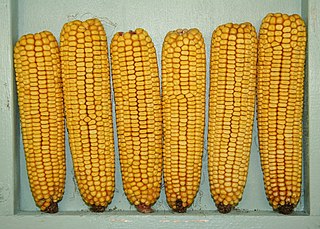
Dent corn, also known as grain corn, is a type of field corn with a high soft starch content. It received its name because of the small indentation, or "dent", at the crown of each kernel on a ripe ear of corn. Reid's Yellow Dent is a variety developed by central Illinois farmer James L. Reid. Reid and his father, Robert Reid, moved from Brown County, Ohio to Tazewell County, Illinois in 1846 bringing with them a red corn variety known as "Johnny Hopkins", and crossed it with varieties of flint corn and flour corn. Most of today's hybrid corn varieties and cultivars are derived from it. This variety won a prize at the 1893 World's Fair.

Hakea minyma, commonly known as watjula, is a species of shrub that is endemic to Australia. It has long, flat leaves, fragrant pink or white flower from late winter to spring.

Conospermum taxifolium, commonly known as variable smoke-bush, yew-leaf smoke bush or paint brush, is a plant in the family Proteaceae and is endemic to eastern Australia. It is an erect shrub with narrow elliptic to narrow egg-shaped leaves with the narrower end towards the base and panicles of cream-coloured to white, tube-shaped flowers.

Hakea invaginata is a shrub in the family Proteacea and is endemic to Western Australia. It has purplish-pink flowers, smooth needle-shaped leaves and the branchlets are thickly covered in hairs.

Orites diversifolia (=diversifolius), commonly known as variable orites, is a member of the family Proteaceae and is endemic to Tasmania. The common name stems from the variable form of the leaves, which range from entire and linear to serrated and ovate. It is a common shrub in lowland rainforest, subalpine woodland and scrub.
Petrophile axillaris is a species of flowering plant in the family Proteaceae and is endemic to southwestern Western Australia. It is a shrub with pinnately-divided, sharply-pointed leaves, and spherical heads of hairy pink or grey flowers.
Chinese virus or China virus may refer to:
Nepenthes fractiflexa is a tropical pitcher plant endemic to Borneo, where it has been recorded from a small number of localities across Sarawak and Kalimantan. It grows both terrestrially and epiphytically in ridge forest at elevations of 1400–2150 m above sea level. Nepenthes fractiflexa is considerably more diminutive than its putative closest relative, N. mollis. It also differs in its unusual growth habit and plant architecture, producing secondary stems with a frequency rarely seen in the genus, and having activated axillary buds that commonly develop into bract-like prophylls up to 5 cm long. Furthermore, the inflorescence appears to emerge from the middle of the internode, rather than from the leaf axil as is the norm in the genus; it is the first Nepenthes species for which concaulescence has been proposed.
Hibbertia axillaris is a species of flowering plant in the family Dilleniaceae and is endemic to northern Western Australia. It is usually a multi-stemmed shrublet with ridged branchlets, foliage covered with scales and rosette-like hairs and mostly elliptic to lance-shaped leaves. The flowers are arranged singly in leaf axils, with forty-two to fifty stamens arranged around the three carpels.
Johnstonalia is a monotypic genus of flowering plants belonging to the family Rhamnaceae. The only species is Johnstonalia axilliflora(M.C.Johnst.) Tortosa