The Ayas Nautical Research Club was founded in 1985. The range of its activities includes historical aspects of World and Armeniannavigation and shipbuilding, reconstruction of ancient Armenian vessels, study of sea routes, old maps, navigation devices, banners, collecting data on Armenian navigators, making underwater archaeological surveys and research. Since 1985 the Club has organized 15 exhibitions and has carried out several surveys on Armeniannavigation. It has restored and reconstructed 26 different types of vessels (rafts, leather boats, log-boats, boats and ships) used in historical Armenia. Members of the Club participate at international conferences on underwater archaeology and nautical history and have published a number of articles.
Medieval sailing ship replica reconstruction and test (1985–2003)
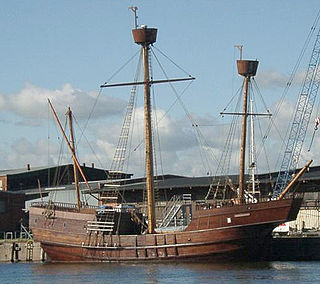
Cilicia, the replica of a 13th-century Armenian merchant sailing ship
The Ayas Nautical Research Club has built a replica of a 13th-century merchant sailing ship of the Armenian Kingdom of Cilicia. The ship was reconstructed in strict accordance with the information found in medieval manuscripts and miniatures, using the techniques and technologies available in the 13th century. The ship of 20 metres in length and displacing 50 tonnes was tested in 2002-2003 on Lake Sevan in Armenia.
Expedition around Europe (2004-2006)
The Cilicia is a functioning replica of a 13th-century merchantsailing ship of the Armenian Kingdom of Cilicia. It has sailed the medieval sea trade routes around Europe, via the Black and Mediterranean Seas, the Atlantic Ocean, the North and Baltic Seas, the rivers of Russia and finishing on the Black Sea, passing more than 15,000 nautical miles, visiting 63 ports in 25 countries of Europe and Asia. This is the first time in the history of navigation, that a vessel has closed a full ring around Europe by water.[citation needed] The voyage was equipped with accessories typical of the 13th century (navigation tools, merchandise goods, food, clothes, etc.). replicating the methods of navigation and the lifestyle of medieval sailors. The main goal of the experiment was to feel and to check how medieval sailors had sailed and operated with such vessels. Common responsibility to safeguard historical and cultural heritage was the objective. The Expedition highlighted the significant role of travelers and merchants in establishing connections between cultures and civilizations separated by seas, and the ship as the symbol and means of unification.
Expedition to the Caribbean (2007-2008) (jointly with the ANAHIT association)
The club sailed the yacht Anahit, a ketch under Armenian flag, from Annapolis, Chesapeake bay, to the Dominican Republic in the Caribbean.[citation needed]
Members of the club have found the remains of the vessel (guns) and investigated in site the shipwreck area.
Kidd took his most valuable prize, the Armenian ship Quedagh Merchant, in January 1698 and scuttled his own unseaworthy Adventure Galley. When he reached Anguilla, in the West Indies (April 1699), he learned that he had been denounced as a pirate. He left the Quedagh Merchant at Catalina Island, Dominican Republic (where the ship was possibly scuttled).
Traditional Sevanian sailing boats reconstruction (on-going project, 2008 - )
Ayas Nautical Research Club has restored the old Sevanian sailboat. There are plans to build 10 boats and organize an annual international regatta of the traditional sailing fishing boats of Lake Sevan. Two of them were sailed and tested in summer 2009. It is hoped that the development of such sailing as a sport will bring attention to the problems of the ecology of Lake Sevan.
Establish Maritime Museum in Yerevan, Armenia (on-going project)
This section is empty. You can help by adding to it. (July 2010)
External links
Ayas – The official website of Ayas Nautical Research Club
Related Research Articles
William Kidd, also known as Captain William Kidd or simply Captain Kidd, was a Scottish privateer. Conflicting accounts exist regarding his early life, but he was likely born in Dundee and later settled in New York City. By 1690, Kidd had become a highly successful privateer, commissioned to protect English interests in North America and the West Indies.
A ship is a large vessel that travels the world's oceans and other navigable waterways, carrying cargo or passengers, or in support of specialized missions, such as defense, research and fishing. Ships are generally distinguished from boats, based on size, shape, load capacity and purpose. Ships have supported exploration, trade, warfare, migration, colonization, and science. Ship transport is responsible for the largest portion of world commerce.
Sailing employs the wind—acting on sails, wingsails or kites—to propel a craft on the surface of the water, on ice (iceboat) or on land over a chosen course, which is often part of a larger plan of navigation.
A sailing ship is a sea-going vessel that uses sails mounted on masts to harness the power of wind and propel the vessel. There is a variety of sail plans that propel sailing ships, employing square-rigged or fore-and-aft sails. Some ships carry square sails on each mast—the brig and full-rigged ship, said to be "ship-rigged" when there are three or more masts. Others carry only fore-and-aft sails on each mast, for instance some schooners. Still others employ a combination of square and fore-and-aft sails, including the barque, barquentine, and brigantine.
Seamanship is the art, competence, and knowledge of operating a ship, boat or other craft on water. The Oxford Dictionary states that seamanship is "The skill, techniques, or practice of handling a ship or boat at sea."
Viking ships were marine vessels of unique structure, used in Scandinavia throughout the Middle Ages. The boat-types were quite varied, depending on what the ship was intended for, but they were generally characterized as being slender and flexible boats, with symmetrical ends with true keel. They were clinker built, which is the overlapping of planks riveted together. Some might have had a dragon's head or other circular object protruding from the bow and stern for design, although this is only inferred from historical sources. Viking ships were used both for military purposes and for long-distance trade, exploration and colonization.
Dhow is the generic name of a number of traditional sailing vessels with one or more masts with settee or sometimes lateen sails, used in the Red Sea and Indian Ocean region. Typically sporting long thin hulls, dhows are trading vessels primarily used to carry heavy items, such as fruit, fresh water, or other heavy merchandise, along the coasts of Eastern Arabia, Iran, East Africa, Yemen and coastal South Asia. Larger dhows have crews of approximately thirty and smaller ones typically around twelve.
Catalina Island or Isla Catalina is a tropical island in the Caribbean Sea located 2.4 kilometres (1.5 mi) from the mainland on the south-east corner of the Dominican Republic, near the provinces of La Altagracia and La Romana. It is an occasional destination for cruise ships on Caribbean routes. In particular, Costa Cruises has a private beach on the island. Their ships anchor offshore and transport passengers to shore via tender.
The mast of a sailing vessel is a tall spar, or arrangement of spars, erected more or less vertically on the centre-line of a ship or boat. Its purposes include carrying sails, spars, and derricks, giving necessary height to a navigation light, look-out position, signal yard, control position, radio aerial or signal lamp. Large ships have several masts, with the size and configuration depending on the style of ship. Nearly all sailing masts are guyed.
This glossary of nautical terms is an alphabetical listing of terms and expressions connected with ships, shipping, seamanship and navigation on water. Some remain current, while many date from the 17th to 19th centuries. The word nautical derives from the Latin nauticus, from Greek nautikos, from nautēs: "sailor", from naus: "ship".
A ship replica is a reconstruction of a no longer existing ship. Replicas can range from authentically reconstructed, fully seaworthy ships, to ships of modern construction that give an impression of a historic vessel. Some replicas may not even be seaworthy, but built for other educational or entertainment purposes.
La Grace is a replica of a brig from the 18th century. The original ship of Augustine Herman bore this name during merchant and exploratory travels around Europe, United States, Caribbean and across the Atlantic Ocean. La Grace was also renowned for her corsair activities. Especially well-known is her victory over two Spanish barques carrying sugar, tobacco and wine near the coast of Guatemala. This modern replica is utilised solely to teach the art of old-time seamanship. Her crew is mainly from the Czech Republic.
Quedagh Merchant, also known as the Cara Merchant and the Adventure Prize, was an Armenian merchant vessel famously captured by Scottish privateer William Kidd on 30 January 1698.
Shoghakat is a village in the Shoghakat Municipality of the Gegharkunik Province of Armenia, located near Lake Sevan, northwest of the Artanish Peninsula. The village was founded in the 1810s by Mordvins exiled from Russia. At the beginning of the 20th century Turks settled in the village. In 1988-1989 Armenian refugees from Azerbaijan settled in the village.
The maritime history of England involves events including shipping, ports, navigation, and seamen, as well as marine sciences, exploration, trade, and maritime themes in the arts of England. Until the advent of air transport and the creation of the Channel Tunnel, marine transport was the only way of reaching the rest of Europe from England and for this reason, maritime trade and naval power have always had great importance. Prior to the Acts of Union in 1707, the maritime history of the British Isles was largely dominated by England.
Captain Kidd's cannon is an iron cannon that was discovered in 2007 off of the coast of Catalina Island in the Dominican Republic. The cannon is believed to be part of the wreckage of the Quedagh Merchant, a ship that was commandeered and later abandoned by Captain Kidd in 1699. It is the first pirate cannon that has been recovered from the Caribbean. It's one of 26 cannons found off the coast of Catalina Island. It was first taken to Indiana University's School of Health, Physical Education, and Recreation for investigation and research before being displayed in the exhibit National Geographic: Treasures of the Earth at The Children's Museum of Indianapolis in Indianapolis, Indiana.
The settee sail was a lateen sail with the front corner cut off, giving it a quadrilateral shape. The settee sail requires a shorter yard than does the lateen, and both settee and lateen have shorter masts than square-rigged sails.
Tempest Rogers was a pirate trader active in the Caribbean and off Madagascar. He is best known for his association with William Kidd.
This glossary of nautical terms is an alphabetical listing of terms and expressions connected with ships, shipping, seamanship and navigation on water. Some remain current, while many date from the 17th to 19th centuries. The word nautical derives from the Latin nauticus, from Greek nautikos, from nautēs: "sailor", from naus: "ship".
Cilicia is a sailing ship built by the Ayas Nautical research club. The ship's design is modeled on existing samples from the 13th century Armenian Kingdom of Cilicia, with extensive reference to manuscripts and illustrations. The ship was built with medieval ship-building techniques. The crew's clothing was also crafted in a medieval style, with methods from the period. During her voyage, Cilicia visited 63 ports in 25 countries in both Europe and Asia.
This page is based on this Wikipedia article Text is available under the CC BY-SA 4.0 license; additional terms may apply. Images, videos and audio are available under their respective licenses.