
The Armed Forces of Yemen are the military forces of the Republic of Yemen. They include the Yemeni Army, Yemeni Navy and the Yemeni Air Force. The capital of the country, Sana’a is where the military is headquartered. Per the constitution of Yemen, the President of Yemen serves as the commander-in-chief.
ISO 3166-2:YE is the entry for Yemen in ISO 3166-2, part of the ISO 3166 standard published by the International Organization for Standardization (ISO), which defines codes for the names of the principal subdivisions of all countries coded in ISO 3166-1.

The State flag of Yemen was adopted on May 22, 1990, the day that North Yemen and South Yemen were unified. The flag of Yemen is the Arab Liberation Flag of 1952, introduced after the Egyptian Revolution of 1952 in which Arab nationalism was a dominant theme. The Arab Liberation Flag of 1952 served as the inspiration for the flags of both North and South Yemen prior to unification, as well as for the current flags of Egypt, Iraq, Sudan, Palestine and Syria.
Uzal, in the Hebrew Bible, was a descendant of Shem and the sixth son of Joktan as per the Book of Genesis 10:27 and 1 Chronicles 1:21. His settlements are traced in the ancient name of Sanaʽa, the capital city of the Yemen. Easton's Bible Dictionary describes Uzal as a wanderer and the founder of an Arabian tribe.

Dhamar, also spelt Thamar, is a governorate of Yemen located in the central highlands.

Marib is a governorate of Yemen. It is located 173 kilometers to the northeast of Yemen's capital, Sana'a. The population of Marib Governorate comprises 1.2% of the country's total population. The city of Marib is the capital of the governorate, and was established after the discovery of oil deposits in 1984. The total number of residents living in the governorate was 238,522 according to the 2004 census, and the rate of growth was 2.72%.

Sanaa, also spelled San'a' or Sana, is a governorate of Yemen. Its capital is Sanaa, which is also the national capital. However, the city of Sanaa is not part of the governorate but instead forms the separate governorate of Amanat Al-Asemah. The Governorate covers an area of 13,850 km2 (5,350 sq mi). As of 2004, the population was 2,918,379 inhabitants. Within this place is Jabal An-Nabi Shu'ayb or Jabal Hadhur, the highest mountain in the nation and the Arabian Peninsula.
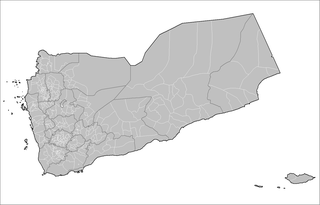
The administrative division of Yemen consists of two main divisions. There are 22 governorates, including the capital Sana'a and Socotra Archipelago. The 22 governorates are then divided into 333 districts, subdivided into 2,210 sub-districts, and then into 38,284 villages.

Sanaa, also spelled Sana'a and Sana, is the capital and largest city of Yemen and the capital of the Sanaa Governorate. The city is not part of the Governorate, but forms the separate administrative district of ʾAmānat al-ʿĀṣimah. According to the Yemeni constitution, Sanaa is the capital of the country, although the seat of the Yemeni government moved to Aden, the former capital of South Yemen in the aftermath of the Houthi occupation. Aden was declared as the temporary capital by then-president Abdrabbuh Mansur Hadi in March 2015.
Topics related to Yemen include:

The National Dialogue Conference (NDC) was a transitional dialogue process held at the Movenpick Hotel in Sanaa, Yemen from March 18, 2013 to January 24, 2014, as part of the Yemeni crisis reconciliation efforts.

The Houthi takeover in Yemen, also known as the September 21 Revolution, or 2014–15 coup d'état, was a popular revolution against Yemeni President Abdrabbuh Mansur Hadi led by the Houthis and their supporters that pushed the Yemeni government from power. It had origins in Houthi-led protests that began the previous month, and escalated when the Houthis stormed the Yemeni capital Sanaa on 21 September 2014, causing the resignation of Prime Minister Mohammed Basindawa, and later the resignation of President Abdrabbuh Mansur Hadi and his ministers on 22 January 2015 after Houthi forces seized the presidential palace, residence, and key military installations, and the formation of a ruling council by Houthi militants on 6 February 2015.
The following lists events that happened during 2014 in Yemen.
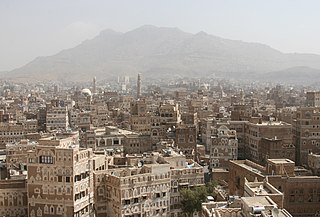
The Battle of Sanaa in 2014 marked the advance of the Houthis into Sanaa, the capital of Yemen, and heralded the beginning of the armed takeover of the government that unfolded over the following months. Fighting began on 9 September 2014, when pro-Houthi protesters under the command of Abdul-Malik al-Houthi marched on the cabinet office and were fired upon by security forces, leaving seven dead. The clashes escalated on 18 September, when 40 were killed in an armed confrontation between the Houthis led by military commander Mohammed Ali al-Houthi and supporters of the Sunni hardliner Islah Party when the Houthis tried to seize Yemen TV, and 19 September, with more than 60 killed in clashes between Houthi fighters and the military and police in northern Sanaa. By 21 September, the Houthis captured the government headquarters, marking the fall of Sanaa.
The battle of 'Amran, refers to a battle that took place in the summer of 2014, between the Houthi Zaydi movement, and the Yemeni government of President Abdrabbuh Mansur Hadi. The Houthis eventually won the battle, leading them to the capture of Sanaa.

The Islamic State – Yemen Province is a branch of the militant Islamist group Islamic State (IS), active in Yemen. IS announced the group's formation on 13 November 2014.

The federalization of Yemen is the proposed transformation of the Republic of Yemen from a unitary state to a federal state. Driven by the significant economic, religious, political, and historical differences between the northern and southern parts of the country, federalization has been a common and controversial proposal to resolve regionalist tensions since the unification of the country in 1990.
The Ministry of Defense is is a government ministry of Yemen that is responsible for the Yemen Armed Forces. The current minister of defense is Lt. Gen. Mohsen Mohammed al-Daeri, who was appointed on 28 July 2022. The main headquarters of the Ministry is in Sana'a.
Azal is a sub-district located in al-Radmah District, Ibb Governorate, Yemen. Azal had a population of 7974 according to the 2004 census.

Janad Region or Al-Janad Region is one of the six federal regions of Yemen that is expected to be established in the upcoming constitution, becoming an autonomous federal self-governing region in southwestern Yemen. the Janad Region comprises two Yemeni Wilayat or States: Taiz and Ibb, with Taiz being its capital.


 Yemen
Yemen


