The record of human rights in Venezuela has been criticized by human rights organizations such as Human Rights Watch and Amnesty International. Concerns include attacks against journalists, political persecution, harassment of human rights defenders, poor prison conditions, torture, extrajudicial executions by death squads, and forced disappearances.

Foro Penal is a Venezuelan human rights organization that provides legal assistance pro bono to people subject of arbitrary detentions and their relatives. The organization is composed of regional coordinators for each state in Venezuela, pro bono lawyers on a national level and a network of over five thousand volunteers, non-lawyer activists, known as "active defensors".
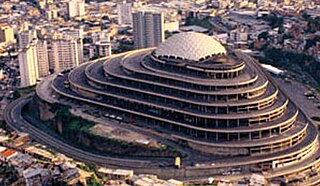
Torture in Venezuela has been a consistent phenomenon throughout its history. Various dictatorships from the Spanish colonial era into the twentieth century utilized torture against common criminals and political opponents. In the twentieth century, torture was common during the dictatorships of Juan Vicente Gómez and Marcos Pérez Jiménez. Torture also took place occasionally during Venezuela's democratic period, particularly during social outbursts, such as during the Caracazo and the 1992 coup attempts.
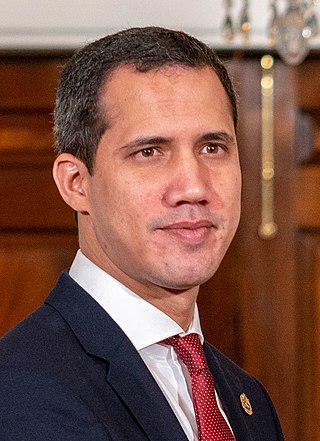
The Venezuelan presidential crisis was a political crisis concerning the leadership and the legitimate president of Venezuela between 2019 and 2023, with the nation and the world divided in support for Nicolás Maduro or Juan Guaidó.

Edgar José Zambrano Ramírez is a Venezuelan lawyer and politician that currently serves as a National Assembly deputy for the Lara state. From January 5, 2019 to January 5, 2020, he served as First Vice President of the Assembly. He was President of the Permanent Defense and Security Parliamentary Commission between 2016 and 2018. He is the vice president of the opposition political party Democratic Action.
The Local Committees for Supply and Production are food distribution committees promoted by the Venezuelan government in which the communities themselves supply and distribute the priority foods through a house-to-house delivery method. It was established in 2016 by President Nicolás Maduro in response to the shortages in Venezuela. The committees have been subject of complaints about corruption, political use, delays, poor food quality and price increases without prior warning. This service is a subsidiary of the Ministry of Popular Power for Food.
Venezuela Aid Live was a concert to benefit Venezuela in Cúcuta, Colombia, a city near the Venezuelan border, on 22 February 2019. The all-day concert, called Música por Venezuela: Ayuda y Libertad, was organized by Richard Branson and Bruno Ocampo, and featured over thirty of the best known Latin American artists from nine countries. The concert's slogan was, "Let the stars shine for all".
Rafael Ramón Acosta Arévalo was a Venezuelan military officer with the rank of corvette captain of the Venezuela Navy. Acosta Arévalo was victim of forced disappearance and tortured by agents of the General Directorate of Military Counterintelligence (DGCIM) during his detention after being accused by the government of Nicolás Maduro of "conspiring to carry out an attempted coup d'état". Acosta Arévalo died as a result of injuries suffered after being tortured while in detention in the Military Hospital of the Army Dr. Vicente Salias Sanoja. The news of his death caused great impact in the media and the condemnation of both national and international authorities.

An investigation by the International Criminal Court (ICC) to analyze possible crimes against humanity committed in Venezuela was opened in 2021. A preliminary examination was initially opened in 2006, and closed after concluding that the requirements to start an investigation had not been met. In February 2018, the ICC announced that it would open preliminary probes into alleged crimes against humanity performed by Venezuelan authorities since at least April 2017. In 2020, the Office of the Prosecutor of the ICC stated that it believed there was a "reasonable basis" to believe that "since at least April 2017, civilian authorities, members of the armed forces and pro-government individuals have committed the crimes against humanity", and on 2021 ICC Prosecutor Karim Khan announced the opening of an investigation regarding the situation in the country.
The following lists events in the year 2020 in Venezuela.

Operation Gideon was an unsuccessful attempt by the Active Coalition of the Venezuelan International Reserve, Venezuelan dissidents, and a private security firm, Jordan Goudreau's Silvercorp USA, to infiltrate Venezuela by sea and remove Nicolás Maduro from power. The plan executed from 3 to 4 May 2020 was for expatriate Venezuelan former military personnel living in Colombia to enter the country by boat at Macuto, take control of an airfield, capture Maduro and other high-level figures in his administration, and expel them from the country.
Alena Douhan of Belarus is the United Nations Special Rapporteur on the negative impact of the unilateral coercive measures on the enjoyment of human rights, as 25 March 2020. When appointed, she was a professor of International Law and the Director of the Peace Research Center at the Belarusian State University.
The 2019 Sacaba massacre occurred when Bolivian soldiers and police attacked and broke up a protest led by Bolivian coca growers at Huayllani in Sacaba municipality, Cochabamba on 15 November 2019. It came in the first week of the interim presidency of Jeanine Áñez. Marchers intended to enter the town of Sacaba and proceed to the departmental capital of Cochabamba to protest the ousting of Bolivian president Evo Morales, but were stopped by the police and military. During the afternoon, police and soldiers clashed with protesters, and eventually soldiers opened fire on the crowd. Eleven demonstrators were killed; an estimated ninety-eight people were wounded, including four journalists and eight members of the security forces. Two hundred twenty-three protesters were arrested, many of whom suffered mistreatment and at least nine of whom were tortured.

The La Vega raid was a police raid that occurred on 8 January 2021 in La Vega Parish, Caracas, Venezuela. The objective of the raid was to take control of La Vega Parish, which was controlled by a criminal organization, led by Leonardo José Polanco Angulo; he was a drug lord, known as "El Loco Leo". Members of the Venezuelan National Police (PNB), the Special Action Forces (FAES) and the Venezuelan National Guard seized control of the parish, killing a number of people in the neighborhood. According to investigative journalists and human rights organizations, the death toll was 23 people. By 11 January, no member of the Nicolás Maduro administration had made a statement about the events or announced a death toll.
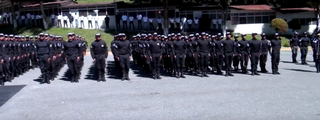
The Special Action Forces is an elite command of the Venezuelan National Police created in April 2016. By 2019, it had around 1,300 officers. The FAES includes the Unidad de Operaciones Tácticas Especiales (UOTE) a police tactical unit. The FAES have been accused of being a political instrument of Nicolás Maduro, as well as being a death squad and of repressing the opposition.
Daniela Geraldine Figueredo Salazar was a Venezuelan young woman detained in a police cell in the Zamora municipality, Miranda state. Figueredo was killed while in state custody, shot by a police officer in the prison cell. The officer, Daniel Galarraga, has maintained that the death was accidental, but testimony from other inmates indicates that it occurred after Galarraga drew his service weapon to force her to have sexual relations with him. Galarraga was subsequently arrested and charged; the charges filed by the prosecution ruled out that it was an accidental shooting. National Assembly deputies, activists and human rights defenders denounced her killing.
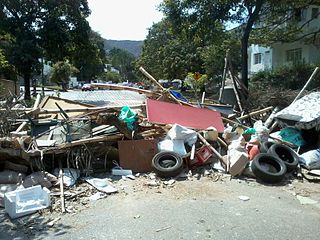
Guarimba is a term colloquially used in Venezuela for a protest method primarily used by the Venezuelan opposition that involves erecting street barricades or roadblocks. Although the erection of barricades in Venezuela dates back decades, the term has gained relevance during protests against the governments of Hugo Chávez and Nicolás Maduro, when it has become a pejorative and stigmatizing term. Venezuelan officials have used the term to disqualify and criminalize the opposition or opposition demonstrations.
The International Independent Fact-Finding Mission on the Bolivarian Republic of Venezuela is an observation body established in 2019 to study the human rights situation under the Bolivarian Revolution.
On 9 February 2024, Venezuelan activist Rocío San Miguel was detained at the Simón Bolívar International Airport in Maiquetía, near Caracas. Alongside her, two brothers, her ex-husband, and the father of her daughter were also detained. In response to the detention, international human rights organizations, such as Amnesty International, have called for San Miguel's immediate and unconditional release, citing a precautionary measure of protection issued by the Inter-American Commission on Human Rights (IACHR) in 2012.

The 2024 Venezuelan protests broke out after the 2024 presidential election on 28 July, in response to voter fraud and other irregularities during the election cycle. The election and unrest occurred in the context of the ongoing crisis in Venezuela.