The Parliament of Pakistan is the federal and supreme legislative body of Pakistan. It is a bicameral federal legislature that consists of the Senate as the upper house and the National Assembly, as the lower house. According to the constitution of Islamic Republic of Pakistan, the President of Pakistan is also a component of the Parliament. The National Assembly is elected for a five-year term on the basis of adult franchise and one-man one-vote. The tenure of a Member of the National Assembly is for the duration of the house, or sooner, in case the Member dies or resigns. The tenure of the National Assembly also comes to an end if dissolved on the advice of the Prime Minister or by the president in his discretion under the Constitution.

Since its establishment in 1947, Pakistan has had an asymmetric federal government and is a federal parliamentary democratic republic. At the national level, the people of Pakistan elect a bicameral legislature, the Parliament of Pakistan. The parliament consists of a lower house called the National Assembly, which is elected directly, and an upper house called the Senate, whose members are chosen by elected provincial legislators. The head of government, the Prime Minister, is elected by the majority members of the National Assembly and the head of state, the President, is elected by the Electoral College, which consists of both houses of Parliament together with the four provincial assemblies. In addition to the national parliament and the provincial assemblies, Pakistan also has more than five thousand elected local governments.
The Pakistan Muslim League (F) is a centrist, nationalist, and pro-Hurs clan political party in Pakistan. It is one of the Pakistan Muslim Leagues. The letter 'F' in its name stands for functional. It is primarily associated with the Sindhi religious leader Pir Pagara. It was formed in 1985 when the Pakistani establishment decided to make Muhammad Khan Junejo the president of united PML. In response, Pir Pagara Syed Shah Mardan Shah-II parted ways with the mother league and formed his own party.
Chaudhry Pervaiz Elahi is a Pakistani politician who is the current Speaker of the Provincial Assembly of the Punjab, in office since August 2018. He has been a member of the Provincial Assembly of the Punjab since August 2018.
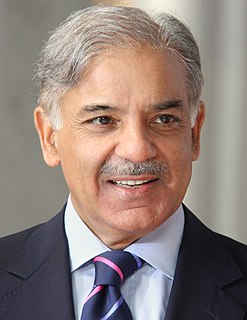
Mian Muhammad Shehbaz Sharif is a Pakistani politician who is the current Leader of the Opposition in the National Assembly of Pakistan, in office since 20 August 2018. He has been a member of the National Assembly since 13 August 2018 and is the current President of the Pakistan Muslim League-N. He has recently served his third term as the Chief Minister of Punjab from June 2013 to May 2018.

General elections were held in Pakistan on 10 October 2002 to elect the National Assembly of Pakistan and the provincial assemblies. The elections were held under the watchful scrutiny of the military government of General Pervez Musharraf. This elections featured the multiparty democracy as it brought an end to the two-party system between the Pakistan Peoples Party and Pakistan Muslim League (N). A right of center Pakistan Muslim League (Q) emerged in the mainstream political spectrum of Pakistan, that supported liberal President Musharraf.
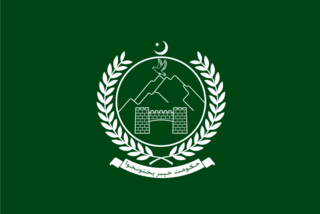
The Khyber Pakhtunkhwa Assembly is the unicameral legislative body of the Khyber Pakhtunkhwa province in Pakistan. It was established under Article 106 of the Constitution of the Pakistan. The assembly has 124 elected members, 99 regular seats, 22 seats reserved for women and 3 seats for Non-Muslims.

The Election Commission of Pakistan, is an independent, autonomous, permanent and constitutionally established federal body responsible for organizing and conducting of elections to state parliament, provincial legislatures, local governments, elections to the office of President of Pakistan, delimitation of constituencies and preparation of Electoral Rolls. As per the principles enlightened by the Constitution of Pakistan, the Commission makes such arrangements as are necessary to ensure that the election is conducted honestly, justly, fairly and in accordance with law, and that corrupt practices are guarded against The Election Commission was formed on 23 March 1956 and has been restructured and reformed in various occasions of history of the country.

Makhdoom Shah Mahmood Hussain Qureshi is a Pakistani politician who is the current Federal Minister for Foreign Affairs, in office since 20 August 2018. He has been a member of the National Assembly of Pakistan since August 2018 and currently serves as Vice Chairman of the Pakistan Tehreek-e-Insaf, in office since December 2011.
Khawaja Saad Rafique is a Pakistani politician who has been a member of the National Assembly of Pakistan since October 2018.

NA-2 (Swat-I) is a constituency for the National Assembly of Pakistan. The constituency was known as NA-30 (Swat-II) from 1977 to 2018, the name was changed to NA-2 (Swat-I) after the delimitation in 2018 and tehsil Matta was carved out of it to create NA-4 (Swat-III); it was merged with tehsil Kabal to form the constituency.
NA-151 (Khanewal-II) is a constituency for the National Assembly of Pakistan.
NA-168 (Bahawalnagar-III) is a constituency for the National Assembly of Pakistan.

General elections were held in Pakistan on Wednesday 25 July, after the completion of a five-year term by the outgoing government. At the national level, elections were held in 270 constituencies, each electing one member to the National Assembly. At the provincial level, elections were held in each of the four provinces to elect Members of the Provincial Assemblies (MPA).

Presidential elections were held on 30 July 2013 in Pakistan to elect the 12th President of Pakistan. Incumbent President Asif Ali Zardari’s term was scheduled to expire on 8 September 2013; and as such, Article 41 of the Constitution of Pakistan required the elections to be held no later than 8 August 2013. The Electoral College of Pakistan – a joint sitting of the Senate, National Assembly and Provincial Assemblies – were tasked with electing a new President to succeed President Zardari, who declined to seek a second term in office. After the Pakistan Peoples Party and its allies boycotted the presidential election, the two candidates were Mamnoon Hussain backed by the Pakistan Muslim League (N), and Wajihuddin Ahmed backed by Pakistan Tehreek-e-Insaf. Agra-born Hussain was elected president by a majority securing 432 votes. The elections were the first time in Pakistani history where a civilian President was elected while an incumbent civilian President was still in office, completing a historic and democratic transition of power that began with the 2013 General Elections.
Constituency PK-93 is a constituency for the Khyber Pakhtunkhwa Assembly of the Khyber Pakhtunkhwa province of Pakistan.
PP-115 (Gujrat-VIII) is a Constituency of Provincial Assembly of Punjab.
Constituency PP-171 is a Constituency of Provincial Assembly of Punjab.
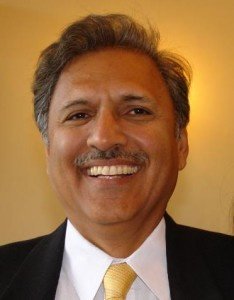
Presidential elections were held in Pakistan on 4 September 2018.