English usually refers to:
Moses M. Beachy was the founding bishop of the Beachy Amish Mennonite churches in 1927 and a former bishop in the Old Order Amish churches.
Weavertown Amish Mennonite Church is a Beachy Amish Mennonite congregation located in the village of Weavertown, between the somewhat larger villages of Bird-in-Hand and Intercourse in Lancaster County, Pennsylvania.
Amish Mennonites came into existence through reform movements among North American Amish mainly between 1862 and 1878. These Amish moved away from the old Amish traditions and drew near to the Mennonites, becoming Mennonites of Amish origin. Over the decades, most Amish Mennonites groups removed the word "Amish" from the name of their congregations or merged with Mennonite groups.
Hochstetler is a surname originating in Switzerland, particularly in Bern-Mittelland.
The Beachy Amish Mennonites, also known as the Beachy Amish or Beachy Mennonites, are an Anabaptist group of churches in the Conservative Mennonite tradition that have Amish roots. Although they have retained the name "Amish" they are quite different from the Old Order Amish: they do not use horse and buggy for transportation, with a few exceptions they do not speak Pennsylvania Dutch anymore, nor do they have restrictions on technology except for radio and television. In the years 1946 to 1977 a majority of the Beachy Amish incorporated certain elements of revivalist practice, such as the preaching of the New Birth. The traditionalists who wanted to preserve the old Beachy Amish ways then withdrew and formed their own congregations. Today they are known as Midwest Beachy Amish Mennonites or Old Beachy Amish.
Hostetler is a surname of German origin. Notable people with the surname include:

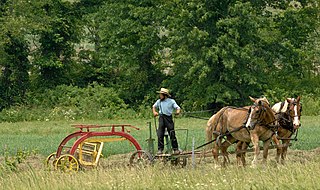
The Amish, formally the Old Order Amish, are an ethnoreligious group with Swiss German and Alsatian origins. Consisting of several Anabaptist Christian church fellowships, they are closely related to Mennonites, a separate Anabaptist denomination. The Amish are known for simple living, plain dress, Christian pacifism, and slowness to adopt many conveniences of modern technology, with a view neither to interrupt family time, nor replace face-to-face conversations whenever possible, and a view to maintain self-sufficiency. The Amish value rural life, manual labor, humility and Gelassenheit. As they rarely accept converts, maintain a separate language and culture from surrounding populations, and hold their faith in common, they have been described by scholars as an ethnoreligious group, combining features of an ethnicity and a denomination.
Gingerich is a surname of German origin. Other forms of the name are Gingrich, Gingerick and Gingery and its original form Güngerich, also written Guengerich. In Bern, Switzerland it was record as early as 1389 and in 1692 it was first recorded among Anabaptists. The first attestation in North America was in Lancaster County, Pennsylvania in 1724. The name is seldomly seen in Europe but was spread in North America by Amish and Mennonite immigrants.
Troyer is a last name of German origin which is widespread among the Amish, Brethren and the Mennonites. It is the Pennsylvania German form of the German last name "Dreier", "Dreyer", "Treyer" or "Dreher". A Dreher in German is a traditional operator of a rotating cutting machine.
Over the years, as Amish churches have divided many times over doctrinal disputes, subgroups have developed. The "Old Order Amish", a conservative faction that withdrew in the 1860s from fellowship with the wider body of Amish, are those that have most emphasized traditional practices and beliefs. There are many different subgroups of Amish with most belonging, in ascending order of conservatism, to the Beachy Amish, New Order, Old Order, or Swartzentruber Amish groups.
Stoltzfus is a surname of German origin. It is common among the Amish. Most American Stoltzfuses are descended from Nicholas Stoltzfus (1719–1774), an Amish man who migrated from Germany to America in 1766.
The Renno Amish, also called Beachy Amish or "black toppers" are a subgroup of Amish that was formed in 1863 in Mifflin County, Pennsylvania. They are the moderately conservative Old Order Amish group in Kishacoquillas Valley, locally called Big Valley, but still relatively conservative compared with the Amish of other regions.
Believers in Christ is a Plain horse-and-buggy Anabaptist Christian community at Cane Creek, Lobelville, Tennessee, that is rather intentional than traditional. They are sometimes seen as either Amish or Old Order Mennonite. G. C. Waldrep classifies them as "para-Amish". Among Anabaptists the community is often simply called "Lobelville".
Vernon Community in Hestand, Kentucky is home to a Anabaptist Christian community, that was founded in 1996 by Simon Beachy, former leader of the "Believers in Christ" in Lobelville, Tennessee. The Christian community is classified as "para-Amish" by G.C. Waldrep, adhering to plain dress using horse and buggy for transportation.
A Seeker is a person likely to join an Old Order Anabaptist community, like the Amish, the Old Order Mennonites, the Hutterites, the Old Order Schwarzenau Brethren or the Old Order River Brethren. Among the 500,000 members of such communities in the United States there are only an estimated 1,200 to 1,300 outsiders who have joined them.
Devgan is a surname native to India.
The Old Beachy Amish or Old Beachy Amish Mennonites, also called Midwest Beachy Amish Mennonites, are a Plain, car-driving Beachy Amish group, that preserves the old ways of the Beachy Amish including the German language. They live in Kentucky and Illinois. They are part of the Amish Mennonite movement in a broader sense, but they are not an organized denomination.
The New Order Amish Fellowship or New New Order Amish, most commonly called New Order Christian Fellowship, is the most progressive affiliation among the New Order Amish. Because some scholars see the New Order Amish just as a subgroup of the Old Order Amish, the New Order Christian Fellowship is thus the most progressive affiliation among the Old Order Amish. In spirituality, they are close to Beachy Amish. Their use of horse and buggy transportation and their preservation of the German language distinguishes them from the Beachys, except for the Old Beachy Amish who have also retained the German language but drive cars.
