
The West Bengal State Assembly Election of 1952 was a part of the series of Legislative Assembly elections in 1952.

The first legislative assembly Election to the Madras state on the basis of universal adult suffrage was held in March 1952. This was the first election held in Madras state after the Indian Independence. This election was officially known as 1951 Madras State Election, even though through delays, actual voting didn't take place until early 1952.

The 1952 Coorg Legislative Assembly election was held to constitute the Coorg Legislative Assembly, electing members of legislature for 18 constituencies of the erstwhile Indian State of Coorg. It took place on 27 March 1952 and a total of 87,947 people voted 24 out of 60 candidates to power. This was the only election to the assembly before the State was merged into Mysore as per the States Reorganisation Act in 1956.
Elections to the Ajmer Legislative Assembly were held on 27 March 1952. 134 candidates competed for the 30 seats in the Assembly.
Elections to the Legislative Assembly of the Indian state of Hyderabad were held on 27 March 1952. 564 candidates competed for the 175 seats in the Assembly. There were 33 two-member constituencies and 109 constituencies single-member constituencies.
The first Delhi Legislative Assembly election to the Delhi Legislative Assembly was held on 27 March 1952. Forty-eight seats were up for election. Six of the constituencies elected two assembly members, the remaining 36 constituencies elected a single member.
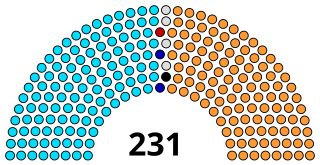
The Madhya Pradesh Vidhan Sabha or the Madhya Pradesh Legislative Assembly is the unicameral state legislature of Madhya Pradesh state in central India. The seat of the Vidhan Sabha is at Bhopal, the capital of the state. It is housed in the Vidhan Bhavan, an imposing building located at the centre of the Capital Complex in the Arera Hill locality of Bhopal city. The term of the Vidhan Sabha is five years, unless dissolved earlier. Presently, it comprises 230 members who are directly elected from single-seat constituencies and one nominated member.
Elections to the Legislative Assembly of the Indian state of Bombay were held on 26 March 1952. 1239 candidates contested for the 260 constituencies in the Assembly. There were 1 three-member, 47 two-member constituencies and 212 single-member constituencies.
Elections to the Madhya Pradesh Legislative Assembly were held on 26 March 1952. 1,122 candidates contested for the 184 constituencies in the Assembly. There were 48 two-member constituencies and 136 single-member constituencies. On 1 November 1956, under States Reorganisation Act, 1956, Madhya Bharat, Vindhya Pradesh, and Bhopal state were merged into Madhya Pradesh and the Marathi-speaking districts of Nagpur Division were transferred to Bombay State. Hence the constituencies were re-organized during 1957 elections.
Elections to the Legislative Assembly of the Indian state of Mysore were held on 26 March 1952. 394 candidates contested for the 80 constituencies in the Assembly. There were 19 two-member constituencies and 61 single-member constituencies.
Elections to the Punjab Legislative Assembly were held on 26 March 1952. 842 candidates contested for the 105 constituencies in the Assembly. There were 21 two-member constituencies and 84 single-member constituencies.
Elections to the Rajasthan Legislative Assembly were held on February 29, 1952. 616 candidates contested for the 140 constituencies in the Assembly. There were 20 two-member constituencies and 120 single-member constituencies.
Elections to the Legislative Assembly of the Indian state of Saurashtra were held on March 26, 1952. 222 candidates contested for the 55 constituencies in the Assembly. There were 5 two-member constituencies and 50 single-member constituencies.
Elections to the Andhra State Legislative Assembly were held on February 11, 1955. 581 candidates contested for the 167 constituencies in the Assembly. There were 29 two-member constituencies and 138 single-member constituencies.
Elections to the Andhra Pradesh Legislative Assembly were held on February 25, 1957. 319 candidates contested for the 85 constituencies in the Assembly. There were 20 two-member constituencies and 65 single-member constituencies.
Elections to the Madhya Pradesh Legislative Assembly were held on 25 February 1957. 1,108 candidates contested for the 218 constituencies in the Assembly. There were 69 two-member constituencies and 149 single-member constituencies.
Elections to the Mysore Legislative Assembly were held on 25 February 1957. 589 candidates contested for the 208 seats of the 179 constituencies in the Assembly.
Elections to the second Punjab Legislative Assembly were held in 1957. 661 candidates contested for the 154 seats of the 121 constituencies in the Assembly. There were 21 two-member constituencies and 84 single-member constituencies.
Elections to the second Rajasthan Legislative Assembly were held in 1957.


