
Drug Abuse Resistance Education is an education program that seeks to prevent use of controlled drugs, membership in gangs, and violent behavior. It was founded in Los Angeles in 1983 as a joint initiative of then-LAPD chief Daryl Gates and the Los Angeles Unified School District as a demand-side drug control strategy of the American War on Drugs. The program's mascot is Daren the Lion.
Behavior change, in context of public health, refers to efforts put in place to change people's personal habits and attitudes, to prevent disease. Behavior change in public health can take place at several levels and is known as social and behavior change (SBC). More and more, efforts focus on prevention of disease to save healthcare care costs. This is particularly important in low and middle income countries, where supply side health interventions have come under increased scrutiny because of the cost.
The social norms approach, or social norms marketing, is an environmental strategy gaining ground in health campaigns. While conducting research in the mid-1980s, two researchers, H.W. Perkins and A.D. Berkowitz, reported that students at a small U.S. college held exaggerated beliefs about the normal frequency and consumption habits of other students with regard to alcohol. These inflated perceptions have been found in many educational institutions, with varying populations and locations. Despite the fact that college drinking is at elevated levels, the perceived amount almost always exceeds actual behavior. The social norms approach has shown signs of countering misperceptions, however research on changes in behavior resulting from changed perceptions varies between mixed to conclusively nonexistent.
Brief intervention can often be referred to as screening and brief intervention (SBI) or, in England, identification and brief advice (IBA). Brief interventions are a technique used to initiate change for an unhealthy or risky behaviour such as smoking, lack of exercise or alcohol misuse. This page primarily describes brief interventions as applied to alcohol. As an alcohol intervention it is typically targeted to non-dependent drinkers, or drinkers who might be experiencing problems but are not seeking treatment. It is an approach which aims to prevent the acceleration or impact of alcohol problems, and/or to reduce alcohol consumption. It can be carried out in a range of settings such as in primary care, emergency or other hospital departments, criminal justice settings, workplaces, online, university/college settings, and other settings.
Workplace wellness is any workplace health promotion activity or organizational policy designed to support healthy behavior in the workplace and to improve health outcomes. Known as 'corporate wellbeing' outside the US, workplace wellness often comprises activities such as health education, medical screenings, weight management programs, on-site fitness programs or facilities.
Stewart I. Donaldson, Ph.D. is a psychologist specializing in theory-driven evaluation science, positive organizational psychology, and optimal health, well-being and human flourishing.
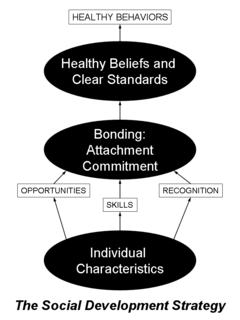
Communities That Care (CTC) is a program of the Center for Substance Abuse Prevention (CSAP) in the office of the United States Government's Substance Abuse and Mental Health Services Administration (SAMHSA). CTC is a coalition-based prevention operating system that uses a public health approach to prevent youth problem behaviors such as violence, delinquency, school drop out and substance abuse. Using strategic consultation, training, and research-based tools, CTC is designed to help community stakeholders and decision makers understand and apply information about risk and protective factors, and programs that are proven to make a difference in promoting healthy youth development, in order to most effectively address the specific issues facing their community's youth.
Health communication is the study and practice of communicating promotional health information, such as in public health campaigns, health education, and between doctor and patient. The purpose of disseminating health information is to influence personal health choices by improving health literacy. Health communication is a unique niche in healthcare that allows professionals to use communication strategies to inform and influence decisions and actions of the public to improve health.
The PRECEDE–PROCEED model is a cost–benefit evaluation framework proposed in 1974 by Lawrence W. Green that can help health program planners, policy makers and other evaluators, analyze situations and design health programs efficiently. It provides a comprehensive structure for assessing health and quality of life needs, and for designing, implementing and evaluating health promotion and other public health programs to meet those needs. One purpose and guiding principle of the PRECEDE–PROCEED model is to direct initial attention to outcomes, rather than inputs. It guides planners through a process that starts with desired outcomes and then works backwards in the causal chain to identify a mix of strategies for achieving those objectives. A fundamental assumption of the model is the active participation of its intended audience — that is, that the participants ("consumers") will take an active part in defining their own problems, establishing their goals and developing their solutions.
Prevention science is the application of a scientific methodology that seeks to prevent or moderate major human dysfunctions before they occur. Regardless of the type of issue on hand, the factors that lead to the problem must be identified and addressed. Prevention research is thus focused primarily on the systematic study of these potential precursors of dysfunction, also known as risk factors; as well as components or circumstances that reduces the probability of problem development in the presence of risk, also known as protective factors. Preventive interventions aim to counteract risk factors and reinforce protective factors in order to disrupt processes or situations that give rise to human or social dysfunction.
The FRIENDS Programs are a series of Resilience programs developed by Professor Paula Barrett. The programs aim to increase social and emotional skills, promote resilience, and preventing anxiety and depression across the lifespan. As a prevention protocol, FRIENDS has been noted as “one of the most robustly-supported programmes for internalising disorders,” with “a number of large-scale type 1 randomised control trials worldwide” demonstrating its effectiveness ( ). The FRIENDS programs are acknowledged by the World Health Organization as effective evidence based prevention programs.

Mary Jane Rotheram-Borus is a licensed clinical psychologist and professor with the University of California, Los Angeles, Department of Psychiatry and Biobehavioral Sciences. Rotheram is the professor-in-residence in the Semel Institute for Neuroscience and Human Behavior. She is the Director of the Global Center for Children and Families at UCLA and the former director of the Center for HIV Identification, Prevention, and Treatment Services.

Kenneth Dodge is the William McDougall Distinguished Professor of Public Policy and Professor of Psychology and Neuroscience at Duke University. He is also the founding and past director of the Duke University Center for Child and Family Policy and founder of Family Connects International.
School-based prevention programs are initiatives implemented into school settings that aim to increase children's academic success and reduce high-risk problem behaviors.
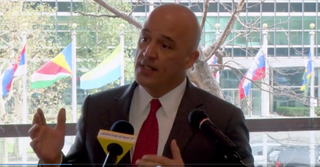
William W. Latimer is an infectious disease epidemiologist. He is the Vice President of the Bronx Campus of Mercy College.
Risky sexual behavior is the description of the activity that will increase the probability that a person engaging in sexual activity with another person infected with a sexually transmitted infection will be infected or become pregnant, or make a partner pregnant. It can mean two similar things: the behavior itself, the description of the partner's behavior. The behavior could be unprotected vaginal, oral, or anal intercourse. The partner could be a nonexclusive partner, HIV-positive, or an person who injects substances. Substance use is associated with risky sexual behaviors.
Mary E. Larimer is an American psychologist and academic. Larimer is a Professor of Psychiatry and Behavioral sciences, Professor or Psychology, and the Director of the Center for the Study of Health & Risk Behaviors at University of Washington (UW). Additionally, she serves as a psychologist at the Psychiatry Clinic at UW Medical Center-Roosevelt.

Lisa Bowleg is an applied social psychologist known for conducting research on intersectionality in social and behavioral science and the relationship between social-contextual factors and stress, resilience, and HIV risk in Black communities.
Angela Denise Bryan is a social psychologist known for her research on HIV/STD prevention, healthy eating habits, and use of legalized cannabis. She is Professor of Psychology and Neuroscience at the University of Colorado Boulder where she co-directs the Center for Health and Neuroscience, Genes, and Environment.

Debra A. Murphy is a Professor Emerita at the University of California, Los Angeles in the Department of Psychiatry.


