Block-oriented terminal

Last updated
IBM 3279 Color Display Terminal IBM-3279.jpg
IBM 3279 Color Display Terminal

A block-oriented terminal or block mode terminal is a type of computer terminal that communicates with its host in blocks of data, as opposed to a character-oriented terminal that communicates with its host one character at a time. The IBM 3270 is perhaps the most familiar implementation of a block-oriented terminal, but most mainframe computer manufacturers and several other companies produced them.

Computer terminal computer input/output device; an electronic or electromechanical hardware device that is used for entering data into, and displaying data from, a computer or a computing system

A computer terminal is an electronic or electromechanical hardware device that is used for entering data into, and displaying or printing data from, a computer or a computing system. The teletype was an example of an early day hardcopy terminal, and predated the use of a computer screen by decades.

A network host is a computer or other device connected to a computer network. A network host may offer information resources, services, and applications to users or other nodes on the network. A network host is a network node that is assigned a network address.

Character-oriented terminal

A character-oriented terminal is a type of computer terminal that communicates with its host one character at a time, as opposed to a block-oriented terminal that communicates in blocks of data. It is the most common type of data terminal, because it's easy to implement and program. Connection to the mainframe computer or terminal server is achieved via RS-232 serial links, Ethernet or other proprietary protocols.

Contents

In a typical application the host sends the terminal a preformatted panel containing both static data and fields into which data may be entered. The terminal operator keys data, such as updates in a database entry (or the device's buffer - 3270), into the appropriate fields. When entry is complete (or ENTER or PF key pressed on 3270's), a block of data, usually just the data entered by the operator (modified data), is sent to the host in one transmission. The 3270 terminal buffer (at the device) could be updated on a single character basis, if necessary, because of the existence of a "set buffer address order" (SBA), that usually preceded any data to be written/overwritten within the buffer. A complete buffer could also be read or replaced using the READ BUFFER command or WRITE Command (unformatted or formatted in the case of the 3270).

A panel is "a particular arrangement of information grouped together for presentation to users in a window or pop-up". In ISPF, a panel is "a predefined display image that you see on a display screen".

Database organized collection of data

A database is an organized collection of data, generally stored and accessed electronically from a computer system. Where databases are more complex they are often developed using formal design and modeling techniques.

Block-oriented terminals have the advantage of causing less system load on the host and less network traffic than character-oriented terminals. On a multi-drop line there is considerable overhead for each transmission which is the same for a single character as for thousands of characters. Block-oriented terminals may also appear more responsive to the user, especially over slow connections, since editing within a field is done locally on the terminal itself rather than depending on echoing from the host system.

Load (computing) amount of computational work performed

In UNIX computing, the system load is a measure of the amount of computational work that a computer system performs. The load average represents the average system load over a period of time. It conventionally appears in the form of three numbers which represent the system load during the last one-, five-, and fifteen-minute periods.

In telecommunications, echo is the local display of data, either initially as it is locally sourced and sent, or finally as a copy of it is received back from a remote destination. Local echo is where the local sending equipment displays the outgoing sent data. Remote echo is where the display is a return copy of data as received remotely. Both are used together in a computed form of error detection to ensure that data received at the remote destination of a telecommunication are the same as data sent from the local source. When (two) modems communicate in echoplex mode the remote modem echoes whatever it receives from the local modem.

Early terminals had limited editing capabilities 3270 terminals, for example, only offered the ability to check data entered into a field defined as numeric. [1] Later so-called "smart" or "intelligent" terminals incorporated microprocessors and supported more local processing.

Common block oriented terminals

IBM 2260 block-oriented computer terminal released by IBM in 1964

The text-only monochrome IBM 2260 cathode ray tube (CRT) video display terminal plus keyboard was a 1964 predecessor to the more-powerful IBM 3270 terminal line which eventually was extended to support color text and graphics.

IBM 3270 family of block-oriented computer terminals introduced by IBM in 1971

The IBM 3270 is a class of block oriented computer terminals introduced by IBM in 1971 normally used to communicate with IBM mainframes. The 3270 was the successor to the IBM 2260 display terminal. Due to the text colour on the original models, these terminals are informally known as green screen terminals. Unlike a character-oriented terminal, the 3270 minimizes the number of I/O interrupts required by transferring large blocks of data known as data streams, and uses a high speed proprietary communications interface, using coaxial cable.

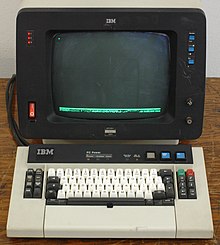
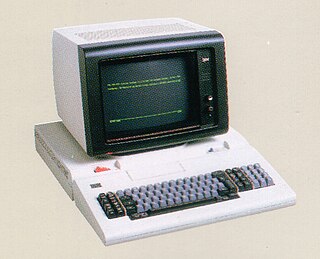
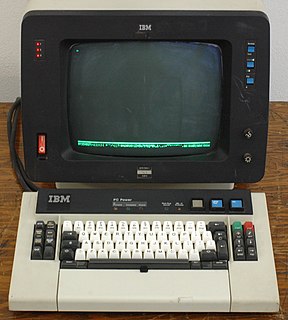
IBM 5250 family of block-oriented terminals used with IBM midrange computer systems (System/34, System/36, System/38, AS/400)

IBM 5250 is a family of block-oriented terminals originally introduced with the IBM System/34 midrange computer systems in 1977. It also connects to the later System/36, System/38, and AS/400 and System i systems, and to IBM Power Systems systems running IBM i.

See also

Related Research Articles

Telnet is a protocol used on the Internet or local area network to provide a bidirectional interactive text-oriented communication facility using a virtual terminal connection. User data is interspersed in-band with Telnet control information in an 8-bit byte oriented data connection over the Transmission Control Protocol (TCP).

In telecommunication, an End-of-Transmission character (EOT) is a transmission control character. Its intended use is to indicate the conclusion of a transmission that may have included one or more texts and any associated message headings.

Terminal emulator program that emulates a video terminal

A terminal emulator, terminal application, or term, is a program that emulates a video terminal within some other display architecture. Though typically synonymous with a shell or text terminal, the term terminal covers all remote terminals, including graphical interfaces. A terminal emulator inside a graphical user interface is often called a terminal window.

The Conversational Monitor System is a simple interactive single-user operating system. CMS was originally developed as part of IBM's CP/CMS operating system, which went into production use in 1967. CMS is part of IBM's VM family, which runs on IBM mainframe computers. VM was first announced in 1972, and is still in use today as z/VM.

Text mode is a computer display mode in which content is internally represented on a computer screen in terms of characters rather than individual pixels. Typically, the screen consists of a uniform rectangular grid of character cells, each of which contains one of the characters of a character set. Text mode is contrasted to all points addressable (APA) mode or other kinds of computer graphics modes.

VT52 CRT-based computer terminal introduced by Digital Equipment Corporation (DEC) in July 1974

The VT50 was a CRT-based computer terminal introduced by Digital Equipment Corporation (DEC) in July 1974. It provided a display with 12 rows and 80 columns of upper-case text, and used an expanded set of control characters and forward-only scrolling based on the earlier VT05. DEC documentation of the era refers to the terminals as the DECscope, a name that was otherwise almost never seen.

HP 2640 block-mode serial terminals produced by Hewlett-Packard using the Intel 8008 and 8080 microprocessors

The HP 2640A and other HP 264X models were block-mode "smart" and intelligent ASCII standard serial terminals produced by Hewlett-Packard using the Intel 8008 and 8080 microprocessors.

Uniscope computer terminals used to communicate with Univac mainframes

Uniscope was a class of computer terminals made by Sperry Rand Corporation, Univac Division, and successors since 1964 that were normally used to communicate with Univac mainframes. As such, it was the successor to various models of Teletype. Due to the text color on the original models, these terminals are informally known as green screen terminals.

IBM 2741 IBM hardcopy terminal introduced in 1965

The IBM 2741 is a printing computer terminal that was introduced in 1965. Compared to the teletypewriter machines that were commonly used as printing terminals at the time, the 2741 offers 50% higher speed, much higher quality printing, quieter operation, interchangeable type fonts, and both upper and lower case letters.

Binary Synchronous Communication is an IBM character-oriented, half-duplex link protocol, announced in 1967 after the introduction of System/360. It replaced the synchronous transmit-receive (STR) protocol used with second generation computers. The intent was that common link management rules could be used with three different character encodings for messages. Six-bit Transcode looked backwards to older systems; USASCII with 128 characters and EBCDIC with 256 characters looked forward. Transcode disappeared very quickly but the EBCDIC and USASCII dialects of Bisync continued in use.

ADM-3A

The ADM-3A was an early video display terminal introduced in 1976. It was manufactured by Lear Siegler and had a 12-inch screen displaying 12 or 24 lines of 80 characters. It set a new industry low single unit price of $995. Its "dumb terminal" nickname came from some of the original trade publication advertisements. It quickly became commercially successful because of the rapid increase of computer communications speeds, and because of new minicomputer systems released to the market which required inexpensive operator consoles.

The IBM 2780 and the IBM 3780 are devices developed by IBM to perform Remote Job Entry (RJE) functions. They communicate with the mainframe via Binary Synchronous Communications.

IBM 3101 ASCII-based IBM computer terminal introduced in 1979

The IBM 3101 ASCII Display Station, and IBM's subsequent products, the 3151/315X and 3161/316X, were display terminals with asynchronous serial communication that were used with a variety of IBM and non-IBM computers during the 1980s–90s, especially the data processing terminals on non-IBM minicomputers, IBM Series/1 and IBM AIX computers.

Synchronous transmit-receive (STR) was an early IBM character-oriented communications protocol which preceded Bisync. STR was point-to-point only, and employed a four-of-eight transmission code, communicating at up to 5100 characters per second over half-duplex or full-duplex communication lines.

The IBM WebSphere Host On-Demand Server, or HOD as it is commonly known is a Java application that runs on a Server that is deliverable via modern web servers such as the Apache web server. The application allows the end user to access IBM 3270, IBM 5250 and other Virtual terminals using the Telnet protocol whether through a secure or unsecured mode of communication. The product in its present form runs on AIX, UNIX, HP-UX, i5/OS, Z/OS, Linux, Solaris and Windows Server.

References

  1. IBM Corporation (1972). IBM 3270 Information Display System Component Description (PDF).
  2. "Already over 80,000 winners out there! (advertisement)". Computerworld. January 18, 1982. Retrieved November 27, 2012.
  3. "HP 3000s, IBM CPUs Get On-Line Link". Computerworld. March 24, 1980. Retrieved November 27, 2012.
  4. Lear Siegler Inc. "The ADM-31. A terminal far too smart to be considered Dumb" (PDF). Retrieved November 27, 2012.