Related Research Articles

A boat is a watercraft of a large range of types and sizes, but generally smaller than a ship, which is distinguished by its larger size, shape, cargo or passenger capacity, or its ability to carry boats.
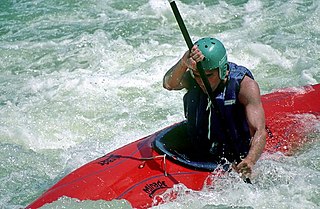
A kayak is a small, narrow human-powered watercraft typically propelled by means of a long, double-bladed paddle. The word kayak originates from the Greenlandic word qajaq.

Mezcal, sometimes spelled mescal, is a distilled alcoholic beverage made from any type of agave. The word mezcal comes from Nahuatl mexcalli, which means "oven-cooked agave", from metl and ixcalli. Traditionally the word "mezcal" has been used generally in Mexico for all agave spirits and it continues to be used for many agave spirits whether these spirits have been legally certified as "mezcal" or not.
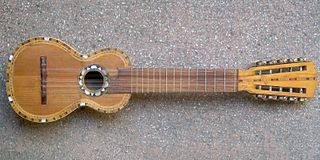
The charango is a small Andean stringed instrument of the lute family, from the Quechua and Aymara populations in the territory of the Altiplano in post-Colonial times, after European stringed instruments were introduced by the Spanish during colonialization. The instrument is widespread throughout the Andean regions of Bolivia, Peru, Ecuador, northern Chile and northwestern Argentina, where it is a popular musical instrument that exists in many variant forms.

Timbales or pailas are shallow single-headed drums with metal casing. They are shallower than single-headed tom-toms and usually tuned much higher, especially for their size. They were developed as an alternative to classical timpani in Cuba in the early 20th century and later spread across Latin America and the United States.

Bongos are an Afro-Cuban percussion instrument consisting of a pair of small open bottomed hand drums of different sizes. The pair consists of the larger hembra and the smaller macho, which are joined by a wooden bridge. They are played with both hands and usually held between the legs, although in some cases, as in classical music, they may be played with sticks or mounted on stands.
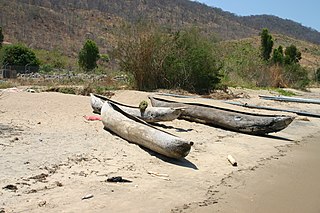
A dugout canoe or simply dugout is a boat made from a hollowed-out tree. Other names for this type of boat are logboat and monoxylon. Monoxylon (μονόξυλον) is Greek – mono- (single) + ξύλον xylon (tree) – and is mostly used in classic Greek texts. In German, they are called Einbaum. Some, but not all, pirogues are also constructed in this manner.

A llanero is a South American herder. The name is taken from the Llanos grasslands occupying eastern Colombia and western-central Venezuela.
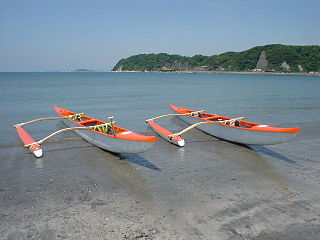
Outrigger boats are various watercraft featuring one or more lateral support floats known as outriggers, which are fastened to one or both sides of the main hull. They can range from small dugout canoes to large plank-built vessels. Outrigger boats can also vary in their configuration, from the ancestral double-hull configuration (catamarans), to single-outrigger vessels prevalent in the Pacific Islands and Madagascar, to the double-outrigger vessels (trimarans) prevalent in Island Southeast Asia. They are traditionally fitted with Austronesian sails, like the crab claw sails and tanja sails, but in modern times are often fitted with petrol engines.
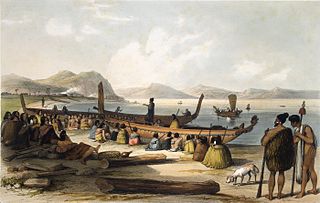
Waka are Māori watercraft, usually canoes ranging in size from small, unornamented canoes used for fishing and river travel to large, decorated war canoes up to 40 metres (130 ft) long.
Bongo may refer to:

The Warao are an indigenous Amerindian people inhabiting northeastern Venezuela, Trinidad and Tobago, Guyana, and Suriname. Alternate common spellings of Warao are Waroa, Guarauno, Guarao, and Warrau. The term Warao translates as "the boat people," after the Warao's lifelong and intimate connection to the water. Most Warao inhabit Venezuela's Orinoco Delta region, with smaller numbers in neighbouring Guyana, Trinidad and Tobago, and Suriname. With a population of 49,271 people in Venezuela during the 2011 census, they were the second largest indigenous group after the Wayuu people. They speak an agglutinative language, Warao.
Aboriginal dugout canoes were a significant advancement in canoe technology. Dugout canoes may have been stronger, faster, and more efficient than previous types of bark canoes. The Australian Aboriginal peoples' use of these canoes brought about many changes to both their hunting practices and society.

Traditionally, many different kinds of boats have been used as fishing boats to catch fish in the sea, or on a lake or river. Even today, many traditional fishing boats are still in use. According to the United Nations Food and Agriculture Organization (FAO), at the end of 2004, the world fishing fleet consisted of about 4 million vessels, of which 2.7 million were undecked (open) boats. While nearly all decked vessels were mechanised, only one-third of the undecked fishing boats were powered, usually with outboard engines. The remaining 1.8 million boats were traditional craft of various types, operated by sail and oars.

A carrying pole, also called a shoulder pole or a milkmaid's yoke, is a yoke of wood or bamboo, used by people to carry a load. This piece of equipment is used in one of two basic ways:
This is a compilation of traditional dances from Nicaragua.

The extensive trade networks of the Ancient Maya contributed largely to the success of their civilization spanning three millennia. Maya royal control and the wide distribution of foreign and domestic commodities for both population sustenance and social affluence are hallmarks of the Maya visible throughout much of the iconography found in the archaeological record. In particular, moderately long-distance trade of foreign commodities from the Caribbean and Gulf Coasts provided the larger inland Maya cities with the resources they needed to sustain settled population levels in the several thousands. Though the ruling class essentially controlled the trade economy, a middle merchant class supervised import and export from cities and trade ports. Not much is known of the Maya merchant class; however, merchants of royal lineage are sometimes represented in the iconography. Notably, a canoe paddle often accompanies the royal merchant depictions, signifying their association with marine resources.

The baston is one of the primary weapons of Arnis and Filipino martial arts. It is also known as yantok, olisi, palo, pamalo, garrote, caña, cane, arnis stick, eskrima stick or simply, stick.

Basketry of Mexico has its origins far into the pre Hispanic period, pre-dating ceramics and the domestication of crops. By the time the Spanish arrived, there were a number of indigenous forms, a number of which are still made today. These and products that the Spanish introduced form the combined tradition that remains today. Like other Mexican handcrafts, sales to tourists and collectors is important, but basketry is not as popular as other handcrafts. Basketry techniques and materials vary from region to region depending on the vegetation available, with important traditions in Sonora, State of Mexico, Michoacán, Veracruz, Oaxaca and the Yucatán Peninsula.

Bangka are various native watercraft of the Philippines. It originally referred to small double-outrigger dugout canoes used in rivers and shallow coastal waters, but since the 18th century, it has expanded to include larger lashed-lug ships, with or without outriggers. Though the term used is the same throughout the Philippines, "bangka" can refer to a very diverse range of boats specific to different regions. Bangka was also spelled as banca, panca, or panga in Spanish. It is also known archaically as sakayan.
References
- ↑ Palenque, Cartagena y Afro-Caribe: historia y lengua, 2013
- ↑ "El bongo es la nave ancestral de los pescadores - El Comercio".
- ↑ "El bongo pescador". 31 July 2015.
- ↑ Carbó, Eduardo Posada (15 October 1989). "Bongos, champanes y vapores en la navegación fluvial colombiana del siglo XIX". Boletín Cultural y Bibliográfico. 27 (21): 2–14.