
The Okavango River, is a river in southwest Africa. It is known by this name in Botswana, and as Cubango in Angola, and Kavango in Namibia. It is the fourth-longest river system in southern Africa, running southeastward for 1,600 km (1,000 mi). It begins at an elevation of 1,300 metres (4,300 ft) in the sandy highlands of Angola. Farther south, it forms part of the border between Angola and Namibia, and then flows into Botswana. The Okavango does not have an outlet to the sea. Instead, it discharges into the Okavango Delta or Okavango Alluvial Fan, in an endorheic basin in the Kalahari Desert. The Cuito River is a major tributary.

The Okavango Delta in Botswana is a vast inland delta formed where the Okavango River reaches a tectonic trough at an altitude of 930–1,000 m in the central part of the endorheic basin of the Kalahari.

Lake Makgadikgadi was a paleolake that existed in what is now the Kalahari Desert in Botswana from 2,000,000 years BP to 10,000 years BP. It may have once covered an area of from 80,000 to 275,000 km2 and was 30 metres (98 ft) deep. The Okavango, Upper Zambezi, and Cuando rivers once all emptied into the lake. Its remains are seen in the Makgadikgadi salt pans, one of the largest salt pans in the world.
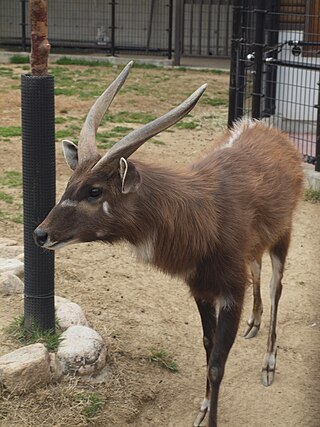
The sitatunga or marshbuck is a swamp-dwelling medium-sized antelope found throughout central Africa, centering on the Democratic Republic of the Congo, the Republic of the Congo, Cameroon, parts of Southern Sudan, Equatorial Guinea, Burundi, Ghana, Botswana, Rwanda, Zambia, Gabon, the Central African Republic, Tanzania, Uganda and Kenya. The sitatunga is mostly confined to swampy and marshy habitats. Here they occur in tall and dense vegetation as well as seasonal swamps, marshy clearings in forests, riparian thickets and mangrove swamps.
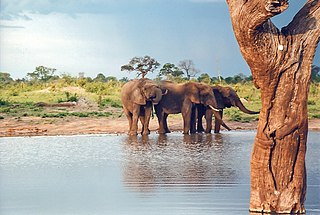
Hwange National Park is the largest natural reserve in Zimbabwe. It is around 14,600 sq km in area. It lies in the northwest of the country, just off the main road between Bulawayo and Victoria Falls. The nearest town is Dete. Histories of the region's pre-colonial days and its development as a game reserve and National Park are available online
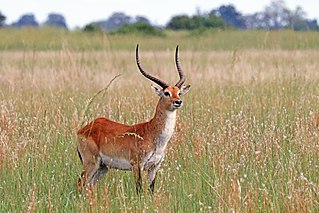
The lechwe, red lechwe, or southern lechwe is an antelope found in wetlands of south-central Africa.

The Kalahari Basin, also known as the Kalahari Depression, Okavango Basin or the Makgadikgadi Basin, is an endorheic basin and large lowland area covering approximately 725,293 km2 (280,037 sq mi) — mostly within Botswana and Namibia, but also parts of Angola, South Africa, Zambia, and Zimbabwe. The outstanding physical feature in the basin, and occupying the centre, is the large Kalahari Desert.
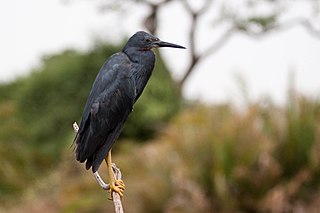
The slaty egret is a small, dark egret found in southern Africa. It is one of the species to which the Agreement on the Conservation of African-Eurasian Migratory Waterbirds (AEWA) applies. It is classified as Vulnerable, the biggest threat being habitat loss.

The blacksmith lapwing or blacksmith plover is a lapwing species that occurs commonly from Kenya through central Tanzania to southern and southwestern Africa. The vernacular name derives from the repeated metallic 'tink, tink, tink' alarm call, which suggests a blacksmith's hammer striking an anvil.

Moremi Game Reserve is a protected area in Botswana. It lies on the eastern side of the Okavango Delta and was named after Chief Moremi of the BaTawana tribe. Moremi was designated as a game reserve, rather than a national park, when it was created. This designation meant that the BaSarwa or Bushmen that lived there were allowed to stay in the reserve.
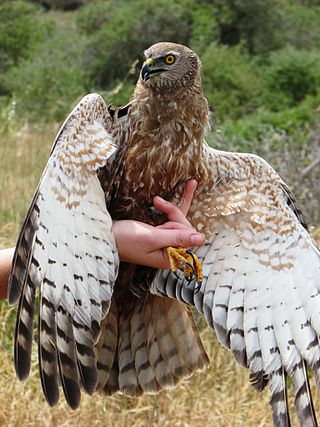
The African marsh harrier is a bird of prey belonging to the harrier genus Circus. It is largely resident in wetland habitats in southern, central and eastern Africa from South Africa north to South Sudan.
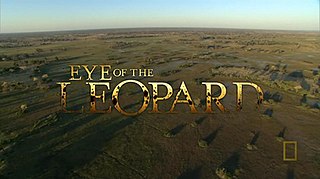
Eye of the Leopard is a 2006 National Geographic documentary directed by Dereck and Beverly Joubert. Set in the Mombo region of the Okavango Delta, Botswana, the film explores the life of a female leopard, Legadema, as she matures from a cub to an adult. Jeremy Irons, voice actor of Scar from Disney's 1994 animation The Lion King, narrates the film. It premiered in the US on the National Geographic Channel on October 8, 2006, and has won many awards including the BBC wildscreen Panda award for Best Sound Wild Screen and an Emmy. Since the success of the film, a book and an app of the same title have been released.

The wildlife of Botswana refers to the flora and fauna of this country. Botswana is around 90% covered in savanna, varying from shrub savanna in the southwest in the dry areas to tree savanna consisting of trees and grass in the wetter areas. Even under the hot conditions of the Kalahari Desert, many species survive; in fact the country has more than 2500 species of plants and 650 species of trees. Vegetation and its wild fruits are also extremely important to rural populations living in the desert and are the principal source of food, fuel and medicine for many inhabitants.

Botswana's principal tourist attractions are its game reserves, with hunting and photographic safaris available. Other attractions include the Okavango Delta region, which during the rainy season is a maze of waterways, islands, and lakes. The tourism industry also helped to diversify Botswana's economy from traditional sources such as diamonds and beef and created 23,000 jobs in 2005.
John McNutt, known as Tico McNutt, started the Wild Dog Research Project in 1989. His research in that field has been supported in part by the National Geographic Society. He received a doctorate in animal behavior from the University of California in 1995. At the time, he founded the Botswana Wild Dog Research Project as little was known about the biology of the African wild dog, though it was believed to be one of the most endangered canine species. Since then, Tico has followed many wild dog packs in Botswana’s Okavango Delta, eventually expanding his studies to include all major predators in the region.

The African wild dog, also known as the painted dog or Cape hunting dog, is a wild canine native to sub-Saharan Africa. It is the largest wild canine in Africa, and the only extant member of the genus Lycaon, which is distinguished from Canis by dentition highly specialised for a hypercarnivorous diet and by a lack of dewclaws.

The Nata Bird Sanctuary, the only protected reserve in the northeastern periphery of Sowa Pan in Botswana, is a community-managed project, with assistance from the Nata Conservation Committee and national and international organizations. Founded in 1988, it opened for operations in 1993; it encompasses an area of 230 square kilometres (89 sq mi), with the objective of conservation of wildlife. The community project is managed by a Trust titled the "Kalahari Conservation Society", which has members drawn from the four villages of Nata, Sepako, Maposa and Manxotae in the vicinity of the sanctuary.
Wilderness is an ecotourism operator, headquartered in Gaborone, Botswana. It operates camps and mobile safaris across seven countries: Botswana, Kenya, Namibia, Rwanda, South Africa, Zambia and Zimbabwe. Known for its ongoing conservation work, the company is helping to conserve some 33 species on the IUCN Red List and lists some 2.5 million hectares as being under protection.

The Southeast African cheetah is the nominate cheetah subspecies native to East and Southern Africa. The Southern African cheetah lives mainly in the lowland areas and deserts of the Kalahari, the savannahs of Okavango Delta, and the grasslands of the Transvaal region in South Africa. In Namibia, cheetahs are mostly found in farmlands. In India, four cheetahs of the subspecies are living in Kuno National Park in Madhya Pradesh after having been introduced there.
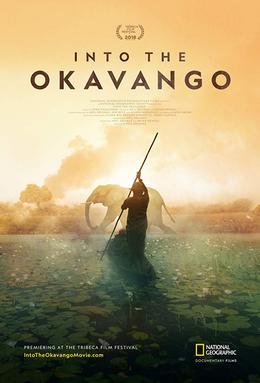
Into the Okavango is a 2018 American National Geographic documentary film written, directed and produced by Neil Gelinas. It focuses on a team of modern-day explorers who go for a 1500 mile, four-month expedition through Angola, Botswana and Namibia to save the Okavango River that joins the Okavango Delta. The film was predominantly shot in Angola and Botswana. It was released on 22 April 2018 and gained critical acclaim for the portrayal of wildlife. It was also screened at a handful of international film festivals and won several awards and nominations.

