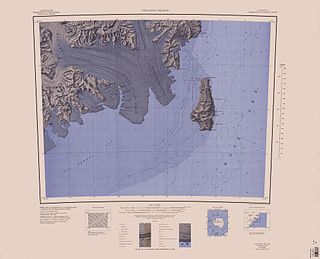
Borchgrevink Glacier is a large glacier in the Victory Mountains, Victoria Land, draining south between Malta Plateau and Daniell Peninsula, and thence projecting into Glacier Strait, Ross Sea, as a floating glacier tongue, the Borchgrevink Glacier Tongue, just south of Cape Jones. It was named by the New Zealand Geological Survey Antarctic Expedition, 1957–58, for Carsten Borchgrevink, leader of the British Antarctic Expedition, 1898–1900. Borchgrevink visited the area in February 1900 and first observed the seaward portion of the glacier.
Shmidt Point is a point marking the north extremity of Arrowsmith Peninsula, which separates Hanusse Bay and Lallemand Fjord on the west coast of Graham Land. First seen and roughly surveyed in 1909 by the French Antarctic Expedition under Charcot. It was sketched from the air in 1937 by the British Graham Land Expedition (BGLE) under Rymill. Named in 1954 by the United Kingdom Antarctic Place-Names Committee (UK-APC) for Professor Otto Schmidt, director of the Arctic Institute at Leningrad in 1930-32, head of the Chief Administration of the Northern Sea Route in 1932-39, and leader of many Arctic expeditions.

Sabine Glacier is a 13.5 km long glacier on the north side of Detroit Plateau, flowing from Mount Bris and Tsarevets Buttress northwards along the east slopes of Korten Ridge, and terminating at the sea in Jordanoff Bay on Davis Coast in Graham Land, Antarctica. Captain Henry Foster gave the name "Cape Sabine" in 1829 to a feature lying southeast of Cape Kater but it has not been possible to identify that cape. This toponym preserves the early use of Sabine in this area. Sir Edward Sabine (1788-1883), English astronomer and geodesist, was a member of the committee which planned the 1829 voyage of Foster in the Chanticleer.
Meander Glacier is a large meandering tributary to Mariner Glacier in Victoria Land, Antarctica. The glacier emerges in the vicinity of Mount Supernal and Hobbie Ridge and drains generally eastward for 30 nautical miles (56 km) through the Mountaineer Range to join Mariner Glacier just east of Engberg Bluff. The descriptive name was given by the New Zealand Geological Survey Antarctic Expedition, 1962–63.

Acosta Glacier is a glacier about 2 miles (3 km) long flowing north from Thurston Island just east of Dyer Point in Antarctica. It was named by the Advisory Committee on Antarctic Names (US-ACAN) after Alex V. Acosta of the United States Geological Survey (USGS) in Flagstaff, Arizona. He is a computer and graphic specialist, and was part of the USGS team that compiled the 1:5,000,000-scale Advanced Very High Resolution Radiometer satellite image maps of Antarctica and the 1:250,000-scale Landsat image maps of the Siple Coast area in the 1990s.

Carey Glacier is a glacier on the east side of Miller and Fruzhin Peaks and west of Ruset and Malkoch Peaks in Petvar Heights at the southeast end of the Sentinel Range, Ellsworth Mountains, flowing southeast to Minnesota Glacier. It was mapped by the United States Geological Survey from surveys and from U.S. Navy air photos, 1957–59, and named by the Advisory Committee on Antarctic Names for Lieutenant David W. Carey, pilot with U.S. Navy Squadron VX-6, who was killed in the crash of a P2V Neptune airplane at McMurdo Sound in October 1956.

Orford Cliff is a coastal cliff of Pernik Peninsula, Loubet Coast in Graham Land, overlooking the east side of Lallemand Fjord just east of Andresen Island. Surveyed by Falkland Islands Dependencies Survey (FIDS) in 1956. Named for Michael J.H. Orford, FIDS assistant surveyor at Detaille Island in 1956, a member of the party which found a route from Detaille Island to Avery Plateau, via Orford Cliff and Murphy Glacier.
Naess Glacier is a small glacier, which is separated from Chapman Glacier to the north by a rocky ridge, flowing from the west coast of Palmer Land into George VI Sound. First surveyed in 1936 by the British Graham Land Expedition (BGLE) under Rymill. Named by the United Kingdom Antarctic Place-Names Committee (UK-APC) in 1954 for Erling D. Naess, Mgr. of the Vestfold Whaling Co., who was of great assistance to the BGLE, 1934-37.
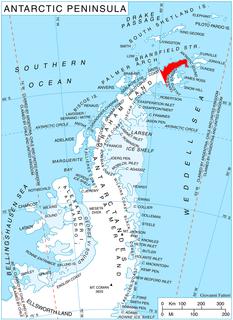
Whitecloud Glacier is a glacier which flows northward between Klokotnitsa Ridge on the east and Tsarevets Buttress on the west to discharge into Charcot Bay just west of Almond Point, Trinity Peninsula. Named by United Kingdom Antarctic Place-Names Committee (UK-APC) in 1960. The name is descriptive of cloud conditions that prevailed at the time of Falkland Islands Dependencies Survey (FIDS) survey of the area in 1948.
Cumpston Glacier is a small glacier on the east coast of Graham Land, draining between Breitfuss Glacier and Quartermain Glacier into the head of Mill Inlet. It was named by the UK Antarctic Place-Names Committee for J.S. Cumpston, an Australian historian of the Antarctic.
Tragic Corner is a bluff rising to about 750 m and marking the northeast end of Boulding Ridge, located between Todd Glacier and McClary Glacier on Fallières Coast. So named by United Kingdom Antarctic Place-Names Committee (UK-APC) because Thomas J. Allan and John Fraser Noel died in the vicinity as a result of an accident on a sledge journey from Stonington Island in May 1966.
Parrish Peak is a very pointed, partly snow-topped peak, 1,775 m, surmounting the ridge next south of Seal Glacier in the Enterprise Hills, Heritage Range. It was mapped by the United States Geological Survey (USGS) from surveys and U.S. Navy air photos from 1961-66. It was named by the Advisory Committee on Antarctic Names (US-ACAN) for Edward N. Parrish, a glaciologist on the United States Antarctic Research Program (USARP) South Pole—Queen Maud Land Traverse I and II, 1964–65 and 1965-66.

Mincer Glacier is a broad glacier flowing from Zuhn Bluff into the southeast arm of Murphy Inlet on the north side of Thurston Island, Antarctica. It was named by the Advisory Committee on Antarctic Names after Lieutenant Dale F. Mincer, a co-pilot of PBM Mariner aircraft in the Eastern Group of U.S. Navy Operation Highjump, which obtained aerial photographs of Thurston Island and adjacent coastal areas in 1946–47.

McCance Glacier is the 30-km long and 5 km wide glacier draining the Hutchison Hill area on the west slopes of Avery Plateau on Loubet Coast in Graham Land, Antarctica. It flows north-northwestwards along the west side of Osikovo Ridge, Kladnitsa Peak and Rubner Peak and enters Darbel Bay.
Spear Glacier is a glacier between the Hauberg Mountains and Peterson Hills, in southern Palmer Land. Mapped by United States Geological Survey (USGS) from surveys and U.S. Navy air photos, 1961-67. Named by Advisory Committee on Antarctic Names (US-ACAN) for Milton B. Spear, construction electrician at Eights Station in 1965.
Reynolds Glacier is a glacier 5 nautical miles (9 km) long, flowing eastward from the Haines Mountains along the south side of Keyser Nunatak to enter the Hammond Glacier, in Marie Byrd Land. Mapped by United States Geological Survey (USGS) from surveys and U.S. Navy air photos, 1959-65. Named by Advisory Committee on Antarctic Names (US-ACAN) for Donald K. Reynolds, ionospheric physicist at Byrd Station, 1967-68 season.
Vaughan Glacier is a tributary glacier, 10 nautical miles (18 km) long, draining eastward from Mount Vaughan to enter Scott Glacier just south of Taylor Ridge, in the Hays Mountains of the Queen Maud Mountains. It was mapped by the United States Geological Survey (USGS) from surveys and U.S. Navy air photos, 1960–64, and was named by the Advisory Committee on Antarctic Names (US-ACAN) in association with Mount Vaughan.

Rickmers Glacier is a glacier flowing into Hugi Glacier just northwest of Ezerets Knoll, on the west coast of Graham Land. Photographed by Hunting Aerosurveys Ltd. in 1955-57, and mapped from these photos by the Falkland Islands Dependencies Survey (FIDS). Named by the United Kingdom Antarctic Place-Names Committee (UK-APC) in 1959 for W. Rickmer Rickmers, German pioneer exponent of skiing and joint author of the first English manual on skiing. He also improved the design of ice axes, introducing the characteristic shape still in use.
Romulus Glacier is a glacier, 7 nautical miles (13 km) long and 2 nautical miles (3.7 km) wide, which flows from the north slopes of Mount Lupa westward to Rymill Bay between the Blackwall Mountains and Black Thumb, on the west coast of Graham Land. First surveyed in 1936 by the British Graham Land Expedition (BGLE) under Rymill. Resurveyed in 1948-49 by the Falkland Islands Dependencies Survey (FIDS), who so named it for its association with Remus Glacier, whose head lies near the head of this glacier.

Anderson Glacier is a heavily crevassed glacier 12 nautical miles (22 km) long, flowing southeast into Cabinet Inlet between Cape Casey and Balder Point, on the east coast of Graham Land. It was charted by the Falklands Islands Dependencies Survey (FIDS) and photographed from the air by the Ronne Antarctic Research Expedition in December 1947. It was named by FIDS for Sir John Anderson, M.P., Lord President of the Council and member of the British War Cabinet.