The music of the Isle of Man reflects Celtic, Norse and other influences, including those from its neighbours, Scotland, Ireland, England and Wales. The Isle of Man is a small island nation in the Irish Sea, between Great Britain and Ireland.

The Manx Labour Party is a political party on the Isle of Man that was founded in 1918.
The culture of the Isle of Man is influenced by its Celtic and, to a lesser extent, its Norse origins, though its close proximity to the United Kingdom, popularity as a UK tourist destination, and recent mass immigration by British migrant workers has meant that British influence has been dominant since the Revestment period. Recent revival campaigns have attempted to preserve the surviving vestiges of Manx culture after a long period of Anglicisation, and significant interest in the Manx language, history and musical tradition has been the result.
The Manx are an ethnic group originating on the Isle of Man in the Irish Sea in northern Europe. Their native culture has significant Norse, Gaelic and English influences. The Manx language descends from Middle Irish.
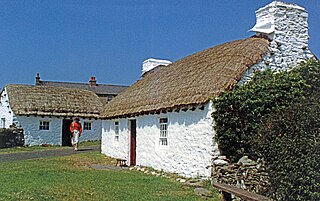
Cregneash or Cregneish is a small village and tourist destination in the extreme south-west of the Isle of Man, about 1 mi (2 km) from Port Erin. Most of the village is now part of a living museum run by Manx National Heritage. There are also a number of private homes in the village, but their external appearance is controlled to maintain an older look. The village was also home to prominent Manx language speakers, Edward Faragher and Ned Maddrell.

Hop-tu-Naa is a Celtic festival celebrated in the Isle of Man on 31 October. It is the celebration of the traditional Celtic festival of Samhain, the start of winter. It is thought to be the oldest unbroken tradition in the Isle of Man.
Thomas Brian Stowell also known as Brian Mac Stoyll was a Manx radio personality, linguist, physicist and author. He was formerly Yn Lhaihder to the Parliament of the Isle of Man, Tynwald. He is considered one of the primary people behind the revival of the Manx language.
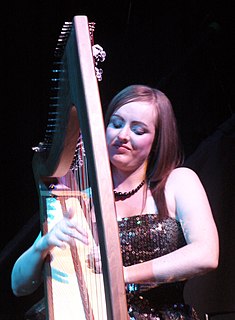
Rachel Hair is a folk harpist from Scotland. She plays the Celtic harp, also known by the Scottish Gaelic word clarsach.

Mona Douglas was a Manx cultural activist, folklorist, poet, novelist and journalist. She is recognised as the main driving force behind the modern revival of Manx culture and is acknowledged as the most influential Manx poet of the 20th century, but she is best known for her often controversial work to preserve and revive traditional Manx folk music and dance. She was involved in a great number of initiatives to revive interest and activity in Manx culture, including societies, classes, publications and youth groups. The most notable and successful of these was Yn Chruinnaght.
Aeglagh Vannin was a youth group in the Isle of Man whose purpose was the engagement with and revitalisation of Manx language, history and culture. It was established by Mona Douglas in 1931, went through a number of mutations, and faded out in the 1970s. It is best remembered for its central role in the revival of Manx folk dancing.

Culture Vannin is the trading name for the Manx Heritage Foundation, established in 1982 by the Isle of Man Government to promote Manx culture, heritage and language. It was rebranded in February 2014, having previously been known as the "Manx Heritage Foundation", since the former title "held connotations more towards the cultural history of the island" which were not felt to be accurate to the organisation's progressive approach to invigorating Manx culture. Culture Vannin's motto is "Taking our culture forward".
Colin Jerry was a Manx cultural activist best known for his contributions to Manx music through his books, Kiaull yn Theay, published in two volumes. He was awarded the Reih Bleeaney Vanannan in 1991 for his contributions to Manx culture which were 'extensive and staggering.'
Yn Çheshaght Ghailckagh, also known as the Manx Language Society and formerly known as Manx Gaelic Society, was founded in 1899 in the Isle of Man to promote the Manx language. The group's motto is Gyn çhengey, gyn çheer.
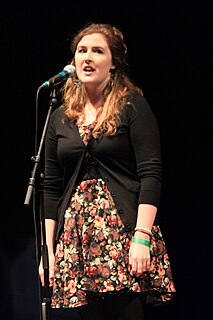
Ruth Keggin is a Manx Gaelic singer-songwriter. She holds degrees from the University of York and the University of Cambridge.
Hop-tu-naa is a traditional Manx dance connected to the hop-tu-naa festivities around 31 October in the Isle of Man. It is a simple processional dance for any number of two pairs of dancers. The dance shares its name with the festivities and the music to which the dance is connected.

Hunt the Wren is a traditional custom carried out on the Isle of Man on the 26 December, St. Stephen's Day. It consists of groups of people going around villages and towns singing and dancing a traditional song and dance around a decorated wren pole.
The Flitter Dance is a traditional dance from the Isle of Man associated with Good Friday. It was collected by Mona Douglas in the 1940s or 50s and is popular among younger Manx dancers today.
Doug Fargher also known as Doolish y Karagher or Yn Breagagh, was a Manx language activist, author, and radio personality who was involved with the revival of the Manx language on the Isle of Man in the 20th century. He is best known for his English-Manx Dictionary (1979), the first modern dictionary for the Manx language. Fargher was involved in the promotion of Manx language, culture and nationalist politics throughout his life.

Shennaghys Jiu(English: Tradition Today) is a four-day youth music and performing arts festival on the Isle of Man. The festival's aim is to give young performers of traditional Manx music and dance the opportunity to come together in a non-competitive environment, and share culture with the other Celtic nations.
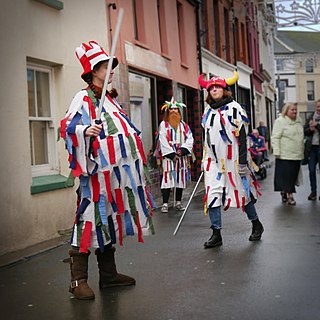
The White Boys is the traditional mummers' play of the Isle of Man.