Related Research Articles

Alex Michael Azar Jr. is an American politician, attorney and former pharmaceutical executive who served as the United States Secretary of Health and Human Services from 2018 to 2021. Azar was nominated to his post by President Donald Trump on November 13, 2017, and confirmed by the United States Senate on January 24, 2018. He was also Chairman of the White House Coronavirus Task Force from its inception in January 2020 to February 2020, when he was replaced by Vice President Mike Pence.
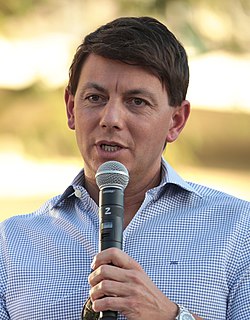
John Hogan Gidley is an American political aide who served as White House Deputy Press Secretary from 2019 to 2020. He previously served as a Junior Deputy Press Secretary from 2017 to 2019. In July 2020, Gidley became the press secretary of President Donald Trump's reelection campaign.
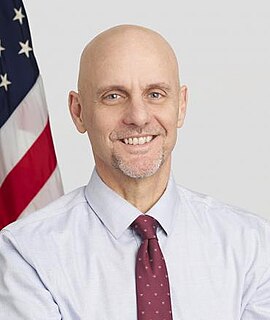
Stephen Michael Hahn is an American physician who served as the Commissioner of Food and Drugs from 2019 to 2021. Before becoming Commissioner, he was a radiation oncologist serving as Chief Medical Executive of the MD Anderson Cancer Center.

Hope Charlotte Hicks is an American public relations executive and political advisor who served in President Donald Trump’s administration from 2017 to 2018 and 2020 to 2021. She served as White House Director of Strategic Communications from January to September 2017 and as White House Communications Director from 2017 to 2018. Hicks served as a Counselor to the President from 2020 to 2021.

Kayleigh McEnany is an American political commentator and author who served as the 33rd White House press secretary for the Trump administration from April 2020 to January 2021.

Tony Sayegh served as a White House Senior Advisor for Strategy until February 2020, and is a former Assistant Secretary for Public Affairs for the U.S. Department of the Treasury, serving from March 6, 2017 to June 2019. He led the department's Office of Public Affairs. During the passage of the Tax Cuts And Jobs Act, Sayegh was detailed to the White House Office of Communications appearing numerous times in the media to promote the passage of comprehensive tax reform. Sayegh was a Republican strategist and contributor for the Fox News Channel prior to joining the administration, and served as Executive Vice President at Jamestown Associates from 2013 to 2017.
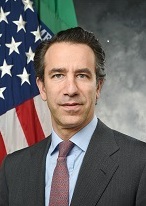
Justin George Muzinich is an American businessman and Trump administration official who served as the United States Deputy Secretary of the Treasury, from December 2018 to January 2021. Muzinich previously served as the Counselor to the Secretary at the United States Department of the Treasury. Prior to that, he served as Policy Director for the Presidential Campaign of Jeb Bush.
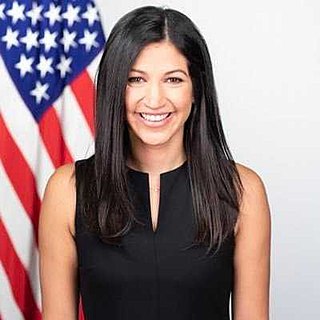
Katie Rose Miller is an American political advisor who served as the communications director for the Vice President of the United States Mike Pence from March 2020 to the end of the term. She was previously his press secretary from October 2019 to March 2020.
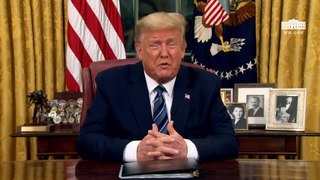
The March 2020 Oval Office Address, officially titled On the Coronavirus Pandemic, was the second Oval Office address delivered during the presidency of Donald Trump. It was released during the rapidly spreading COVID-19 pandemic and the 2020 stock market crash.

The COVID-19 pandemic has impacted politics, both international and domestic, by affecting the governing & political systems of multiple countries, causing suspensions of legislative activities, isolation or deaths of multiple politicians and reschedulings of elections due to fears of spreading the virus. The pandemic has triggered broader debates about political issues such as the relative advantages of democracy and autocracy, how states respond to crises, politicization of beliefs about the virus, and the adequacy of existing frameworks of international cooperation. Additionally, the pandemic has, in some cases, posed several challenges to democracy, leading to it being fatally undermined and damaged.
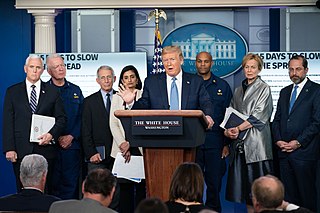
The White House Coronavirus Task Force was the United States Department of State task force during the Trump administration that "coordinate[d] and overs[aw] the administration's efforts to monitor, prevent, contain, and mitigate the spread" of coronavirus disease 2019 (COVID-19). Also referred to as the President's Coronavirus Task Force, it was established on January 29, 2020, with Secretary of Health and Human Services Alex Azar as chair. On February 26, 2020, U.S. vice president Mike Pence was named to chair the task force, and Deborah Birx was named the response coordinator.

The Special Inspector General for Pandemic Recovery (SIGPR) is an Inspector General position created by the Coronavirus Aid, Relief, and Economic Security (CARES) Act of 2020 to oversee spending of government funds in response to the COVID-19 pandemic in the United States. The position was included at the insistence of Congressional Democrats. The SIGPR is nominated by the President and confirmed by the Senate.

The COVID-19 pandemic has affected international relations and caused diplomatic tensions, as well as resulted in a United Nations Security Council resolution demanding a global ceasefire. Some scholars have argued that the pandemic necessitates a significant rethinking of existing approaches to international relations, with a greater focus on issues such as health diplomacy, the politics of crisis, and border politics. Others have argued that the pandemic is unlikely to lead to significant changes in the international system. Diplomatic relations have been affected due to tensions around trade and transport of medicines, diagnostic tests and hospital equipment for coronavirus disease 2019. Leaders of some countries have accused other countries for not containing the disease effectively and resulting in the uncontrolled spread of the virus. Developing nations in Latin America and Africa cannot find enough materials for testing for coronavirus disease, partly because the United States and countries in Europe are outspending the resources.
The Donald Trump administration conducted various forms of communication during the COVID-19 pandemic in the United States, including via social media, interviews, and press conferences with the White House Coronavirus Task Force. Opinion polling indicated that less than 50% of Americans trusted information provided by Trump regarding the COVID-19 pandemic, as opposed to local government officials, state government officials, the Centers for Disease Control and Prevention (CDC), and National Institute of Allergy and Infectious Diseases director Dr. Anthony Fauci.

Scott William Atlas is an American radiologist, political commentator, and health care policy advisor. He is a senior fellow at Stanford University's Hoover Institution, a conservative think tank. From 1998 to 2012 he was a professor and chief of neuroradiology at the Stanford University Medical Center.

The wearing of non-medical face masks in public to lessen transmission of COVID-19 in the United States was first recommended by the CDC on April 3, 2020 as supplemental to hygiene and appropriate social distancing. Over the course of the pandemic, various states, counties, and municipalities have issued health orders requiring the wearing of non-medical face coverings — such as cloth masks — in spaces and/or businesses accessible to the public, especially when physical distancing is not possible. Some areas only mandated their use by public-facing employees of businesses, although these narrower orders have since been superseded in multiple states by a general mandate.
The federal government of the United States initially responded to the COVID-19 pandemic in the country with various declarations of emergency, some of which led to travel and entry restrictions, and the formation of the White House Coronavirus Task Force. As the pandemic progressed in the U.S. and throughout the rest of the world, the U.S. government began issuing recommendations regarding the response by state and local governments, as well as social distancing measures and workplace hazard controls. Following the closure of most businesses throughout a number of U.S. states, President Donald Trump announced the mobilization of the National Guard in the most affected areas.

The administration of 45th President of the United States Donald Trump repeatedly politicized science by pressuring or overriding health and science agencies to change their reporting and recommendations so as to conform to his policies and public comments. This was particularly true with regard to the COVID-19 pandemic in the United States.

The White House COVID-19 outbreak was a cluster of SARS-CoV-2 infections that began in September 2020 and ended in January 2021 that spread among people, including many U.S. government officials, who were in close contact during the COVID-19 pandemic in Washington, D.C. Numerous high-profile individuals were infected, including President Donald Trump, who was hospitalized for three days. At least 48 White House staff members or associates, closely working with White House personnel, have tested positive for the virus. The White House resisted efforts to engage in contact tracing, leaving it unclear how many people were infected in total and what the origins of the spread were.
Misinformation related to the COVID-19 pandemic by the United States consists of disinformation about the COVID-19 pandemic propagated by officials of the United States government. The Trump administration in particular made a large number of misleading statements about the pandemic. A Cornell University study found that U.S. President Donald Trump was "likely the largest driver" of the COVID-19 misinformation infodemic in English-language media. Others have also been cited as spreading misinformation, including U.S. senators and New York City mayor Bill de Blasio.
References
- ↑ Staff, Politico. "BIRTHDAY OF THE DAY: Brian Morgenstern, White House deputy comms director and deputy press secretary". POLITICO. Retrieved 2020-09-06.
- ↑ Perlman, Derek Kravitz,Al Shaw,Claire. "Brian Robert Morgenstern | Trump Town". ProPublica. Retrieved 2020-07-29.
- ↑ "Brian R. Morgenstern, Lawyer at Gibson, Dunn & Crutcher LLP | LawyerDB.org". www.lawyerdb.org. Retrieved 2020-07-29.
- ↑ "GUSA official steps down". The Georgetown Voice. 2003-09-11. Retrieved 2020-07-29.
- ↑ "Alpha Kappa Delta Honor Society". Department of Sociology. Retrieved 2020-07-29.
- ↑ Campbell, Colin. "New York Young Republican Resigns After Worrying About The 'United States Of Gaymeria'". Business Insider. Retrieved 2020-09-06.
- ↑ Drucker, Jesse; Tankersley, Jim (2019-12-30). "How Big Companies Won New Tax Breaks From the Trump Administration". The New York Times. ISSN 0362-4331 . Retrieved 2020-07-29.
- ↑ Summary of Public Stakeholder Briefings on Proposed Regulations Implementing FIRRMA by Senior Treasury Officials
- ↑ "White House adds top Treasury aide to press team". POLITICO. Retrieved 2020-07-29.
- ↑ Palmer, Anna; Sherman, Jake. "POLITICO Playbook: Warning: Turbulence ahead". POLITICO. Retrieved 2020-07-29.
- ↑ Jacobs, Emily (2020-07-21). "Trump campaign sees more staff shake-ups after Brad Parscale demotion". New York Post. Retrieved 2020-07-29.
- ↑ Chalfant, Morgan. "Trump spokesman repeatedly dodges questions on last negative coronavirus test". The Hill. Retrieved 12 October 2020.
- ↑ Rieger, JM. "The White House has dodged questions for six straight days about when Trump last tested negative for the coronavirus". The Washington Post. Retrieved 12 October 2020.
- ↑ Collins, Michael. "Trump claims he no longer has COVID-19 as White House dodges questions on whether he has tested negative". USA Today. Retrieved 12 October 2020.
- ↑ Waller, John. "Video: MSNBC's Hallie Jackson presses White House deputy press secretary on Trump's last negative COVID-19 test for over 5 minutes". The Boston Globe. Retrieved 12 October 2020.
- ↑ Burnett, Eric. "White House official shares how staff is interacting with Trump". CNN. Retrieved 12 October 2020.
- ↑ Jackson, Hallie. "WH press official repeatedly pressed over date of Trump's last negative Covid test". MSNBC. Retrieved 12 October 2020.
- ↑ Simmons-Duffin, Selena. "The Many, Maddening Hurdles To Contact Tracing The White House Outbreak". NPR. Retrieved 12 October 2020.
- ↑ Seddiq, Oma. "White House spokesman refuses to answer when Trump's last negative COVID-19 test was 6 times in one interview". Business Insider. Retrieved 12 October 2020.
- ↑ "White House spokesman sidesteps question on Trump's last negative coronavirus test". MSN. Retrieved 12 October 2020.