Bridal Veil Falls, Bridalveil Falls or Bridalveil Fall is a frequently-used name for waterfalls that observers fancy resemble a bride's veil:

Macon County is a county located in the U.S. state of North Carolina. As of the 2010 census, the population was 33,922. Its county seat is Franklin.

Franklin is a town in and the county seat of Macon County, North Carolina. It is situated within the Nantahala National Forest. The population was estimated to be 4,105 in 2019, an increase from 3,845 reported in the 2010 census.

The Bridal Veil Falls is the smallest of the three waterfalls that make up Niagara Falls. It is located on the American side ; Luna Island separates it from the American Falls and Goat Island separates it from the Horseshoe Falls. The Bridal Veil Falls faces to the northwest and has a crest 56 ft (17 m) wide. Luna Island being very small, the Bridal Veil is similar in appearance to the American Falls, starting with a vertical fall of 78 ft (24 m), followed by the water violently descending the talus boulders to the Maid of the Mist pool 103 ft (31 m) below. The total vertical drop is 181 ft (55 m). The crest elevation of the Falls is 508 ft (155 m).

Beira is the capital and largest city of Sofala Province, where the Pungwe River meets the Indian Ocean, in the central region of Mozambique. It is the fourth-largest city by population in Mozambique, after Maputo, Matola and Nampula. Beira had a population of 397,368 in 1997, which grew to 530,604 in 2019. A coastal city, it holds the regionally significant Port of Beira, which acts as a gateway for both the central interior portion of the country as well as the land-locked nations of Zimbabwe, Zambia and Malawi.

Chimanimani District is a mountainous district in Manicaland Province of eastern Zimbabwe. The district headquarters is the town of Chimanimani.

Billings is a township in the Canadian province of Ontario, as well as the name of a community within that township.
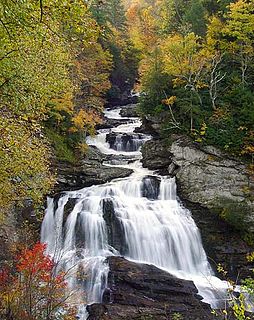
Cullasaja Falls is a waterfall in southwestern North Carolina. The waterfall is located on the Cullasaja River in the Nantahala National Forest and is part of the Mountain Waters Scenic Byway. Cullasaja comes from a Cherokee word meaning "honey locust place".
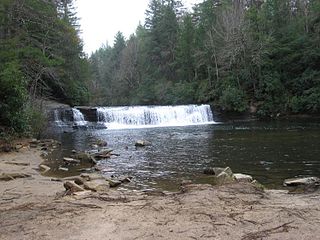
Hooker Falls is a 14-foot waterfall located in the DuPont State Forest, southeast of Brevard, North Carolina.

Bridal Veil Fall is a waterfall in Banff National Park, Alberta, Canada. It originates in the Huntington Glacier on the slopes of Cirrus Mountain. Its waters drain into Nigel Creek, then into the North Saskatchewan River at the Big Bend of the Icefields Parkway.

Zimbabwe boasts several tourist attractions, located in almost every region of the country. Before the economic changes, much of the tourism for these locations came to the Zimbabwean side but now Zambia benefits from the tourism. The Victoria Falls National Park is also a tourist attraction in this area and is one of the eight main National Parks in Zimbabwe, largest of which is Hwange National Park.

Chimanimani is a town in Zimbabwe.
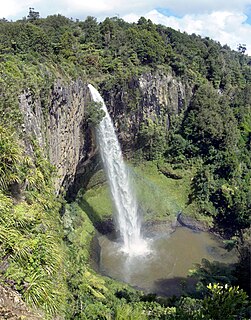
Wairēinga / Bridal Veil Falls is a plunge waterfall located along the Pakoka River in the Waikato area of New Zealand. The waterfall is 55 m (180 ft) high, and has over time caused the formation of a large pool at the base of the waterfall. The falls are in the 217 ha Wairēinga Scenic Reserve with tawa-dominated forest.

Havasu Creek is a stream in the U.S. state of Arizona associated with the Havasupai people. It is a tributary to the Colorado River, which it enters in the Grand Canyon.

The Bridal Veil Falls is six kilometres outside Sabie, Mpumalanga in South Africa. It is 70 metres high. The falls is slow flowing under normal conditions making it appear like a veil, hence its name. It is one of many waterfalls in the area that is located on the Sabie River and is a popular tourist destination. It is accessible by car, with parking and a picnic area on SAFCOL's grounds. Local curio dealers sell arts and crafts from the car park area. From the car park, a footpath runs through indigenous forest for about 750 metres directly to the waterfall.
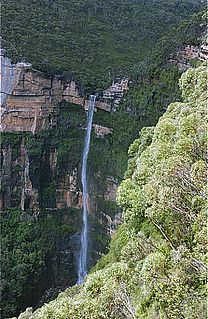
The Govetts Leap Falls, also called the Bridal Veil Falls or simply Govetts Leap, is a bridal veil waterfall on the Govetts Leap Brook where it falls over Taylor Wall, located at Govetts Leap Lookout, approximately 2.4 kilometres (1.5 mi) east of Blackheath in the Blue Mountains region of New South Wales, Australia.

The Bridal Veil Falls is a cascade waterfall on the Leura Falls Creek where it spills into the Jamison Valley, located south-east of Leura in the Blue Mountains region of New South Wales, Australia.

Intense Tropical Cyclone Idai was one of the worst tropical cyclones on record to affect Africa and the Southern Hemisphere. The long-lived storm caused catastrophic damage, and a humanitarian crisis in Mozambique, Zimbabwe, and Malawi, leaving more than 1,300 people dead and many more missing. Idai is the deadliest tropical cyclone recorded in the South-West Indian Ocean basin. In the Southern Hemisphere, which includes the Australian, South Pacific, and South Atlantic basins, Idai ranks as the second-deadliest tropical cyclone on record. The only system with a higher death toll is the 1973 Flores cyclone that killed 1,650 off the coast of Indonesia.

Severe Tropical Storm Chalane was the first of three consecutive tropical cyclones that struck Mozambique in the 2020-21 South-West Indian Ocean cyclone season. As the fourth tropical depression, third named storm, and second severe tropical storm of the season, Chalane developed out of a zone of disturbed weather which was first monitored RSMC La Réunion on 19 December. Despite conditions slowly becoming unfavorable, the system formed into a tropical depression on 23 December due to the presence of a Kelvin wave and an equatorial Rossby wave, as well as warm sea surface temperatures. The depression soon strengthened into Tropical Storm Chalane on the following day. Chalane made landfall on Madagascar on 26 December and weakened, before emerging into the Mozambique Channel a couple days later. Subsequently, Chalane restrengthened, before making landfall on Mozambique on 30 December. The system weakened as it moved inland, degenerating into a remnant low later that day. However, Chalane's remnants continued moving westward for another several days, emerging into the South Atlantic on 3 January, before dissipating later that day.


