
Network topology is the arrangement of the elements of a communication network. Network topology can be used to define or describe the arrangement of various types of telecommunication networks, including command and control radio networks, industrial fieldbusses and computer networks.

A radio-controlled model is a model that is steerable with the use of radio control (RC). All types of model vehicles have had RC systems installed in them, including ground vehicles, boats, planes, helicopters and even submarines and scale railway locomotives.

In electronics, a remote control is an electronic device used to operate another device from a distance, usually wirelessly. In consumer electronics, a remote control can be used to operate devices such as a television set, DVD player or other digital home media appliance. A remote control can allow operation of devices that are out of convenient reach for direct operation of controls. They function best when used from a short distance. This is primarily a convenience feature for the user. In some cases, remote controls allow a person to operate a device that they otherwise would not be able to reach, as when a garage door opener is triggered from outside.

Radio control is the use of control signals transmitted by radio to remotely control a device. Examples of simple radio control systems are garage door openers and keyless entry systems for vehicles, in which a small handheld radio transmitter unlocks or opens doors. Radio control is also used for control of model vehicles from a hand-held radio transmitter. Industrial, military, and scientific research organizations make use of radio-controlled vehicles as well. A rapidly growing application is control of unmanned aerial vehicles for both civilian and military uses, although these have more sophisticated control systems than traditional applications.

An antenna tuner is a passive electronic device inserted into the feedline between a radio transmitter and its antenna. Its purpose is to optimize power transfer by matching the impedance of the radio to the signal impedance at the end of the feedline connecting the antenna to the transmitter.
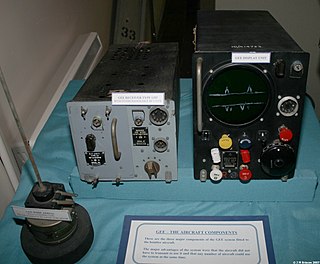
Gee, sometimes written GEE, was a radio navigation system used by the Royal Air Force during World War II. It measured the time delay between two radio signals to produce a fix, with accuracy on the order of a few hundred metres at ranges up to about 350 miles (560 km). It was the first hyperbolic navigation system to be used operationally, entering service with RAF Bomber Command in 1942.

A diving bell is a rigid chamber used to transport divers from the surface to depth and back in open water, usually for the purpose of performing underwater work. The most common types are the open-bottomed wet bell and the closed bell, which can maintain an internal pressure greater than the external ambient. Diving bells are usually suspended by a cable, and lifted and lowered by a winch from a surface support platform. Unlike a submersible, the diving bell is not designed to move under the control of its occupants, or to operate independently of its launch and recovery system.

A trainer is a class of aircraft designed specifically to facilitate flight training of pilots and aircrews. The use of a dedicated trainer aircraft with additional safety features—such as tandem flight controls, forgiving flight characteristics and a simplified cockpit arrangement—allows pilots-in-training to safely advance their skills in a more forgiving aircraft.
Futaba Corporation is a Japanese company founded in 1948, originally to produce vacuum tubes. As time passed, production and elemental techniques of the vacuum tube transformed into the manufacturing of vacuum fluorescent displays (VFDs), tool and die set components, radio control equipment and OLED displays.
The Joint Electronics Type Designation System (JETDS), which was previously known as the Joint Army-Navy Nomenclature System (AN System. JAN) and the Joint Communications-Electronics Nomenclature System, is a method developed by the U.S. War Department during World War II for assigning an unclassified designator to electronic equipment. In 1957, the JETDS was formalized in MIL-STD-196.

A radio-controlled aircraft is a small flying machine that is radio controlled by an operator on the ground using a hand-held radio transmitter. The transmitter continuously communicates with a receiver within the craft that sends signals to servomechanisms (servos) which move the control surfaces based on the position of joysticks on the transmitter. The control surfaces, in turn, directly affect the orientation of the plane.

An intercom, also called an intercommunication device, intercommunicator, or interphone, is a stand-alone voice communications system for use within a building, small collection of buildings or portably within a small coverage area, which functions independently of the public telephone network. Intercoms are generally mounted permanently in buildings and vehicles, but can also be detachable and portable. Intercoms can incorporate connections to public address loudspeaker systems, walkie talkies, telephones, and other intercom systems. Some intercom systems incorporate control of devices such as signal lights and door latches.

Pilot certification in the United States is typically required for an individual to act as a pilot-in-command of an aircraft. It is regulated by the Federal Aviation Administration (FAA), a branch of the U.S. Department of Transportation (USDOT). A pilot may be certified under 14 Code of Federal Regulations (CFR) Part 61 or 14 CFR Part 141. Pilots may also be certified under 14 CFR Part 107 for commercial drone operations.

A radio-controlled helicopter is model aircraft which is distinct from a RC airplane because of the differences in construction, aerodynamics, and flight training. Several basic designs of RC helicopters exist, of which some are more maneuverable than others. The more maneuverable designs are often harder to fly, but benefit from greater aerobatic capabilities.
A radio transmitter or receiver is connected to an antenna which emits or receives the radio waves. The antenna feed system or antenna feed is the cable or conductor, and other associated equipment, which connects the transmitter or receiver with the antenna and makes the two devices compatible. In a radio transmitter, the transmitter generates an alternating current of radio frequency, and the feed system feeds the current to the antenna, which converts the power in the current to radio waves. In a radio receiver, the incoming radio waves excite tiny alternating currents in the antenna, and the feed system delivers this current to the receiver, which processes the signal.

An amateur radio repeater is an electronic device that receives a weak or low-level amateur radio signal and retransmits it at a higher level or higher power, so that the signal can cover longer distances without degradation. Many repeaters are located on hilltops or on tall buildings as the higher location increases their coverage area, sometimes referred to as the radio horizon, or "footprint". Amateur radio repeaters are similar in concept to those used by public safety entities, businesses, government, military, and more. Amateur radio repeaters may even use commercially packaged repeater systems that have been adjusted to operate within amateur radio frequency bands, but more often amateur repeaters are assembled from receivers, transmitters, controllers, power supplies, antennas, and other components, from various sources.

The AN/ARC-5 Command Radio Set is a series of radio receivers, transmitters, and accessories carried aboard U.S. Navy aircraft during World War II and for some years afterward. It is described as "a complete multi-channel radio transmitting and receiving set providing communication and navigation facilities for aircraft. The LF-MF-HF components are designed to transmit and receive voice, tone-modulated, and continuous wave (cw) signals." Its flexible design provided AM radiotelephone voice communication and Modulated continuous wave (MCW) and Continuous wave (CW) Morse code modes, all of which are typical capabilities in other Navy aircraft communication sets of the period. It was an improvement of the Navy's ARA/ATA command set. Similar units designated SCR-274-N were used in U.S. Army aircraft. The Army set is based on the ARA/ATA, not the later AN/ARC-5. The ARA/ATA and SCR-274-N series are informally referred to as "ARC-5", despite small differences that render all three series incompatible. Like the AN/ARC-5, the ARA/ATA and SCR-274-N had AM voice communication and two-way MCW and CW Morse code capability.

Radio is the technology of signaling and communicating using radio waves. Radio waves are electromagnetic waves of frequency between 3 hertz (Hz) and 300 gigahertz (GHz). They are generated by an electronic device called a transmitter connected to an antenna which radiates the waves, and received by another antenna connected to a radio receiver. Radio is widely used in modern technology, in radio communication, radar, radio navigation, remote control, remote sensing, and other applications.
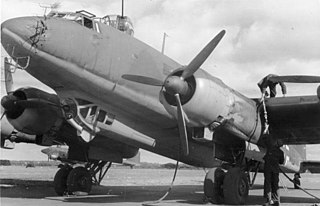
The FuG 200 Hohentwiel was a low-UHF band frequency maritime patrol radar system of the Luftwaffe in World War II. It was developed by C. Lorenz AG of Berlin starting in 1938 under the code name "Hohentwiel", an extinct volcano in the region of Baden-Württemberg in southern Germany.

A dive light is a light source carried by an underwater diver to illuminate the underwater environment. Scuba divers generally carry self-contained lights, but surface supplied divers may carry lights powered by cable supply.
