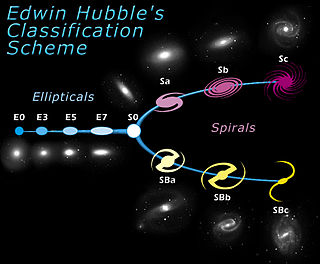
Dark matter is a form of matter thought to account for approximately 85% of the matter in the universe and about a quarter of its total energy density. Most dark matter is thought to be non-baryonic in nature, possibly being composed of some as-yet undiscovered subatomic particles. Its presence is implied in a variety of astrophysical observations, including gravitational effects which cannot be explained by accepted theories of gravity unless more matter is present than can be seen. For this reason, most experts think dark matter to be abundant in the universe and to have had a strong influence on its structure and evolution. Dark matter is called dark because it does not appear to interact with observable electromagnetic radiation, such as light, and is thus invisible to the entire electromagnetic spectrum, making it undetectable using existing astronomical instruments. Primary evidence for dark matter comes from calculations showing many galaxies would fly apart instead of rotating, or would not have formed or move as they do, if they did not contain a large amount of unseen matter. Other lines of evidence include observations in gravitational lensing, from the cosmic microwave background, also astronomical observations of the observable universe's current structure, the formation and evolution of galaxies, mass location during galactic collisions, and the motion of galaxies within galaxy clusters. In the standard Lambda-CDM model of cosmology, the total mass–energy of the universe contains 5% ordinary matter and energy, 27% dark matter and 68% of an unknown form of energy known as dark energy. Thus, dark matter constitutes 85% of total mass, while dark energy plus dark matter constitute 95% of total mass–energy content.
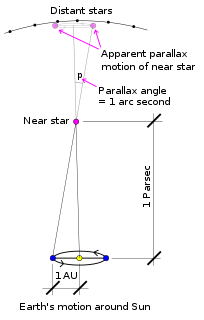
The parsec (symbol: pc) is a unit of length used to measure the large distances to astronomical objects outside the Solar System. A parsec is obtained by the use of parallax and trigonometry, and is defined as the distance at which one astronomical unit subtends an angle of one arcsecond, ie. 1/3600th of a degree. This corresponds to 648000/π astronomical units. One parsec is approximately equal to 31 trillion kilometres (31×1012 km) or 19 trillion miles (19×1012 mi), and equates to about 3.26 light-years. The nearest star, Proxima Centauri, is about 1.3 parsecs (4.2 light-years) from the Sun. Most of the stars visible to the unaided eye in the night sky are within 500 parsecs of the Sun.

Luminosity is an absolute measure of radiated electromagnetic power (light), the radiant power emitted by a light-emitting object.

Photometry, from Greek photo- ("light") and -metry ("measure"), is a technique used in astronomy that is concerned with measuring the flux or intensity of light radiated by astronomical objects. This light is measured through a telescope using a photometer, often made using electronic devices such as a CCD photometer or a photoelectric photometer that converts light into an electric current by the photoelectric effect. When calibrated against standard stars of known intensity and colour, photometers can measure the brightness or apparent magnitude of celestial objects.

The observable universe is a spherical region of the universe comprising all matter that can be observed from Earth or its space-based telescopes and exploratory probes at the present time, because electromagnetic radiation from these objects has had time to reach the Solar System and Earth since the beginning of the cosmological expansion. There are at least 2 trillion galaxies in the observable universe. Assuming the universe is isotropic, the distance to the edge of the observable universe is roughly the same in every direction. That is, the observable universe has a spherical volume centered on the observer. Every location in the universe has its own observable universe, which may or may not overlap with the one centered on Earth.
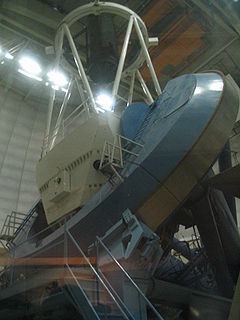
Observational astronomy is a division of astronomy that is concerned with recording data about the observable universe, in contrast with theoretical astronomy, which is mainly concerned with calculating the measurable implications of physical models. It is the practice and study of observing celestial objects with the use of telescopes and other astronomical instruments.

The Space Interferometry Mission, or SIM, also known as SIM Lite, was a planned space telescope proposed by the U.S. National Aeronautics and Space Administration (NASA), in conjunction with contractor Northrop Grumman. One of the main goals of the mission was the hunt for Earth-sized planets orbiting in the habitable zones of nearby stars other than the Sun. SIM was postponed several times and finally cancelled in 2010. In addition to detecting extrasolar planets, SIM would have helped astronomers construct a map of the Milky Way galaxy. Other important tasks would have included collecting data to help pinpoint stellar masses for specific types of stars, assisting in the determination of the spatial distribution of dark matter in the Milky Way and in the local group of galaxies and using the gravitational microlensing effect to measure the mass of stars. The spacecraft would have used optical interferometry to accomplish these and other scientific goals.
The Sloan Digital Sky Survey or SDSS is a major multi-spectral imaging and spectroscopic redshift survey using a dedicated 2.5-m wide-angle optical telescope at Apache Point Observatory in New Mexico, United States. The project was named after the Alfred P. Sloan Foundation, which contributed significant funding.
The ΛCDM or Lambda-CDM model is a parametrization of the Big Bang cosmological model in which the universe contains three major components: first, a cosmological constant denoted by Lambda and associated with dark energy; second, the postulated cold dark matter ; and third, ordinary matter. It is frequently referred to as the standard model of Big Bang cosmology because it is the simplest model that provides a reasonably good account of the following properties of the cosmos:
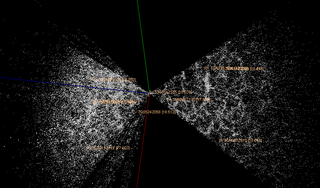
In astronomy, a redshift survey is a survey of a section of the sky to measure the redshift of astronomical objects: usually galaxies, but sometimes other objects such as galaxy clusters or quasars. Using Hubble's law, the redshift can be used to estimate the distance of an object from Earth. By combining redshift with angular position data, a redshift survey maps the 3D distribution of matter within a field of the sky. These observations are used to measure detailed statistical properties of the large-scale structure of the universe. In conjunction with observations of early structure in the cosmic microwave background, these results can place strong constraints on cosmological parameters such as the average matter density and the Hubble constant.
Surface metrology is the measurement of small-scale features on surfaces, and is a branch of metrology. Surface primary form, surface fractality and surface roughness are the parameters most commonly associated with the field. It is important to many disciplines and is mostly known for the machining of precision parts and assemblies which contain mating surfaces or which must operate with high internal pressures.

In astronomy, magnitude is a unitless measure of the brightness of an object in a defined passband, often in the visible or infrared spectrum, but sometimes across all wavelengths. An imprecise but systematic determination of the magnitude of objects was introduced in ancient times by Hipparchus.
The expansion of the universe is the increase in distance between any two given gravitationally unbound parts of the observable universe with time. It is an intrinsic expansion whereby the scale of space itself changes. The universe does not expand "into" anything and does not require space to exist "outside" it. Technically, neither space nor objects in space move. Instead it is the metric governing the size and geometry of spacetime itself that changes in scale. Although light and objects within spacetime cannot travel faster than the speed of light, this limitation does not restrict the metric itself. To an observer it appears that space is expanding and all but the nearest galaxies are receding into the distance.
The Deep Lens Survey is an ultra-deep multi-band optical survey of seven 4 square degree fields. Mosaic CCD imagers at the National Optical Astronomy Observatory's Blanco and Mayall telescopes are being used. The deep fields took five years to complete (2001–2006), in four bands: B, V, R, and z', to 29/29/29/28 mag per square arcsecond surface brightness. Optical transient events and supernova candidates are released in real time.

The Dark Energy Survey (DES) is a visible and near-infrared survey that aims to probe the dynamics of the expansion of the Universe and the growth of large-scale structure. The collaboration is composed of research institutions and universities from the United States, Australia, Brazil, the United Kingdom, Germany, Spain, and Switzerland.
In physical cosmology, fractal cosmology is a set of minority cosmological theories which state that the distribution of matter in the Universe, or the structure of the universe itself, is a fractal across a wide range of scales. More generally, it relates to the usage or appearance of fractals in the study of the universe and matter. A central issue in this field is the fractal dimension of the universe or of matter distribution within it, when measured at very large or very small scales.

NGC 4889 is an E4 supergiant elliptical galaxy. It was discovered in 1785 by the British astronomer Frederick William Herschel I, who catalogued it as a bright, nebulous patch. The brightest galaxy within the northern Coma Cluster, it is located at a median distance of 94 million parsecs from Earth. At the core of the galaxy is a supermassive black hole that heats the intracluster medium through the action of friction from infalling gases and dust. The gamma ray bursts from the galaxy extend out to several million light years of the cluster.

While the presence of any mass bends the path of light passing near it, this effect rarely produces the giant arcs and multiple images associated with strong gravitational lensing. Most lines of sight in the universe are thoroughly in the weak lensing regime, in which the deflection is impossible to detect in a single background source. However, even in these cases, the presence of the foreground mass can be detected, by way of a systematic alignment of background sources around the lensing mass. Weak gravitational lensing is thus an intrinsically statistical measurement, but it provides a way to measure the masses of astronomical objects without requiring assumptions about their composition or dynamical state.

A measuring instrument is a device for measuring a physical quantity. In the physical sciences, quality assurance, and engineering, measurement is the activity of obtaining and comparing physical quantities of real-world objects and events. Established standard objects and events are used as units, and the process of measurement gives a number relating the item under study and the referenced unit of measurement. Measuring instruments, and formal test methods which define the instrument's use, are the means by which these relations of numbers are obtained. All measuring instruments are subject to varying degrees of instrument error and measurement uncertainty.
This glossary of astronomy is a list of definitions of terms and concepts relevant to astronomy and cosmology, their sub-disciplines, and related fields. Astronomy is concerned with the study of celestial objects and phenomena that originate outside the atmosphere of Earth. The field of astronomy features an extensive vocabulary and a significant amount of jargon.