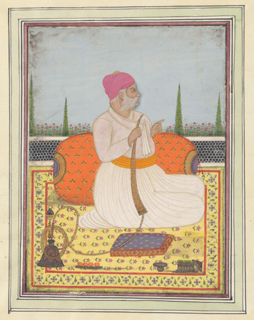
Maharaja Suraj Mal or Sujan Singh, was a Hindu Jat ruler of Bharatpur in Rajasthan, India. Under him, the Jat rule covered the present-day national capital Delhi and districts of Agra, Aligarh, Alwar, Bharatpur, Bulandshahr, Dholpur, Etah, Etawa, Faridabad, Firozabad, Ghaziabad, Gurgaon, Hathras, Jhajjar, Kanpur, Mainpuri, Mathura, Mewat, Meerut, Muzaffarnagar, Palwal, Rewari, and Rohtak.
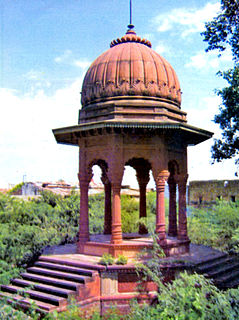
Chhatri are elevated, dome-shaped pavilions used as an element in Indo-Islamic architecture and Indian architecture. Originating as a canopy above tombs, they served as decorative elements. The earliest example of chhatri being used in the Indian Subcontinent were found in the Shrine of Ibrahim in Bhadreswar, constructed between 1159 and 1175 AD.

Shah Alam II, born as Ali Gohar or Ali Gauhar was the seventeenth Mughal Emperor and the son of Alamgir II. Shah Alam II became the emperor of a crumbling Mughal empire. His power was so depleted during his reign that it led to a saying in the Persian language, Sultanat-e-Shah Alam, Az Dilli ta Palam, meaning, 'The empire of Shah Alam is from Delhi to Palam', Palam being a suburb of Delhi.

Gokula Singh was a Jat zamindar of Tilpat, belonging to Haga(Agre/Agha) gotra, in what is now the state of Haryana, India. The second of four sons born to Madu, his birthname was Ola. Gokula provided leadership to the Jats who challenged the power of the Mughal Empire.

Kumher is a historical city and land of Yaduvanshi Sinsinwars the initial name of this city was Kuber. It is located in Bharatpur district of Rajasthan, India.

Badan Singh was the formal founder of the princely state of Bharatpur. He was nephew of Rao Churaman Singh. After the death of Churaman Singh on 22 September 1721 there were family disputes between Badan Singh and Muhkam, son of Churaman. Badan Singh aligned with Jai Singh II of Jaipur to avoid the anger of Muhkam Singh. In this family feud Jai Singh supported Badan Singh.

Malhar Rao Holkar was a noble subedar of the Maratha Empire, in present-day India. He was one of the early officers along with Ranoji Sindhia to help spread the Maratha rule to northern states and was given the estate of Indore to rule by the Peshwas, during the reign of the Maratha Emperor Shahu I.

Najib ad-Dawlah, also known as Najib Khan Yousafzai, was a Rohilla Yousafzai Pashtun who earlier served as a Mughal serviceman but later deserted the cause of the Mughals and joined Ahmed Shah Abdali in 1757 in his attack on Delhi. He was also a House chief in the 18th century Rohilkhand, who in the 1740s founded the city of Najibabad in Bijnor district, India. He was instrumental in winning the Third Battle of Panipat.

Ballabgarh, is a large town and a tehsil (subdistrict) in Faridabad district of Haryana, India, and is part of the National Capital Region. The town was founded by Raja Balram Singh, in 1739, who also built the Nahar Singh Mahal palace in the same year. Raja Nahar Singh (1823–1858) was the last king of the princely state, he was executed for taking part in the 1857 war of independence in 1858. The town of Ballabhgarh is only 18 miles (29 km) from Delhi, and today lies on the National Highway 2, a major portion of historical Grand Trunk Road. It is connected to Faridabad and south-east Delhi by the Delhi Metro. Ballabhgarh is the fourth city in Haryana to get metro connectivity after Gurgaon, Faridabad and Bahadurgarh.
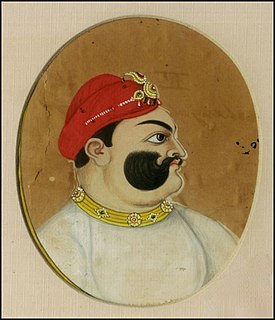
Maharaja Jawahar Singh was a Jat ruler of the Bharatpur State. He succeeded to the throne when his father Maharaja Suraj Mal died in 1763.

Lohagarh Fort is situated at Bharatpur in Rajasthan, India. It was constructed by Bharatpur Jat rulers. Maharaja Suraj Mal built numerous forts and palaces across his kingdom, one of them being the Lohagarh Fort, one of the strongest ever built in Indian history.The inaccessible Lohagarh fort could withstand repeated attacks of British forces led by Lord Lake in 1805 when they laid siege for over six weeks.
The Battle of Maonda and Mandholi was fought between the rajput rulers of Jaipur and the Jaat rulers of Bharatpur in 1767 in Rajasthan. Maharaja Jawahar Singh of Bharatpur was leading an army back from Pushkar when the forces of Maharaja Sawai Madho Singh of Jaipur met them by Maonda and Mandholi villages, near present-day Neem ka Thana. The Bharatpur forces under Jawahar Singh were defeated and the Jaipur ruler Madho Singh I followed up his victory by invading Bharatpur with 16,000 men, where he defeated Jawahar Singh again on 29 February 1768.
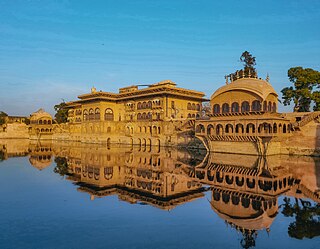
Deeg Palace is a palace 32 km from Bharatpur in Rajasthan, India built in 1772 as a luxurious summer resort for the rulers of Bharatpur State. The palace was in active use till the early 1970s.

Bharatpur State, that is also known as the Jat State of Bharatpur, historically known as the Kingdom of Bharatpur, was a Hindu Kingdom in the northern Indian subcontinent. It was ruled by the Sinsinwar clan of the Hindu Jats. At the time of reign of king Suraj Mal (1755–1763) revenue of the state was 17,500,000 rupees per annual.
Ghasera Fort is a ruined fort in Ghasera village in Nuh district of Haryana state in northern India, which has been notified as a protected monument by the state government. Currently, the majority of the residents of the village are Muslim Meos, though Hindus also live there.

Dhangar Kshatriya maharaja Khanderao Holkar, was the only son of maharaja Malhar Rao Holkar the founder of Holkar dynasty of Indore, and Gautama Bai.

The Capture of Delhi took place on 10 March 1753 between the Kingdom of Bharatpur and the Mughal Empire.
The battle of Kumher was fought among Jats, Marathas and Mughals.
The Battle of Delhi (1764) was fought between the Kingdom of Bharatpur and the Mughal Empire.

 Kingdom of Bharatpur
  Mughal Empire
  Rohilla Afghans [ citation needed ]