Related Research Articles

Kabuki is a classical form of Japanese theatre, mixing dramatic performance with traditional dance. Kabuki theatre is known for its heavily stylised performances, its glamorous, highly decorated costumes, and for the elaborate kumadori make-up worn by some of its performers. The term kabuki originates from a verb that was used to describe young samurai patrons, meaning "being weird" or "offbeat."

The performing arts are arts such as music, dance, and drama which are performed for an audience. They are different from the visual arts, which involve the use of paint, canvas or various materials to create physical or static art objects. Performing arts include a range of disciplines which are performed in front of a live audience, including theatre, music, and dance.

Japanese traditional dance describes a number of Japanese dance styles with a long history and prescribed method of performance. Some of the oldest forms of traditional Japanese dance may be among those transmitted through the kagura tradition, or folk dances relating to food producing activities such as planting rice and fishing, including rain dances. There are large number of these traditional dances, which are often subfixed -odori, -asobi, and -mai, and may be specific to a region or village. Mai and odori are the two main groups of Japanese dances, and the term buyō (舞踊) was coined in modern times as a general term for dance, by combining mai (舞) and odori (踊).
Medea is a tragedy by the ancient Greek playwright Euripides based on a myth. It was first performed in 431 BC as part of a trilogy, the other plays of which have not survived. Its plot centers on the actions of Medea, a former princess of the kingdom of Colchis and the wife of Jason; she finds her position in the world threatened as Jason leaves her for a princess of Corinth and takes vengeance on him by murdering his new wife and her own two sons, before escaping to Athens to start a new life.

Experimental theatre, inspired largely by Wagner's concept of Gesamtkunstwerk, began in Western theatre in the late 19th century with Alfred Jarry and his Ubu plays as a rejection of both the age in particular and, in general, the dominant ways of writing and producing plays. The term has shifted over time as the mainstream theatre world has adopted many forms that were once considered radical.

Shūji Terayama was a Japanese avant-garde poet, artist, dramatist, writer, film director, and photographer. His works range from radio drama, experimental television, underground (Angura) theatre, countercultural essays, to Japanese New Wave and "expanded" cinema.

Yukio Ninagawa was a Japanese theatre director, actor and film director, particularly known for his Japanese language productions of Shakespeare plays and Greek tragedies. He directed eight distinct renditions of Hamlet. Ninagawa was also emeritus of the Toho Gakuen College of Drama and Music.

A theater, or playhouse, is a structure where theatrical works, performing arts, and musical concerts are presented. The theater building serves to define the performance and audience spaces. The facility usually is organized to provide support areas for performers, the technical crew and the audience members, as well as the stage where the performance takes place.

Traditional Japanese theatre is among the oldest theatre traditions in the world. Traditional theatre includes Noh, a spiritual drama, and its comic accompaniment kyōgen; kabuki, a dance and music theatrical tradition; bunraku, puppetry; and yose, a spoken drama.

Tetsuji Takechi was a Japanese theatrical and film director, critic, and author. First coming to prominence for his theatrical criticism, in the 1940s and 1950s he produced influential and popular experimental kabuki plays. Beginning in the mid-1950s, he continued his innovative theatrical work in noh, kyōgen and modern theater. In late 1956 and early 1957 he hosted a popular TV program, The Tetsuji Takechi Hour, which featured his reinterpretations of Japanese stage classics.

Kunio Kishida was a Japanese playwright, dramatist, novelist, lecturer, acting coach, theatre critic, translator, and proponent of Shingeki. Kishida spearheaded the modernization of Japanese dramaturgy and transformed Japanese theatre acting. He was a staunch advocate for the theatre to operate as a dual artistic and literary space.

Tenjō Sajiki, also Tenjou Sajiki, was a Japanese independent theater troupe co-founded by Shūji Terayama and whose members include Kohei Ando, Kujō Kyōko, Yutaka Higashi, Tadanori Yokoo, and Fumiko Takagi.

Leonard Cabell Pronko was an American theatre scholar best known for introducing the Japanese dance drama kabuki to the West, beginning in the 1960s. He was a professor of theatre at Pomona College in Claremont, California, where he taught from 1957 to 2014.
Shingeki was a leading form of theatre in Japan that was based on modern realism. Born in the early years of the 20th century, it sought to be similar to modern Western theatre, putting on the works of the ancient Greek classics, William Shakespeare, Molière, Henrik Ibsen, Anton Chekov, Tennessee Williams, and so forth. As it appropriated Western realism, it also introduced women back onto the Japanese stage.
Yuriko Doi is a stage director, choreographer, performer and former founding artistic director of Theatre of Yugen. Doi specializes in the fusion of traditional Japanese dramatic arts with modern world theater.

Jūrō Kara was a Japanese avant-garde playwright, theatre director, author, actor, and songwriter. He was at the forefront of the Angura ("underground") theatre movement in Japan.
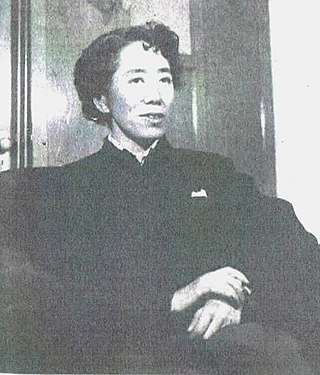
Akimoto Matsuyo was a leading playwright of postwar Japan, most respected as a realist Japanese playwright. Akimoto was known for her shingeki plays, but also wrote some classical bunraku (puppet) and kabuki dramas, and she later became a scriptwriter for both radio and television shows. Along with Akimoto's childhood, World War II played a significant role in her career. As a realist playwright, she used her work to make political statements in order to warn the greater Japanese community that the government was trying to continue their pre-war imperial system of capitalism, militarism, and patriarchy.
Rio Kishida was a Japanese playwright and director. She wrote several plays about women and the problems they faced in a patriarchal society that run parallel with the second wave of the feminist movement in Japan. Even though she did not strictly identify herself as a feminist, she believed that the system of a male dominated society had to change in order for women to gain equal rights as their male counterpart.
Harue Tsutsumi is a Japanese playwright. She specializes in kabuki, specifically kabuki in the Meiji Era.
Angura (アングラ), also known as the "Little Theater" movement, was a Japanese avant-garde theater movement in the 1960s and 1970s that reacted against the Brechtian modernism and formalist realism of postwar Shingeki theater in Japan to stage anarchic "underground" productions in tents, on street corners, and in small spaces that explored themes of primitivism, sexuality, and embodied physicality. The term "Angura" was an abbreviation of the Japanese phrase "underground theater".
References
- ↑ "Carol Sorgenfrei". samuel french.com. Samuel French, Inc.
{{cite web}}: Missing or empty|url=(help) - 1 2 3 Jortner, David (2017). "Carol Fischer Sorgenfrei". Asian Theatre Journal. 31 (1): 208–213.
- ↑ Eiji, Oguma. "Japan's 1968: A Collective Reaction to Rapid Economic Growth in an Age of Turmoil 日本の1968". apjj.org. The Asia-Pacific Journal. Retrieved March 15, 2017.
- 1 2 "Carol Fisher Sorgenfrei". UCLA School of TFT. 2011-09-08. Retrieved 2019-12-13.
- ↑ Drake, Sylvia. "STAGE REVIEW : 'Fireplay': Greek Tinder and Kabuki Flint". Los Angeles Times . Retrieved March 16, 2017.
- ↑ Sorgenfrei, Carol (1998). "Fusing Kabuki with Flamenco: The Creation of Blood Wine, Blood Wedding". Theatre Symposium. 3: 53. Retrieved February 16, 2017.
- ↑ Foley, Helene (2012). Reimagining Greek Tragedy on the American Stage. University of California Press. p. 217. ISBN 9780520272446 . Retrieved February 20, 2017.
- ↑ Yatsunov, Artem. "Ghost Light: The Haunting". theasy.com. Retrieved February 19, 2017.
- ↑ Poulton, Cody. "Unspeakable Acts: The Avant-Garde Theatre of Terayama Shûji and Postwar Japan, Carol Fisher Sorgenfrei (Honolulu, HI: University of Hawai'i Press, 2005)" (PDF). performanceparadigm.net. Performance Paradigm. Retrieved March 16, 2017.
