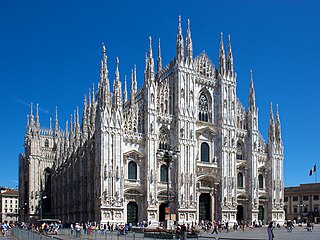
Milan Cathedral, or Metropolitan Cathedral-Basilica of the Nativity of Saint Mary, is the cathedral church of Milan, Lombardy, Italy. Dedicated to the Nativity of St. Mary, it is the seat of the Archbishop of Milan, currently Archbishop Mario Delpini.

The Certosa di Pavia is a monastery and complex in Lombardy, Northern Italy, situated near a small town of the same name in the Province of Pavia, 8 km (5.0 mi) north of Pavia. Built in 1396–1495, it was once located on the border of a large hunting park belonging to the Visconti family of Milan, of which today only scattered parts remain. It is one of the largest monasteries in Italy.

Santa Maria del Carmine is a church in Pavia, Lombardy, northern Italy, considered amongst the best examples of Lombard Gothic architecture. It was begun in 1374 by Gian Galeazzo Visconti, Duke of Milan, on a project attributed to Bernardo da Venezia. The construction followed a slow pace, and was restarted in 1432, being finished in 1461.

Villas and palaces in Milan are used to indicate public and private buildings in Milan of particular artistic and architectural value. Milan has always been an important centre with regard to the construction of historical villas and palaces, ranging from the Romanesque to the neo-Gothic, from Baroque to Rococo.

The Civic Museums of Pavia are a number of museums in Pavia, Lombardy, northern Italy. They are housed in the Castello Visconteo, or Visconti Castle, built in 1360 by Galeazzo II Visconti, soon after taking the city, a free city-state until then. The credited architect is Bartolino da Novara. The castle used to be the main residence of the Visconti family, while the political capital of the state was Milan. North of the castle a wide park was enclosed, also including the Certosa of Pavia, founded 1396 according to a vow of Gian Galeazzo Visconti, meant to be a sort of private chapel of the Visconti dynasty. The Battle of Pavia (1525), climax of the Italian Wars, took place inside the castle park.

Castello Cova, also known as Palazzo Viviani Cova is a landmark Neo-Gothic style residential and business building located on Via Giosuè Carducci #36, in central Milan, region of Lombardy, Italy. It is located some 100 meters west of the Basilica of Sant'Ambrogio. The building was designed by architect Adolfo Coppedè. Adolfo's career is also noted for designing the Casa del Fascio in Signa, and he was never shy to indulge in the appropriation of former styles and symbols; this building notable for its height and accumulation of Gothic architecture motifs such as a merlionated tower, peaked and rusticated ground-floor arches, and mullion-windows. It sports numerous decorated balconies on the facade.

Visconti Park was the private park of the Visconti and Sforza families, lords, and dukes of Milan. Located in Lombardy, northern Italy, it extended between the Pavia Castle and the Pavia Charterhouse. It covered an area of about 2,200 hectares (22 km2) and was encircled by walls about 25 kilometres (16 mi) in length. It was founded in 1360 by Galeazzo II Visconti and enlarged by his son Gian Galeazzo. Its decay began in 1525 with the damages inflicted during the Battle of Pavia. Today, the park's area mainly serves agriculture purposes, while some portions are nature reserves.

San Lanfranco is a Romanesque-style Catholic church and former abbey, located on via San Lanfranco Vescovo, 4/6, just west of the town center of Pavia, region of Lombardy, Italy.

The Visconti Castle of Legnano is a mediaeval castle, located south of the city of Legnano, Metropolitan City of Milan, Lombardy, northern Italy. It lies on a small island formed by the Olona river. Since the 13th century, it is also known as the castle of San Giorgio.
The Visconti Castle of Pavia is a medieval castle in Pavia, Lombardy, Northern Italy. It was built after 1360 in a few years by Galeazzo II Visconti, Lord of Milan, and used as a sovereign residence by him and his son Gian Galeazzo, first duke of Milan. Its wide dimensions induced Petrarch, who visited Pavia in the fall of 1365, to call it "an enormous palace in the citadel, a truly remarkable and costly structure". Adjacent to the castle, the Visconti created a vast walled park that reached the Certosa di Pavia, a Carthusian monastery founded in 1396 by the Visconti as well and located about 7 kilometres (4.3 mi) to the north.

Characteristic of the historic center of Pavia is the presence of medieval noble towers that survive in its urban fabric, despite having once been more numerous, as evidenced by the sixteenth-century representation of the city frescoed in the church of San Teodoro. They were mostly built between the 11th and 13th centuries when the Ghibelline city was at the height of its Romanesque flowering.

The church of San Francesco of Assisi is a Catholic religious building in Pavia, Lombardy, Italy.

The Broletto or Broletto Palace of Pavia, Italy has for centuries housed the civic government offices of this city found in the region of Lombardy, Italy. The term Broletto refers to a buildings equivalent to the town hall or town assembly.

The Old Campus of the University of Pavia is a complex located in Pavia, in Lombardy, home to the rectorate and some university faculties and the University History Museum of the University of Pavia.

The Castiglioni College can be considered the oldest university college in Pavia. It was founded by Cardinal Branda da Castiglione in 1429.

The monastery of Santa Maria Teodote, also known as Santa Maria della Pusterla, was one of the oldest and most important female monasteries in Pavia, Lombardy, now Italy. Founded in the seventh century, it stood in the place where the diocesan seminary is located and was suppressed in the eighteenth century.

The Palazzo Botta or Botta Adorno is a Neoclassical-style palace with a long facade along Via Lanfranco and Piazza Botta Adorno Antoniotto in the town of Pavia, region of Lombardy, Italy. Once the family home of the aristocratic Botta family, it presently houses the Natural History Museum of Pavia and the Museum Camillo Golgi.

Palazzo Cornazzani is a palace in Pavia, in Lombardy, where, between 1895 and 1896, Albert Einstein lived.
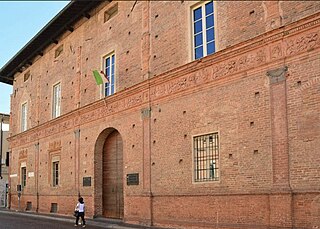
Palace Carminali Bottigella is a noble palace built by the ancient Beccaria family from Pavia. The original structure from the Sforza era was built between 1490 and 1499. The façade, which retains the original terracotta decorations, is one of the major examples of Renaissance civil building in Pavia.
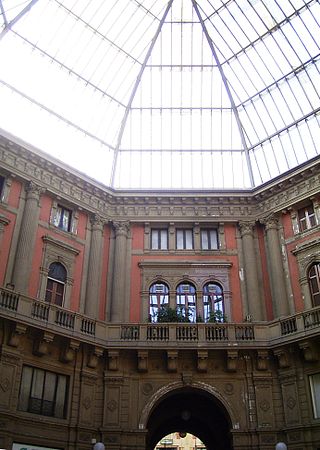
Galleria Arnaboldi is a shopping arcade in Pavia, in Lombardy, which, in the form of a covered pedestrian street, connects Strada Nuova to Piazza del Lino.

