 | This article has an unclear citation style.(September 2012) |

The cascaded arc is a wall-stabilized thermal electric arc discharge that produces a high density, low temperature plasma.
| This article has an unclear citation style.(September 2012) |
The cascaded arc is a wall-stabilized thermal electric arc discharge that produces a high density, low temperature plasma.
The cascaded arc source, developed at the Eindhoven University of Technology, [1] [2] is shown in the figure below. Compared to plasma sources in other linear plasma generators, this source can produce high-density argon and hydrogen plasmas (respectively 1021 – 1024 and 1019 – 1022 m−3) at a relatively low electron temperature (~1 eV). Due to the high collision frequency of the particles in the source, the plasma is in thermal equilibrium and reasonably homogeneous.
The cascaded arc consists of a gas inlet, three tungsten cathodes, cascaded plates, a nozzle and an anode. Via the gas inlet, the working gas -argon or hydrogen- can flow into the cathode chamber. The source is typically running at 0.5–3.0 slm (2.2×10²⁰ – 1.3×10²⁰ particles per second) and a discharge current of 100–300 A. The cascaded plates in between the cathode and anode are electrically insulated from each other by 1 mm thick Boron nitride plates. The voltage of these plates is the floating potential. Both nozzle and anode are grounded.
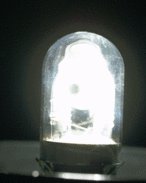
A flashtube (flashlamp) is an electric arc lamp designed to produce extremely intense, incoherent, full-spectrum white light for a very short time. A flashtube is a glass tube with an electrode at each end and is filled with a gas that, when triggered, ionizes and conducts a high-voltage pulse to make light. Flashtubes are used most in photography; they also are used in science, medicine, industry, and entertainment.

A thyratron is a type of gas-filled tube used as a high-power electrical switch and controlled rectifier. Thyratrons can handle much greater currents than similar hard-vacuum tubes. Electron multiplication occurs when the gas becomes ionized, producing a phenomenon known as Townsend discharge. Gases used include mercury vapor, xenon, neon, and hydrogen. Unlike a vacuum tube (valve), a thyratron cannot be used to amplify signals linearly.

A gas-filled tube, also commonly known as a discharge tube or formerly as a Plücker tube, is an arrangement of electrodes in a gas within an insulating, temperature-resistant envelope. Gas-filled tubes exploit phenomena related to electric discharge in gases, and operate by ionizing the gas with an applied voltage sufficient to cause electrical conduction by the underlying phenomena of the Townsend discharge. A gas-discharge lamp is an electric light using a gas-filled tube; these include fluorescent lamps, metal-halide lamps, sodium-vapor lamps, and neon lights. Specialized gas-filled tubes such as krytrons, thyratrons, and ignitrons are used as switching devices in electric devices.
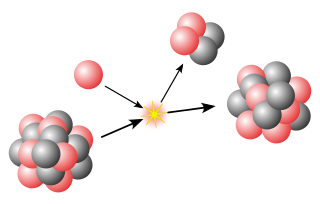
Neutron generators are neutron source devices which contain compact linear particle accelerators and that produce neutrons by fusing isotopes of hydrogen together. The fusion reactions take place in these devices by accelerating either deuterium, tritium, or a mixture of these two isotopes into a metal hydride target which also contains deuterium, tritium or a mixture of these isotopes. Fusion of deuterium atoms results in the formation of a helium-3 ion and a neutron with a kinetic energy of approximately 2.5 MeV. Fusion of a deuterium and a tritium atom results in the formation of a helium-4 ion and a neutron with a kinetic energy of approximately 14.1 MeV. Neutron generators have applications in medicine, security, and materials analysis.

A glow discharge is a plasma formed by the passage of electric current through a gas. It is often created by applying a voltage between two electrodes in a glass tube containing a low-pressure gas. When the voltage exceeds a value called the striking voltage, the gas ionization becomes self-sustaining, and the tube glows with a colored light. The color depends on the gas used.

The krytron is a cold-cathode gas-filled tube intended for use as a very high-speed switch, somewhat similar to the thyratron. It consists of a sealed glass tube with four electrodes. A small triggering pulse on the grid electrode switches the tube on, allowing a large current to flow between the cathode and anode electrodes. The vacuum version is called a vacuum krytron, or sprytron. The krytron was one of the earliest developments of the EG&G Corporation.

An electric arc is an electrical breakdown of a gas that produces a prolonged electrical discharge. The current through a normally nonconductive medium such as air produces a plasma, which may produce visible light. An arc discharge is initiated either by thermionic emission or by field emission. After initiation, the arc relies on thermionic emission of electrons from the electrodes supporting the arc. An arc discharge is characterized by a lower voltage than a glow discharge. An archaic term is voltaic arc, as used in the phrase "voltaic arc lamp".
A vacuum arc can arise when the surfaces of metal electrodes in contact with a good vacuum begin to emit electrons either through heating or in an electric field that is sufficient to cause field electron emission. Once initiated, a vacuum arc can persist, since the freed particles gain kinetic energy from the electric field, heating the metal surfaces through high-speed particle collisions. This process can create an incandescent cathode spot, which frees more particles, thereby sustaining the arc. At sufficiently high currents an incandescent anode spot may also be formed.
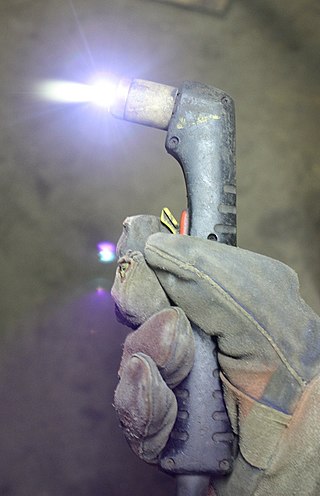
A plasma torch is a device for generating a directed flow of plasma.

Plasma arc welding (PAW) is an arc welding process similar to gas tungsten arc welding (GTAW). The electric arc is formed between an electrode and the workpiece. The key difference from GTAW is that in PAW, the electrode is positioned within the body of the torch, so the plasma arc is separated from the shielding gas envelope. The plasma is then forced through a fine-bore copper nozzle which constricts the arc and the plasma exits the orifice at high velocities and a temperature approaching 28,000 °C (50,000 °F) or higher.
Cathodic arc deposition or Arc-PVD is a physical vapor deposition technique in which an electric arc is used to vaporize material from a cathode target. The vaporized material then condenses on a substrate, forming a thin film. The technique can be used to deposit metallic, ceramic, and composite films.

Thermal spraying techniques are coating processes in which melted materials are sprayed onto a surface. The "feedstock" is heated by electrical or chemical means.
Plasma activation is a method of surface modification employing plasma processing, which improves surface adhesion properties of many materials including metals, glass, ceramics, a broad range of polymers and textiles and even natural materials such as wood and seeds. Plasma functionalization also refers to the introduction of functional groups on the surface of exposed materials. It is widely used in industrial processes to prepare surfaces for bonding, gluing, coating and painting. Plasma processing achieves this effect through a combination of reduction of metal oxides, ultra-fine surface cleaning from organic contaminants, modification of the surface topography and deposition of functional chemical groups. Importantly, the plasma activation can be performed at atmospheric pressure using air or typical industrial gases including hydrogen, nitrogen and oxygen. Thus, the surface functionalization is achieved without expensive vacuum equipment or wet chemistry, which positively affects its costs, safety and environmental impact. Fast processing speeds further facilitate numerous industrial applications.

Plasma-enhanced chemical vapor deposition (PECVD) is a chemical vapor deposition process used to deposit thin films from a gas state (vapor) to a solid state on a substrate. Chemical reactions are involved in the process, which occur after creation of a plasma of the reacting gases. The plasma is generally created by radio frequency (RF) frequency or direct current (DC) discharge between two electrodes, the space between which is filled with the reacting gases.
A microplasma is a plasma of small dimensions, ranging from tens to thousands of micrometers. Microplasmas can be generated at a variety of temperatures and pressures, existing as either thermal or non-thermal plasmas. Non-thermal microplasmas that can maintain their state at standard temperatures and pressures are readily available and accessible to scientists as they can be easily sustained and manipulated under standard conditions. Therefore, they can be employed for commercial, industrial, and medical applications, giving rise to the evolving field of microplasmas.

Plasma is one of four fundamental states of matter, characterized by the presence of a significant portion of charged particles in any combination of ions or electrons. It is the most abundant form of ordinary matter in the universe, mostly in stars, but also dominating the rarefied intracluster medium and intergalactic medium. Plasma can be artificially generated, for example, by heating a neutral gas or subjecting it to a strong electromagnetic field.

A noise generator is a circuit that produces electrical noise. Noise generators are used to test signals for measuring noise figure, frequency response, and other parameters. Noise generators are also used for generating random numbers.

Nano-PSI is a plasma device at the Differ – Dutch Institute For Fundamental Energy Research research institute in Eindhoven. It is used for experimental research at the junction of plasma physics and materials science. 'PSI' stands for Plasma Surface Interactions, while 'nano' has been chosen to stress the mission of the device to synthesize various nanostructures. Nano-PSI is the belongs to the family of plasma generators at DIFFER, that also hosts the Magnum-PSI and UPP-PSI linear devices.
Piezoelectric direct discharge (PDD) plasma is a type of cold non-equilibrium plasma, generated by a direct gas discharge of a high voltage piezoelectric transformer. It can be ignited in air or other gases in a wide range of pressures, including atmospheric. Due to the compactness and the efficiency of the piezoelectric transformer, this method of plasma generation is particularly compact, efficient and cheap. It enables a wide spectrum of industrial, medical and consumer applications.

Low-energy plasma-enhanced chemical vapor deposition (LEPECVD) is a plasma-enhanced chemical vapor deposition technique used for the epitaxial deposition of thin semiconductor films. A remote low energy, high density DC argon plasma is employed to efficiently decompose the gas phase precursors while leaving the epitaxial layer undamaged, resulting in high quality epilayers and high deposition rates.