
Tremp is a municipality in Catalonia, Spain, the capital of the comarca of the Pallars Jussà. It is the largest municipality in Catalonia in terms of area, accounting for nearly a quarter of the total area of the comarca.

La Pobla de Segur is a municipality located in the comarca of Pallars Jussà, province of Lleida, Catalonia, in northern Spain. According to the 2013 census (INE), the town has a population of 3,073 inhabitants. It is situated at the confluence of the Flamicell and Noguera Pallaresa rivers in the north of the comarca, above the Sant Antoni reservoir. It is an important local service centre, which has allowed it to escape the depopulation which has affected many municipalities in northwestern Catalonia. The village is served by the C-13 road between Tremp and Sort, the N-260 road to Pont de Suert and by a railway station on a railway line to Lleida.

Pararhabdodon is a genus of tsintaosaurin hadrosaurid dinosaur, from the Maastrichtian-age Upper Cretaceous Tremp Group of Spain. The first remains were discovered from the Sant Romà d’Abella fossil locality and assigned to the genus Rhabdodon, and later named as the distinct species Pararhabdodon isonensis in 1993. Known material includes assorted postcranial remains, mostly vertebrae, as well as maxillae from the skull. Specimens from other sites, including remains from France, a maxilla previously considered the distinct taxon Koutalisaurus kohlerorum, an additional maxilla from another locality, the material assigned to the genera Blasisaurus and Arenysaurus, and the extensive Basturs Poble bonebed have been considered at different times to belong to the species, but all of these assignments have more recently been questioned. It was one of the last non-avian dinosaurs known from the fossil record that went extinct during the Cretaceous-Paleogene extinction event.

The municipality is the basic local administrative division in Spain together with the province.
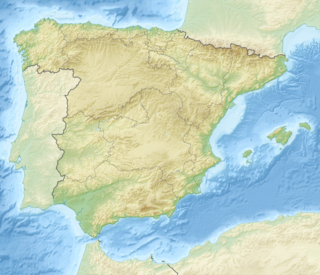
The Arén Formation or Arén Sandstone is a geological formation in the Tremp-Graus Basin around Arén, Catalonia, Spain whose strata date back to the Late Cretaceous. Dinosaur remains are among the fossils that have been recovered from the formation. The formation dates to the Campanian to Maastrichtian and underlies the Tremp Group.

The Tremp Formation, alternatively described as Tremp Group, is a geological formation in the comarca Pallars Jussà, Lleida, Spain. The formation is restricted to the Tremp or Tremp-Graus Basin, a piggyback foreland basin in the Catalonian Pre-Pyrenees. The formation dates to the Maastrichtian to Thanetian, thus the formation includes the Cretaceous-Paleogene boundary that has been well studied in the area, using paleomagnetism and carbon and oxygen isotopes. The formation comprises several lithologies, from sandstone, conglomerates and shales to marls, siltstones, limestones and lignite and gypsum beds and ranges between 250 and 800 metres in thickness. The Tremp Formation was deposited in a continental to marginally marine fluvial-lacustrine environment characterized by estuarine to deltaic settings.

Abella de la Conca is a village and municipi in the province of Lleida in the county of Pallars Jussà and the autonomous community of Catalonia, Spain. The municipality is situated on the eastern bank of the Tremp Basin. It comprises the high valleys of the Abella River tributary of the Conques river on its right bank and of the Rams River. The valley of the latter is sandwiched between the Boumort and Carreu mountains. In addition to the Tremp Basin, it comprises a section of the Puials River valley. A portion of the village houses are semi-excavated in the rock.

Aulàs is a hamlet located in the municipality of Tremp, in Province of Lleida province, Catalonia, Spain. As of 2020, it has a population of 47.

Claret is a hamlet located in the municipality of Tremp, in Province of Lleida province, Catalonia, Spain. As of 2020, it has a population of 7.
Escarlà is a locality located in the municipality of Tremp, in Province of Lleida province, Catalonia, Spain. As of 2020, it has a population of 5.

Espluga Freda or Esplugafreda is a locality located in the municipality of Tremp, in Province of Lleida province, Catalonia, Spain. As of 2020, it has a population of 0.

Fígols de Tremp is a locality located in the municipality of Tremp, in Province of Lleida province, Catalonia, Spain. As of 2020, it has a population of 6.
Els Masos de Tamúrcia is a hamlet located in the municipality of Tremp, in Province of Lleida province, Catalonia, Spain. As of 2020, it has a population of 10.

Palau de Noguera is a locality located in the municipality of Tremp, in Province of Lleida province, Catalonia, Spain. As of 2020, it has a population of 62.

Puigverd is a locality located in the municipality of Tremp, in Province of Lleida province, Catalonia, Spain. As of 2020, it has a population of 2.

Sant Adrià is a locality located in the municipality of Tremp, in Province of Lleida province, Catalonia, Spain. As of 2020, it has a population of 1.

Santa Engràcia is a hamlet located in the municipality of Tremp, in Province of Lleida province, Catalonia, Spain. As of 2020, it has a population of 13.

Sapeira is a hamlet located in the municipality of Tremp, in Province of Lleida province, Catalonia, Spain. As of 2020, it has a population of 4.

Suterranya is a locality located in the municipality of Tremp, in Province of Lleida province, Catalonia, Spain. As of 2020, it has a population of 50.
Torogó is a locality located in the municipality of Tremp, in Province of Lleida province, Catalonia, Spain. As of 2020, it has a population of 6.
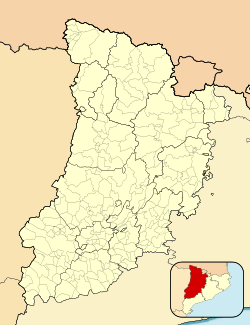


 Spain
Spain  Catalonia