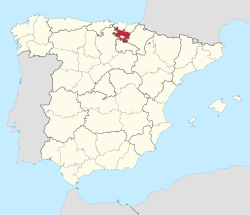
The Ertzaintza, is the autonomous police force for the Basque Country, largely replacing the Spanish Policía Nacional and Guardia Civil. An Ertzaintza member is called an ertzaina.

Cueva de La Pasiega, or Cave of La Pasiega, situated in the Spanish municipality of Puente Viesgo, is one of the most important monuments of Paleolithic art in Cantabria. It is included in the UNESCO World Heritage List since July 2008, as part of the inscription: Cave of Altamira and Paleolithic Cave Art of Northern Spain.

Guriezo is a municipality located in the autonomous community of Cantabria, Spain. According to the 2013 census, the town has a population of 2,424 inhabitants. Its capital is El Puente.

Carlos Martínez Gorriarán is a Spanish scholar, born in San Sebastián, Basque Country, Spain. After being a member of marxist and basque nationalist movements, he became one of the founding members and spokespersons of ¡Basta Ya! association and head of the Plataforma Pro from which the Union, Progress and Democracy (UPyD) party emerged in September 2007. In ¡Basta Ya! he was opposed to ETA, and also to the "obligatory nationalism" that he considered to be occurring in the Basque Country. He is a member of the Directing and Political counsels of the party.

The Basque Country, also called Basque Autonomous Community, is an autonomous community in northern Spain. It includes the Basque provinces of Álava, Biscay, and Gipuzkoa.

The group of over 700 sites of prehistoric Rock art of the Iberian Mediterranean Basin, also known as Levantine art, were collectively declared a World Heritage Site by UNESCO in 1998. The sites are in the eastern part of Spain and contain rock art dating to the Upper Paleolithic or Mesolithic periods of the Stone Age. The art consists of small painted figures of humans and animals, which are the most advanced and widespread surviving from this period, certainly in Europe, and arguably in the world, at least in the earlier works. It is notable for the number of places included, the largest concentration of such art in Europe. Its name refers to the Mediterranean Basin; however, while some sites are located near the sea, many of them are inland in Aragon and Castilla–La Mancha; it is also often referred to as Levantine Art.

The 2012 Basque regional election was held on Sunday, 21 October 2012, to elect the 10th Parliament of the Basque Autonomous Community. All 75 seats in the Parliament were up for election. The election was held simultaneously with a regional election in Galicia. Lehendakari Patxi López announced the parliament's dissolution half a year ahead of schedule as a result of the People's Party (PP) withdrawing their support from his government, prompting Galician president Alberto Núñez Feijóo, who had been scheduling a snap election in Galicia to be held at some point throughout late 2012, to make his decision to have a simultaneous vote.

The 2016 Basque regional election was held on Sunday, 25 September 2016, to elect the 11th Parliament of the Basque Autonomous Community. All 75 seats in the Parliament were up for election. The election was held simultaneously with a regional election in Galicia. Lehendakari Iñigo Urkullu announced that the election would be held one month ahead of schedule, on 25 September 2016, based on the "climate of ungovernability" affecting national politics as a result of the ongoing Spanish government formation negotiations, intending to move the regional election as far away as possible from a possible new general election. This prompted Galician president Alberto Núñez Feijóo to hold the Galician regional election in the same date.

The Tito Bustillo Cave is a prehistoric rock shelter located in the small town of Ribadesella, in the autonomous community of Asturias, Spain. The cave was inhabited by humans (cro-magnon) before the year 10,000 BC. Due to the collapse of the rock, the original entrance to the cave was sealed thousands of years ago, which made it possible for preservation of objects, tools and wall paintings that were discovered in 1968. Based on those objects found in the cave, it is known that there was a significant human presence during the Magdalenian culture of the Upper Palaeolithic, but the cave was probably inhabited before that time.

The 2020 Basque regional election was held on Sunday, 12 July 2020, to elect the 12th Parliament of the Basque Autonomous Community. All 75 seats in the Parliament were up for election. The election was initially scheduled for 5 April 2020 but was postponed as a result of the COVID-19 pandemic. It was held simultaneously with a regional election in Galicia.
The Cave of the Angel refers to several cave-related structures located in the Aras mountain range near the town of Lucena, Córdoba province in Spain. The site contains lithic material of an Acheulean typology and dates to that from the Middle Pleistocene to the Upper Pleistocene. There is geological, paleontological, and archaeological evidence indicating an intense and long-term occupation of this site. The numerous bone and lithic remains found in this site, as well as the matrix surrounding them, reveal exposure to fire. This, along with the finding of a wide and deep combustion structure in the stratigraphic profile, support the hypothesis that at the time of the occupation of the site by humans there was processing and consumption of big mammals.

The Cave of Maltravieso in Cáceres, Extremadura, Spain, was discovered in 1951. It shows traces of human occupation from the Middle Paleolithic. It contains cave art, most notably a total of 71 hand stencils, enumerated in the 1990s using ultraviolet photography, but also linear designs and some animal paintings. In a 2018 study based on uranium-thorium dating, a hand stencil from the Cave of Maltravieso was dated to 64,000 years ago. This would make it Middle Paleolithic art, predating the presence of European early modern humans, with important implications for Neanderthal behavior.

José María "Txema" Portillo Valdés is a Spanish historian, professor of Contemporary History at the University of the Basque Country. He is an expert in the Spanish constitutional history.
Eating is a conceptual and performative work of critical, polemical and political content by artist Abel Azcona. Also known as Eating a Koran, Eating a Torah and Eating a Bible.

The Shame,, is a conceptual, critical and process artwork by Abel Azcona. Developed along the West Bank Wall in 2018, in The Shame Azcona installed original fragments of the Berlin Wall along the Israeli wall in the West Bank, which forms part of the barrier built throughout Israel to separate the Palestinian lands. Azcona made a metaphorical critique by merging both walls in the work. The actual installation, as if it were a piece of land art, currently remains along the wall, and has been exhibited in different countries through photographic and video art. The Israeli government has prohibited the artist from entering Israel because of the piece.
The Streets is a conceptual and performative work of critical and biographical content by artist Abel Azcona. At the end of 2014 and the early part of 2015, Azcona explored the processual work La Calle this time in the Santa Fe locality of Bogota, where he prostituted himself on the streets. In this new work, he explored a change towards the figure of his mother, taking hormones and engaging in prostitution. Azcona was inspired by his biological mother, a prostitute, and sought to empathise with her and with the moment of his own conception. The process continued in the cities of Madrid and Mexico City. The performance emerged, as with the rest of his sex-themed works, as an exercise in empathy with his own biological mother. It was also a social critique, where the artist explored the limits of his body by repeating patterns of sexual abuse, which occurred in his own childhood and in the life of his mother.
In the run up to the 2015 Spanish local elections, various organisations carried out opinion polling to gauge voting intention in local entities in Spain. Results of such polls for municipalities and the three foral deputations in the Basque Country are displayed in this article. The date range for these opinion polls is from the previous local elections, held on 22 May 2011, to the day the next elections were held, on 24 May 2015.
Julio Aróstegui Sánchez (1939–2013) was a Spanish historian. Professor at the Complutense University of Madrid (UCM), some of his research lines included the study of political violence in Modern Spanish history, Carlism, the Spanish Transition, the Spanish Civil War, the history of the workers' movement and collective memory. His scholar production also intertwined with the theoretical problems of history and the methodology of research.