
The siege of Kut Al Amara, also known as the first battle of Kut, was the besieging of an 8,000-strong British Army garrison in the town of Kut, 160 km (100 mi) south of Baghdad, by the Ottoman Army. In 1915, its population was around 6,500. Following the surrender of the garrison on 29 April 1916, the survivors of the siege were marched to imprisonment at Aleppo, during which many died. Historian Christopher Catherwood has called the siege "the worst defeat of the Allies in World War I". Ten months later, the British Indian Army, consisting almost entirely of newly recruited troops from Western India, conquered Kut, Baghdad and other regions in between in the fall of Baghdad.

The First Australian Imperial Force was the main expeditionary force of the Australian Army during the First World War. It was formed as the Australian Imperial Force (AIF) following Britain's declaration of war on Germany on 15 August 1914, with an initial strength of one infantry division and one light horse brigade. The infantry division subsequently fought at Gallipoli between April and December 1915, with a newly raised second division, as well as three light horse brigades, reinforcing the committed units.

The Arab Revolt, also known as the Great Arab Revolt, was an armed uprising by the Hashemite-led Arabs of the Hejaz against the Ottoman Empire amidst the Middle Eastern theatre of World War I.

The Eastern Front or Eastern Theater, of World War I. For Russia Second Patriotic War. Was a theater of operations that encompassed at its greatest extent the entire frontier between Russia and Romania on one side and Austria-Hungary, Bulgaria, the Ottoman Empire, and Germany on the other. It ranged from the Baltic Sea in the north to the Black Sea in the south, involved most of Eastern Europe, and stretched deep into Central Europe. The term contrasts with the Western Front, which was being fought in Belgium and France. Unlike the static warfare on the Western Front, the fighting on the geographically larger Eastern Front was more dynamic, often involving the flanking and encirclement of entire formations, and resulted in over 100,000 square miles of territory becoming occupied by a foreign power.

Marshal of the Royal Air Force Sir John Maitland Salmond, was a British military officer who rose to high rank in the Royal Flying Corps and then the Royal Air Force. During the First World War he served as a squadron commander, a wing commander and then as General Officer Commanding the RAF on the Western Front towards the end of the war. He went on to be Air Officer Commanding British Forces in Iraq in the early 1920s when he halted a Turkish invasion and sought to put down a Kurdish uprising against King Faisal, the British-sponsored ruler of Iraq. He was Chief of the Air Staff in the early 1930s and bitterly opposed the position taken by British politicians at the World Disarmament Conference in Geneva, which would have led to the UK's complete aerial disarmament. In the event the talks broke down when Adolf Hitler withdrew from the Conference in October 1933.
During World War I, the German Empire was one of the Central Powers. It began participation in the conflict after the declaration of war against Serbia by its ally, Austria-Hungary. German forces fought the Allies on both the eastern and western fronts, although German territory itself remained relatively safe from widespread invasion for most of the war, except for a brief period in 1914 when East Prussia was invaded. A tight blockade imposed by the Royal Navy caused severe food shortages in the cities, especially in the winter of 1916–17, known as the Turnip Winter. At the end of the war, Germany's defeat and widespread popular discontent triggered the German Revolution of 1918–1919 which overthrew the monarchy and established the Weimar Republic.
Polish Red Cross is the Polish member of the International Red Cross and Red Crescent Movement. Its 19th-century roots may be found in the Russian and Austrian Partitions of the Polish–Lithuanian Commonwealth. On regaining its independence in 1918 Poland's charitable institutions were able to reconvene and establish the Red Cross on its territory under the presidency of Paweł Sapieha, formerly President of the Red Cross in Galicia. The new society was recognized by the International Red Cross on 24 July 1919. During the Polish People's Republic (1947–1989) the Polish Red Cross lost its autonomy and all its assets to the state. Across its hundred year history it continues its humanitarian work at home and abroad. Its focus is on education, exhumations and missing persons. It continues to carry aid to refugees.

The situation of Prisoners of war in World War I in Germany is an aspect of the conflict little covered by historical research. However, the number of soldiers imprisoned reached a little over seven million for all the belligerents, of whom around 2,400,000 were held by Germany.

Red Cross parcel refers to packages containing mostly food, tobacco and personal hygiene items sent by the International Association of the Red Cross to prisoners of war (POWs) during the First and Second World Wars, as well as at other times. It can also refer to medical parcels and so-called "release parcels" provided during the Second World War.

The Turnip Winter of 1916 to 1917 was a period of profound civilian hardship in Germany during World War I.

Holzminden prisoner-of-war camp was a World War I prisoner-of-war camp for British and British Empire officers located in Holzminden, Lower Saxony, Germany. It opened in September 1917, and closed with the final repatriation of prisoners in December 1918. It is remembered as the location of the largest PoW escape of the war, in July 1918, when twenty-nine officers escaped through a tunnel, ten of whom evaded recapture and managed to make their way back to Britain.
The Volunteer Training Corps was a voluntary home defence reserve force in the United Kingdom during World War I.
William Henry Beach was a senior British Army officer who played an important role in the campaign in Mesopotamia 1915 to 1918.

The 25th Battalion, CEF was a unit in the Canadian Expeditionary Force during the Great War. It was the second infantry battalion of ten to be raised in Nova Scotia during the war. The 25th served in Belgium and France as part of the 5th Canadian Brigade, 2nd Canadian Division from 16 September 1915 until the end of the war. Regimental headquarters were established at the Halifax Armouries, with recruitment offices in Sydney, Amherst, New Glasgow, Truro and Yarmouth. Of the 1000 Nova Scotians that started with the battalion, after the first year of fighting, 100 were left in the battalion, while 900 men were killed, taken prisoner, missing or injured.

The German occupation of north-east France refers to the period in which French territory, mostly along the border with Belgium and Luxembourg, was under military occupation by the German Empire during World War I.
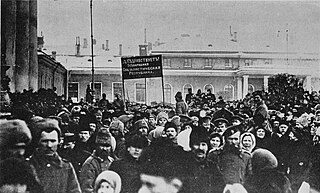
The February Revolution, known in Soviet historiography as the February Bourgeois Democratic Revolution and sometimes as the March Revolution or February Coup was the first of two revolutions which took place in Russia in 1917.

This is a timeline of the British home front during the First World War from 1914 to 1918. This conflict was the first modern example of total war in the United Kingdom; innovations included the mobilisation of the workforce, including many women, for munitions production, conscription and rationing. Civilians were subjected to naval bombardments, strategic bombing and food shortages caused by a submarine blockade.
The Joint War Organisation (JWO) was a combined operation of the British Red Cross Society and the Order of St John of Jerusalem during the World Wars. It was first created in 1914 and ceased operations when World War I ended in 1919; the organisation was re-formed upon the British entry into World War II in 1939 and was active until its permanent disbanding in 1947. The Joint War Committee (JWC), a non-government administrative body, controlled the JWO and the Joint War Finance Committee managed its finances and concentrated on raising donations and funding.

Around 600,000 Italian soldiers were taken prisoner during the First World War, about half in the aftermath of Caporetto. Roughly one Italian soldier in seven was captured, a significantly higher number than in other armies on the Western Front. About 100,000 Italian prisoners of war never returned home, having succumbed to hardship, hunger, cold and disease. Uniquely among the Allied powers, Italy refused to assist its prisoners, and even hindered efforts by soldiers’ families to send them food. As a result, the death rate for Italian prisoners was nine times worse than that of Austro-Hungarian prisoners in Italy.

Mary Elizabeth Maude Chomley was a charity worker, arts patron and feminist. She was secretary of the Prisoners of War branch of the Australian Red Cross based in London during World War I. She coordinated a team of volunteers who facilitated communication with Australian prisoners of war, and their families back home. The prisoners referred to her as an 'angel' and considered her a lifeline providing them with the essential material aid, and communication required to survive.