
Viña del Mar is a city and commune on central Chile's Pacific coast. Often referred to as La Ciudad Jardín, Viña del Mar is located within the Valparaíso Region, and it is Chile's fourth largest city with a population of 324,836. Viña del Mar is also part of the Greater Valparaíso area, the country's second largest metropolitan area, after the Metropolitan area of Santiago. The Greater Valparaíso Area is home to five municipalities: Valparaíso, Viña del Mar, Concon, Quilpue and Villa Alemana.

Catamarca is a province of Argentina, located in the northwest of the country. The province had a population of 429,556 as per the 2022 census [INDEC], and covers an area of 102,602 km2. Its literacy rate is 95.5%. Neighbouring provinces are : Salta, Tucumán, Santiago del Estero, Córdoba, and La Rioja. To the west it borders the country of Chile.

Tacna is the southernmost department and region in Peru. The Chilean Army occupied the present-day Tacna Department during the War of the Pacific from 1885 until 1929 when it was reincorporated into Peru.
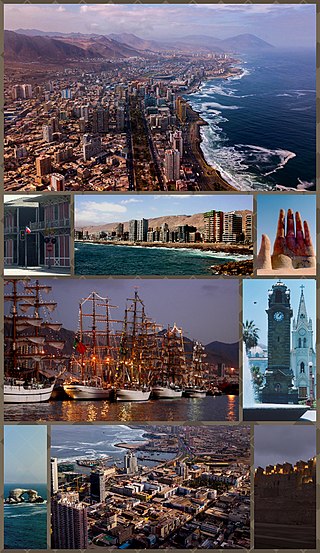
Antofagasta is a port city in northern Chile, about 1,100 kilometres (700 mi) north of Santiago. It is the capital of Antofagasta Province and Antofagasta Region. According to the 2015 census, the city has a population of 402,669.

The ethnocacerist movement is a Peruvian ethnic nationalist movement that espouses an ideology called ethnocacerism. The movement seeks to establish a dictatorship of the proletariat led by the country's Indigenous communities and their descendants. It draws on the ideas and history of several Indigenous and anti-colonial movements, including those of Juan Velasco Alvarado, Evo Morales, Gamal Abdel Nasser, Muammar Gaddafi, and Che Guevara. Ethnocacerism is considered an Indigenist ideology and is currently represented in electoral politics by the Union for Peru party and other smaller parties. The ideology is also followed by Peruvian militant groups such as the Plurinational Association of Tawantinsuyo Reservists and Ejército de Reservistas Andino Amazónico – T.

Quillota is a city located in the valley of the Aconcagua River in Valparaíso Region, Chile. It is the capital and largest city of Quillota Province. It is surrounded by the localities of San Isidro, La Palma, Pocochay, and San Pedro. It is an important agricultural center, mainly because of the plantations of avocado and cherimoya trees.
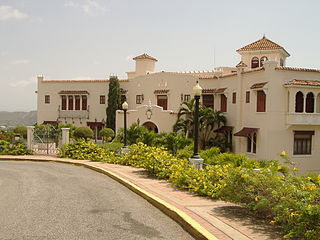
Castillo Serrallés is a mansion located in the city of Ponce, Puerto Rico, overlooking the downtown area. It was built during the 1930s for Juan Eugenio Serrallés, son of businessman Juan Serrallés, founder of Destilería Serrallés. The structure sits on a 2.5-acre (1.0 ha) exceedingly manicured property. Nowadays, the structure functions as a museum, Museo Castillo Serrallés, with information about the sugar cane and rum industries and its impact in the economy of Puerto Rico. It is also increasingly used as a venue for social activities, including destination weddings. The property was listed in the National Register of Historic Places in 1980 and on the Puerto Rico Register of Historic Sites and Zones in 2001. In 1996, the structure was featured in the American TV series America's Castles.

Cerro Castillo National Park is a nature reserve of Chile located in the Aysén del General Carlos Ibáñez del Campo Region, south of Coyhaique. The park is named after Cerro Castillo, its highest mountain and main attraction. The Carretera Austral passes through the park.

Deportes Temuco is a Chilean football club based in Temuco, Araucanía Region. It currently plays in the Chilean Primera División B, holding home games at the new Estadio Municipal Germán Becker.
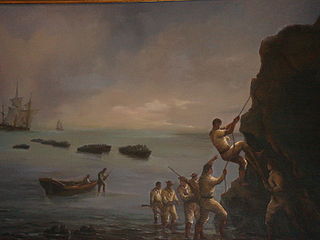
The Capture of Valdivia was a battle in the Chilean War of Independence between Royalist forces commanded by Colonel Manuel Montoya and Fausto del Hoyo and the Patriot forces under the command of Thomas Cochrane and Jorge Beauchef, held on 3 and 4 February 1820. The battle was fought over the control of the city Valdivia and its strategic and heavily fortified harbour. In the battle Patriots gained control of the southwestern part of the Valdivian Fort System after an audacious assault aided by deception and the darkness of the night. The following day the demoralised Spanish evacuated the remaining forts, looted local Patriot property in Valdivia and withdrew to Osorno and Chiloé. Thereafter, Patriot mobs looted the property of local Royalists until the Patriot army arrived to the city restoring order.

San Antonio is a Chilean port city, commune, and the capital of the San Antonio Province in the Valparaíso Region. It has become the main freight port in Chile, surpassing Valparaíso in the 21st century. San Antonio is also the hub of the fishing area that stretches along the Chilean coast from Rocas de Santo Domingo to Cartagena.

The Cueva del Castillo, or Cave of the Castle, is an archaeological site within the complex of the Caves of Monte Castillo, in Puente Viesgo, Cantabria, Spain.

The Andalién River is a river in the province of Concepción, in the Bío Bío Region of Chile. It drains the western side of Chile's Cordillera de la Costa and has a total length of 42 kilometres (26 mi). It is one of the two rivers that bracket the city of Concepción.

Simpson River is a river of Chile located in the Aysén del General Carlos Ibáñez del Campo Region. The river originates east of the Andes mountains. It forms the western boundary of the city of Coihaique, which is bordered on the north by the Coihaique River, a tributary of the Simpson. In its inferior course, the river flows through Río Simpson National Reserve, which is named after the river. In this area, the river roughly parallels the Route CH-240, which connects Coihaique with Puerto Aisén and Puerto Chacabuco.
Jaime Francisco Sebastián Castillo Petruzzi, known as Torito, is a Chilean former militant of the left-wing organization Movimiento de Izquierda Revolucionaria who worked with the Túpac Amaru Revolutionary Movement during the internal conflict in Peru. He was convicted by a Peruvian military tribunal of high treason in 1993 and sentenced to life in prison. In 2003, after a new trial in accordance with a ruling by the Inter-American Court of Human Rights, Castillo was sentenced to 23 years in prison. He was released on 14 October 2016 and expelled to Chile.

Nicolás Ignacio Castillo Mora is a Chilean professional footballer who plays for Universidad Católica as a striker.
The 2005 Campeonato Nacional Clausura Copa Banco del Estado was the 78th Chilean League top flight, in which Universidad Católica won its 9th league title after beating Universidad de Chile on penalties, in the finals.
The 2005 Primera División de Chile season was both 77th and 78th season of top-flight football in Chile.
The 2003 Primera División de Chile season was both 73rd and 74th season of top-flight football in Chile.

Chile España is an underground metro station of Line 3 of the Santiago Metro network, in Santiago, Chile. It is an underground, between the Ñuñoa and Villa Frei stations on Line 3. It is located at the intersection of Irarrázaval Avenue with Chile España Avenue. The station was opened on 22 January 2019 as part of the inaugural section of the line, from Los Libertadores to Fernando Castillo Velasco.


