
Mosta is a small but densely populated city in the Northern Region of Malta. The most prominent building in Mosta is the Rotunda, a large basilica built by its parishioners' volunteer labour. It features the world's 3rd largest unsupported dome, and displays a replica of a German bombshell that famously crashed through the dome but did not detonate upon impact.

Żurrieq is a town in the Southern Region of Malta. It is one of the oldest towns in the country, and has a population of 11,823 inhabitants as of March 2014. Żurrieq is one of the 10 parishes to be documented in 1436 and is dedicated to Saint Catherine. The island of Filfla is administratively a part of the town. The town stretches from Nigret to Ħal Far. In old times the town had a border with Żejtun. The village of Qrendi used to be part of the parish of Żurrieq until 1618 when it was made into its own parish.

Gudja is a village in the Southern Region of Malta, with a population of 3,148 as of March 2017. The village is located on high grounds, south of the capital Valletta. It is administered by the Gudja Local Council. A number of schools, clubs, public gardens and recreation places are found around the village.

Qrendi is a village in the Southern Region of Malta, with a population of 3,148 people as of October 2021. It is located close to Mqabba, Żurrieq and Siggiewi. Within its boundaries are two well-known Neolithic temples called Mnajdra and Ħaġar Qim. In this village two feasts are held annually. The feast of Our Lady of Lourdes is celebrated either on the last Sunday of June or the first Sunday of July, with 15 August the titular feast of the Ascension of Our Lady. This feast is popularly known as the feast of Santa Maria.

St. George's Basilica or the Basilica and Collegiate Parish Church of Saint George, also simply known as San Ġorġ in Maltese, is a historic Baroque church situated in the middle of Gozo, the second largest island in the Maltese archipelago, and is surrounded by a maze of old narrow streets and alleys. The church had been rebuilt numerous times during the Middle Ages. Today's basilica was built between 1672 and 1678.

Santa Brigida is a convent church dedicated to St Bridget of Sweden and the Swedish national church in Rome. It was also known as Santa Brigida a Campo de' Fiori since it was built on what was then part of Campo de' Fiori but is now the urbanistically distinct Piazza Farnese.

Visit the website

The Chapel of St Mary is a medieval chapel located in Bir Miftuħ, limits of Gudja, Malta.

The Church of the Assumption is a Roman Catholic parish church located in Qrendi, Malta.
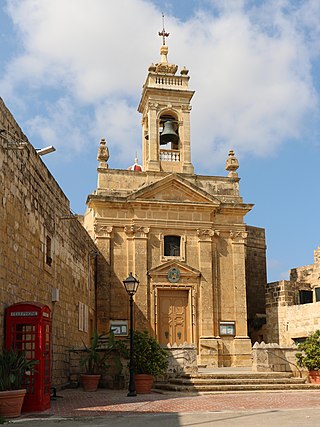
The Church of St Lucy is a rural small church located in a hamlet of Santa Luċija, Gozo, which hamlet was named after this church.

The Chapel of St. Matthew, popularly known as San Mattew Iż-Żgħir, literally meaning Saint Matthew the smaller, is a small medieval chapel located beside a larger church with the same name in an area known as il-Maqluba in Qrendi, Malta. The use of the word the smaller is used that one would not confuse it with the larger St. Matthew's church.

The Chapel of St Michael more popularly known in Maltese as Il-Kappella tas-San Ċir or Il-Kappella ta' San Mikiel is-Sanċir is a medieval chapel located in the limits of Rabat, Malta in an area referred to as Ġnien is-Sultan.

The Chapel of St. Anne is a small Roman Catholic church located in the village of Qrendi, Malta.

The Chapel of the Transfiguration of Jesus or simply known as Our Saviour's or Tas-Salvatur is a Roman Catholic chapel located in the village of Qrendi in the south of Malta.
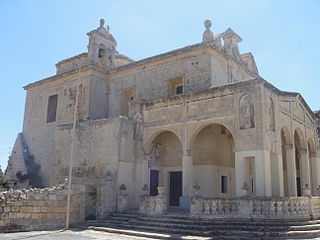
The Shrine of Our Lady of Mercy also known as Chiesa Della Misericordia or simply known as Tal-Ħniena is a Roman Catholic church located i the village of Qrendi, Malta. The church is referred to as a sanctuary due to people's devotion to the Virgin Mary of Mercy.

St. Catherine's Old Church, also known as St. Gregory's Church, is a Roman Catholic church in Żejtun. The church and its complex sit towards the outskirts of the town, commanding views over Marsascala Bay, St. Thomas' Bay and Marsaxlokk harbour. The church is colloquially known as Saint Gregory's due to a traditional procession held on the first Wednesday following Easter Sunday. Its dedication to Catherine of Alexandria dates back to an original chapel on this site, which was one of the eight mother churches on Malta. The church stands next to the three cemeteries of Żejtun, dedicated to St. Rocco, St. Gregory and St. Catherine. The church's functions as the parish church of Żejtun were taken over by a new parish church, also dedicated to St. Catherine, and designed by Lorenzo Gafà.

St Catherine's Chapel officially the Church of St Catherine and St Peter is an 18th-century Roman Catholic church located in Mqabba, Malta.

Our Saviour's formally known as The Church of the Transfiguration of Jesus, popularly known in Maltese as Is-Salvatur is a Roman Catholic church located in the village of Żejtun, in Malta.
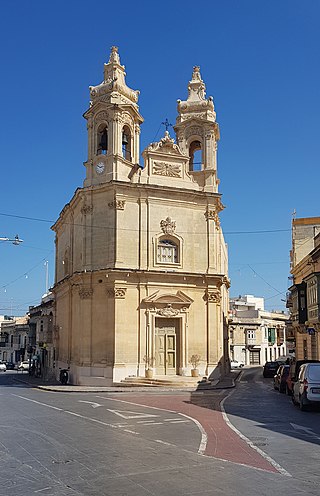
The Old Church of St Sebastian, commonly known as il-knisja ż-żgħira, is a Roman Catholic church in Qormi, Malta, dedicated to Saint Sebastian. It was built between 1880 and 1890 near a statue of the saint which had been erected in 1815 to commemorate deliverance from a plague epidemic in 1813. It was a parish church between 1935 and the 1980s, when a larger parish church with the same dedication was built nearby. The building was only formally consecrated in 2019, and it is now used as an adoration chapel.
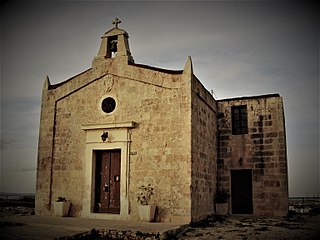
The Chapel of Our Lady of Itria, also known as the Church of Our Lady of Hodegetria, is a small Roman Catholic church in the Binġemma area of Mġarr, Malta.

