Jewish partisan; Bricha operative; U.S. businessman
Charles "Charlie" Thau (born Chaim Thau; 7 July 1921 – 2 April 1995) was a Polish-born Jewish partisan and Red Army lieutenant who appears in one of the most widely reproduced photographs of the Allied–Soviet link-up at the Elbe River on 25 April 1945.
The staged image, taken near Torgau, became a widely reproduced symbol of cooperation between the Western Allies and the Soviet Union. [1][2]
Following the German invasion of the Soviet Union in 1941, Thau survived for approximately nineteen months in hiding in the Carpathian forests.[3] In 1943, after being discovered by Red Army combatants, he joined the Soviet Army, serving as a translator before being field-commissioned as a lieutenant in the 58th Guards Rifle Division of the 1st Ukrainian Front. He participated in the Battle of Berlin and was wounded in combat.[4][5]
After the war, Thau became involved in the Bricha movement in Austria, assisting Holocaust survivors seeking to emigrate to British-administered Palestine. [6][7] He immigrated to the United States in 1951, where he became an automobile service-station owner in Milwaukee, Wisconsin. [4]
In the early 1990s, the tallest American soldier depicted in the Elbe photograph was misidentified in official commemorations for over a decade. The identification was formally corrected in 2008 following a review by the 69th Infantry Division Association.[8][9]
Early life and education
Charles Thau (Chaim Thau) was born on 7 July 1921 in the shtetl of Zabłotów in eastern Poland and was raised in an agrarian Jewish family. His father, Mordechai, worked as a merchant peddler based at the family farm, and his mother, Esther, taught Yiddish, German, and Polish from their home, which also served as a small classroom. Thau had two younger brothers. [10] Archival tax records list the Thau family among the higher tax-assessed households in Zabłotów, a market town in eastern Poland with roughly equal Jewish and Christian populations. This environment contributed to Thau's fluency in several languages. [11][12][a]
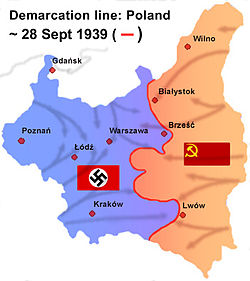
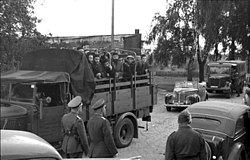
Polish demarcation line following the Molotov–Ribbentrop Pact, 1939Residents speak with a Red Army soldier, 1939
In September 1939, Germany and the Soviet Union signed the Molotov–Ribbentrop Pact,[13] which led to the partition of Poland at the outset of World War II. Zabłotów then came under Soviet administration.[14][15][16] During the Soviet occupation (1939–1941), local schools adopted Russian as a language of instruction, expanding Thau's linguistic knowledge beyond his existing proficiency in Polish, German, Yiddish, and Hebrew.[12][17] Contemporaneous accounts note that while some residents initially viewed the Soviet presence as protective, full integration of eastern Poland into the Soviet system soon followed.[18]
Atrocities against the Jewish population intensified during the latter half of 1941, as local collaborators participated in mass killings carried out by Einsatzgruppen units. [20][21] By the end of 1941, approximately 1,100 of Zabłotów's estimated 2,700 Jews had been executed.[21]
Jews transported, 1941–1942, Zabłotów area
Most of the remaining Jewish residents were deported to extermination camps. Thau's father, mother, and two younger brothers — Mordechai, Esther, Barrish, and Hershel — did not survive.[3][21] According to the survivor account "The Destruction of Our Community," besides Thau only five other Jewish residents of the town are known to have survived the war.[3]
Hiding and partisan activity
Following the German invasion in 1941, Thau fled into the Carpathian forests, where he survived for approximately 19 months.[3]
Thau relied on foraging and survival methods documented among Jewish forest partisans in the region, including concealed dugouts (Zemlyanka) to endure winter conditions and avoid detection and capture.[19][22][23]
He later linked up with another Jewish survivor, a childhood friend named Moshe, and worked together near the Romanian border.[24][25] Retrospective reporting by Der Spiegel (2025) and The Forward (2025) states that on occasion Thau disguised himself as a Wehrmacht officer, using his fluency in German and a procured uniform to enter a nearby city to obtain food and medical treatment.[25][26]
Red Army service
In mid-1943, when Red Army combatants discovered Thau in the woods, they suspected him of being a Nazi collaborator or Wehrmacht deserter, reflecting broader Red Army suspicion toward civilians emerging from occupied territories.[27] His fluency in German initially aroused suspicion among Soviet troops.[28] After Thau demonstrated fluency in Russian as well, he was integrated into their ranks as a translator.[1] His language skills made him valuable in interrogations and liaison duties.[29][30]
During the Battle of Berlin, 76 mm divisional guns such as the ZiS-3 were frequently employed in direct-fire roles against fortified positions and strongpoints in urban combat, a practice documented in contemporary operational histories of the Soviet advance into the city.[34]
Battle of Berlin
Nearing the final weeks of the war, the 58th Guards Rifle Division advanced toward Berlin and fought in street-to-street combat.[35]
Soviet advances in April 1945, illustrating encirclement of the German capital by multiple Soviet fronts.
During the fighting in Berlin, Thau sustained a machine-gun wound to his jaw, one of several combat injuries he suffered during the war. A bullet slug from that wound remained unknowingly lodged in his cheek for over six years before being surgically removed after its discovery during a dental examination in Milwaukee in 1951.[36][37]
In April 1945, as part of the 1st Ukrainian Front's westward advance in the south, Thau's 58th Guards Rifle Division reached the Elbe River on 25 April and participated in the Allied–Soviet link-up before shifting to final operations against Berlin.[5]
Elbe River link-up (April 1945)
U.S. forces advancing eastward were ordered to halt at the Elbe–Mulde line in anticipation of contact with Soviet forces. [5]
The meeting between elements of the 58th Guards Rifle Division and the 69th Infantry Division (United States) was one of several contacts that established the Allied–Soviet link-up in central Germany. [5]
Thau at center behind handshake facing camera
Thau appears in the widely circulated staged re-enactment of the event, positioned in the center behind the handshake and looking directly into the camera.[1] In the image, he appears to be dressed in a standard Red Army field uniform (gymnastyorka Model 1943) with a sidearm in a belt holster.[38]
In the widely reproduced photograph, Thau is shown wearing Soviet military decorations, including what appears to be the Medal "For Courage" and the Medal "For Battle Merit". On his right chest, high-resolution reproductions of the image show wound stripes (ranenie stripes) on his right chest, consistent with Soviet regulations governing decorations for prior injuries.[39]
Film from the camera that captured the handshake was transmitted to the Associated Press. One of the photographs appeared on the front page of The New York Times on 25 April 1945.[40]
Misidentification of American soldier
Beginning in the early 1990s, the tall American soldier at the far left of the Elbe handshake photograph was identified in commemorative materials and ceremonies as Delbert Philpott. The attribution appeared in Torgau historiography, including the third revised edition of ’‘Elbe Begegnung – Link-Up’’ (2007).[41]
During the 50th anniversary observances in Torgau in 1995, Bernard E. Kirschenbaum, a veteran of the 273rd Regiment, 69th Infantry Division, signed the guestbook as the soldier depicted in the photograph and disputing the Philpott attribution.[26] The identification in commemorative materials nevertheless remained unchanged. In May 2005, Philpott even attended the 60th anniversary events in Moscow as an honored guest at a state dinner hosted by Presidents Vladimir Putin and George W. Bush.[42][43]
In 2008, Charles Thau’s son, colonel Jeff Thau, USAF (retired), conducted archival research into the identities of the soldiers depicted and concluded that the individual in question was Bernard E. Kirschenbaum rather than Philpott.[8][26][44] The 69th Infantry Division Association and Torgau historian Uwe Niedersen then subsequently issued a formal correction recognizing Technician Fifth Grade Bernard E. Kirschenbaum as the soldier shown in the photograph.[9]
The correction revised the identification of the American soldier in widely reproduced images of the Allied–Soviet link-up at the Elbe River on 25 April 1945.[44]
Postwar activities
After the war, Thau returned briefly to Zabłotów. Upon learning that his immediate family had perished, he did not remain.[45] He became a clandestine Bricha operative based in Austria and later immigrated to the United States, where he raised a family and became a business owner.[46]
Bricha operative
After the war, Thau relocated to Salzburg, Austria, where he worked as an automobile mechanic and became involved in the underground Bricha network, which assisted Holocaust survivors and other displaced persons seeking to leave postwar Europe for British-administered Palestine.[8][6][7][47]
Thau's Bricha routes from Austria over the Alps to Mediterranean ports, 1946–1947, courtesy of HaBricha Assoc, Chairperson – Dr. Miri Nehari
Operating from the Salzburg region, including the displaced-persons camp at Saalfelden, Thau participated in logistical activities associated with refugee transport despite British immigration restrictions in Palestine.[8][47] He helped coordinate movement routes across the Alps, facilitated border crossings, and assisted refugees traveling toward Mediterranean embarkation ports used for clandestine immigration voyages.[48][47]
Bricha unit at Camp Saalfelden, Austria, c. 1947–48. Thau shown top row, third from right.
Historians note that Bricha activities in Austria were closely tied to the displaced-persons camp system established by Allied authorities, which concentrated large numbers of Jewish survivors in the American occupation zone.[49][50] Camps in the Salzburg region, including Saalfelden, functioned as staging centers where refugee groups were assembled, transportation arranged, and temporary or forged travel documentation prepared for onward movement across Alpine transit corridors into northern Italy and onward to Mediterranean ports.[51][52][53]
Photographs from the late 1940s depict members of Thau’s Bricha unit near Salzburg.[8]
Immigration
Recalling what soldiers of the 69th Infantry Division had told him at the Elbe link-up about life in America, Thau sought help from the American Jewish Joint Distribution Committee at Camp Saalfelden to immigrate to the United States. They assisted him in securing a sponsor, as prospective immigrants were required to have one. Attorney David Rabinowitz of Sheboygan, Wisconsin, was identified as his sponsor. [54]
After resettling in Milwaukee, Chaim Thau adopted the name Charles Thau and resumed his trade as an auto mechanic, a skill he had practiced in postwar Salzburg. [4]
From the early 1950s through the 1990s, Thau owned and operated multiple service stations, eventually expanding to several Phillips 66–branded locations across the city. [56]
Charles Thau (right) and his assistant Glenn Retzlaff, c. 1970Thau's Phillips 66 Garage, Capital Drive circa 1970s
By 1955, Thau was already established as a gas station operator in Milwaukee.[4][c] Independent records from the early 1960s list his business, Thau's 66 Service Station, at 433 South 6th Street.[57] He later established Thau's Garage at 4229 West Greenfield Avenue and operated another Phillips 66 station on West Capitol Drive.[58]
Thau often used his multilingual skills—Polish, Russian, Yiddish, German, and English—to assist newly arrived immigrants from Europe. His garages became gathering places for Milwaukee's post-war Jewish and European community, where he helped with translations, employment referrals, and introductions.[37][46] Even as his business grew, Thau remained personally involved in daily operations and maintained close ties with his family and community.[46]
Thau's Brake & Muffler Shop (Phillips 66), c. 1980s
Personal life
Thau and daughter Esther dancing at June 1975 wedding
Thau worked long hours while raising a family. He married Ida (née Faich); they had three children: Martin, Jeffrey, and Esther.[37]
Thau (right) and two sons Jeff (center) and Martin (left), March 1965.
In 1951, during his first routine dental X-ray in Milwaukee, a slug fragment from his Berlin wound was discovered still lodged in his jaw and was surgically removed, six years after he was wounded. [36]
A family photograph from 1965 (left) shows Thau with his sons socializing in a Milwaukee home, and a photo from 1975 (right) shows him at his daughter's wedding, both taken during the period when he was operating and expanding his Phillips 66 service stations.[59]
Charles Thau died on 2 April 1995, several weeks before the 50th anniversary of Elbe Day. [60]
Legacy
Historians and journalists have frequently cited the Allied–Soviet meeting at the Elbe River on 25 April 1945 as a symbolic moment of cooperation between the Western Allies and the Soviet Union near the end of the war in Europe. The staged handshake photograph in which Thau appears became one of the most widely reproduced images of the link-up and has been referenced in diplomatic commemorations of Elbe Day. Scholars have interpreted the image as representing a brief moment of Allied unity before the onset of Cold War tensions between the former wartime partners.[61][62][63]
In 1955, Thau discussed his wartime experiences in an interview with the Milwaukee Journal.[4]
U.S. President George W. Bush and Russian President Vladimir Putin issued a joint declaration citing the Elbe meeting as a symbol of wartime cooperation between their nations.[2] Similar references to the link-up were made during commemorations under Presidents Bill Clinton and Barack Obama, and by former Soviet leader Mikhail Gorbachev.[64][65][66]
The scene depicted in the photograph is represented in a bas-relief sculpture at the National World War II Memorial in Washington, D.C., where the Elbe meeting is commemorated as a symbol of Allied cooperation.[67]
The city of Torgau has held commemorative events acknowledging Thau's role in the photograph, attended by diplomatic representatives from Russia, the United States, and Germany.[68]
Since Thau's passing, he was represented at multiple Elbe Day anniversary events by his youngest son, retired USAF colonel Jeff Thau.[67]
↑During the interwar years, Zabłotów's Tuesday markets connected surrounding agrarian families with Jewish merchants and craftsmen. The town's population was multilingual, speaking Polish, Yiddish, Ukrainian, and German, reflecting the diverse demographics of Galicia. "Zablotov (in Jewish Galicia & Bukovina)". Jewish Galicia and Bukovina. JGB Organization. Retrieved 24 July 2025.; "Galicia". YIVO Encyclopedia of Jews in Eastern Europe. YIVO Institute for Jewish Research. Retrieved 14 October 2025.
↑ The "Guards" (Gvardiya) designation was an elite status bestowed upon Soviet units that distinguished themselves in major combat operations. The 58th Guards earned this title following the encirclement of the German 6th Army at Stalingrad. For a junior officer like Thau, serving in a Guards unit implied participation in high-tempo offensive operations under the 1st Ukrainian Front's strategic objectives.
↑The earliest site of Thau's garage was located at 59th and Lisbon Avenue. (Wisconsin Jewish Chronicle 2025)
↑Decree of the Presidium of the Supreme Soviet of the USSR No. 213 (14 July 1942): "On the establishment of insignia for military personnel of the Red Army wounded in battles."
Bauer, Yehuda (1970). Flight and Rescue: Brichah. Random House.
Lavsky, Hagit (2002). New Beginnings: Holocaust Survivors in Bergen-Belsen and the British Zone in Germany, 1945–1950. Detroit: Wayne State University Press. ISBN9780814328453.
Brecher, Michael; Wilkenfeld, Jonathan (1997). A Study of Crisis. University of Michigan Press. ISBN0-472-10806-9.
Browning, Christopher R. (2004). The Origins of the Final Solution: The Evolution of Nazi Jewish Policy, September 1939–March 1942. Lincoln: University of Nebraska Press. ISBN978-0-8032-1327-2.
Central Intelligence Agency (1955). Clothing and Individual Equipment — Soviet Army. Washington, D.C.: Central Intelligence Agency.
"Gas Station Operator Recalls U.S.–Russ Union". The Milwaukee Journal. 1 May 1955. p.193.
NASA Ames Research Center (2005). "Retired NASA scientist finds place in history twice". Astrogram: 7.
Nehari, Miri (24 April 2015). "The Association". Ha Bricha Association.
Niedersen, Uwe, ed. (2007). Elbe Begegnung: Link-Up (3rd rev. and exp.ed.). Torgau: Förderverein Europa Begegnungen e.V.
Ofer, Dalia (1990). Escaping the Holocaust: Illegal Immigration to the Land of Israel, 1939–1944. New York: Oxford University Press. ISBN978-0-19-506340-0.
Pogue, Forrest C. (1990). The Supreme Command. Center of Military History, United States Army.
Reese, Roger R. (2011). Why Stalin's Soldiers Fought: Readiness and Resistance in the Red Army. Lawrence: University Press of Kansas. ISBN978-0-7006-1777-7.
Schöne, Günter, ed. (1995). Down by the Riverside: Die Botschaft von der Elbe, 1945–1995 (in German). Leipzig: Thom Verlag.
Tec, Nechama (1993). Defiance: The Bielski Partisans. New York: Oxford University Press. ISBN978-0-19-509390-2.
Tax records of Zabłotów (interwar period). Ivano-Frankivsk: State Archive of Ivano-Frankivsk Oblast. 1939.
Thau, Jeffrey (June 2008). "Memories of a Handshake across the Elbe River Remain 63 Years Later". The Jewish Veteran. 61 (3): 9, 25.
"Obituary for Charles Thau". The Wisconsin Jewish Chronicle. 21 April 1995. p.22.
Zaffern, Bernard H. (2005). "Moscow Celebration of the 60th Anniversary of V-E Day". Fighting 69th Infantry Division Association Bulletin. 58 (3): 9–11.
Ziemke, Earl F. (1975). The U.S. Army in World War II: The Red Army and the Elbe. Center of Military History, United States Army.
This page is based on this Wikipedia article Text is available under the CC BY-SA 4.0 license; additional terms may apply. Images, videos and audio are available under their respective licenses.

 Soviet Union