
Configuration management (CM) is a systems engineering process for establishing and maintaining consistency of a product's performance, functional, and physical attributes with its requirements, design, and operational information throughout its life. The CM process is widely used by military engineering organizations to manage changes throughout the system lifecycle of complex systems, such as weapon systems, military vehicles, and information systems. Outside the military, the CM process is also used with IT service management as defined by ITIL, and with other domain models in the civil engineering and other industrial engineering segments such as roads, bridges, canals, dams, and buildings.
Conformance testing — an element of conformity assessment, and also known as compliance testing, or type testing — is testing or other activities that determine whether a process, product, or service complies with the requirements of a specification, technical standard, contract, or regulation. Testing is often either logical testing or physical testing. The test procedures may involve other criteria from mathematical testing or chemical testing. Beyond simple conformance, other requirements for efficiency, interoperability, or compliance may apply. Conformance testing may be undertaken by the producer of the product or service being assessed, by a user, or by an accredited independent organization, which can sometimes be the author of the standard being used. When testing is accompanied by certification, the products or services may then be advertised as being certified in compliance with the referred technical standard. Manufacturers and suppliers of products and services rely on such certification including listing on the certification body's website, to assure quality to the end user and that competing suppliers are on the same level.
In software project management, software testing, and software engineering, verification and validation (V&V) is the process of checking that a software system meets specifications and requirements so that it fulfills its intended purpose. It may also be referred to as software quality control. It is normally the responsibility of software testers as part of the software development lifecycle. In simple terms, software verification is: "Assuming we should build X, does our software achieve its goals without any bugs or gaps?" On the other hand, software validation is: "Was X what we should have built? Does X meet the high-level requirements?"
Aeronautical Engineers Australia (AEA) is an Australian aeronautical engineering consultancy and aircraft technical service provider. It is the largest civil aircraft design organisation in the Asia Pacific region and is now headquartered in Adelaide.

The European Union Aviation Safety Agency (EASA) is an agency of the European Commission with responsibility for civil aviation safety in the European Union. It carries out certification, regulation and standardisation and also performs investigation and monitoring. It collects and analyses safety data, drafts and advises on safety legislation and co-ordinates with similar organisations in other parts of the world.

A type certificate signifies the airworthiness of a particular category of aircraft, according to its manufacturing design. Certification confirms that the aircraft of a new type intended for serial production is in compliance with applicable airworthiness requirements established by the national air law.
Software quality assurance (SQA) is a means and practice of monitoring all software engineering processes, methods, and work products to ensure compliance against defined standards. It may include ensuring conformance to standards or models, such as ISO/IEC 9126, SPICE or CMMI.
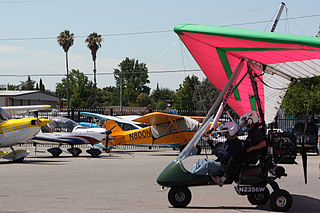
A light-sport aircraft (LSA), or light sport aircraft, is a fairly new category of small, lightweight aircraft that are simple to fly. LSAs tend to be heavier and more sophisticated than ultralight aircraft, but LSA restrictions on weight and performance separates the category from established GA aircraft. There is no standard worldwide description of an LSA.
DO-178B, Software Considerations in Airborne Systems and Equipment Certification is a guideline dealing with the safety of safety-critical software used in certain airborne systems. It was jointly developed by the safety-critical working group RTCA SC-167 of the Radio Technical Commission for Aeronautics (RTCA) and WG-12 of the European Organisation for Civil Aviation Equipment (EUROCAE). RTCA published the document as RTCA/DO-178B, while EUROCAE published the document as ED-12B. Although technically a guideline, it was a de facto standard for developing avionics software systems until it was replaced in 2012 by DO-178C.
Software assurance (SwA) is a critical process in software development that ensures the reliability, safety, and security of software products. It involves a variety of activities, including requirements analysis, design reviews, code inspections, testing, and formal verification. One crucial component of software assurance is secure coding practices, which follow industry-accepted standards and best practices, such as those outlined by the Software Engineering Institute (SEI) in their CERT Secure Coding Standards (SCS).
The process of establishing documentary evidence demonstrating that a procedure, process, or activity carried out in testing and then production maintains the desired level of compliance at all stages. In the pharmaceutical industry, it is very important that in addition to final testing and compliance of products, it is also assured that the process will consistently produce the expected results. The desired results are established in terms of specifications for outcome of the process. Qualification of systems and equipment is therefore a part of the process of validation. Validation is a requirement of food, drug and pharmaceutical regulating agencies such as the US FDA and their good manufacturing practices guidelines. Since a wide variety of procedures, processes, and activities need to be validated, the field of validation is divided into a number of subsections including the following:

In aviation, airworthiness is the measure of an aircraft's suitability for safe flight. Initial airworthiness is demonstrated by a certificate of airworthiness issued by the civil aviation authority in the state in which the aircraft is registered, and continuing airworthiness is achieved by performing the required maintenance actions.
Civil Aviation Authority of Bangladesh (CAAB) functions as the regulatory body for all aviation related activities in Bangladesh. It is the civil aviation authority operating under the Ministry of Civil Aviation & Tourism. All nine operational airports are operated by the CAAB. A member of International Civil Aviation Organization, it has signed bilateral air transport agreement with 52 states. It is headquartered in Kurmitola, Dhaka.

In aviation, V-speeds are standard terms used to define airspeeds important or useful to the operation of all aircraft. These speeds are derived from data obtained by aircraft designers and manufacturers during flight testing for aircraft type-certification. Using them is considered a best practice to maximize aviation safety, aircraft performance, or both.
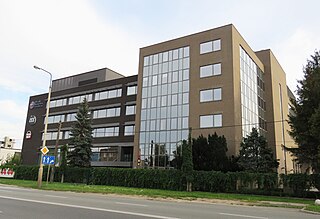
The Civil Aviation Authority (CAA) of the Republic of Poland, as a civil aviation authority, is an agency of the Polish government under the Ministry of Infrastructure and Development responsible for implementing policies on civil aviation to assure safe, economic and efficient air travel. The Civil Aviation Authority is responsible for providing and maintaining safe and efficient aviation services to, from and within Poland. The president of the CAA performs functions of aviation administration and aviation supervision authority in the following areas among others:
A civil aviation authority (CAA) is a national or supranational statutory authority that oversees the regulation of civil aviation, including the maintenance of an aircraft register.

Blade off testing or blade out testing is a specific form of air safety testing required by the Federal Aviation Administration and other safety agencies to certify safety performance of jet engines. The tests require engine manufacturers to carry out at least two tests of the engine, to make sure that the engine can survive a compressor or fan blade breaking off within the engine and a turbine blade breaking off within the engine, without fragments being thrown through the outside enclosure of the engine, creating a contained engine failure.
The Brazilian Organization for the Development of Aeronautical Certification is a nonprofit organization, of public interest, regulated by Brazilian Law number 9.790 as of March 23, 1999, and registered at the Brazilian Ministry of Justice on November 28, 2006.
DO-178C, Software Considerations in Airborne Systems and Equipment Certification is the primary document by which the certification authorities such as FAA, EASA and Transport Canada approve all commercial software-based aerospace systems. The document is published by RTCA, Incorporated, in a joint effort with EUROC and replaces DO-178B. The new document is called DO-178C/ED-12C and was completed in November 2011 and approved by the RTCA in December 2011. It became available for sale and use in January 2012.

The aircraft design process is a loosely defined method used to balance many competing and demanding requirements to produce an aircraft that is strong, lightweight, economical and can carry an adequate payload while being sufficiently reliable to safely fly for the design life of the aircraft. Similar to, but more exacting than, the usual engineering design process, the technique is highly iterative, involving high-level configuration tradeoffs, a mixture of analysis and testing and the detailed examination of the adequacy of every part of the structure. For some types of aircraft, the design process is regulated by civil airworthiness authorities.