
Kalaripayattu is an Indian martial art that originated in Kerala, a state on the southwestern coast of India during the 11th–12th century CE.

Koodiyattam is a traditional performing art form in the state of Kerala, India. It is a combination of ancient Sanskrit theatre with elements of Koothu, an ancient performing art from the Sangam era. It is officially recognised by UNESCO as a Masterpiece of the Oral and Intangible Heritage of Humanity.

The Malayali people are a Dravidian ethnolinguistic group originating from the present-day state of Kerala in India, occupying its southwestern Malabar coast. They form the majority of the population in Kerala and Lakshadweep. They are predominantly native speakers of the Malayalam language, one of the six classical languages of India. The state of Kerala was created in 1956 through the States Reorganisation Act. Prior to that, since the 1800s existed the Kingdom of Cochin, the Kingdom of Travancore, Malabar District, and South Canara of the British India. The Malabar District was annexed by the British through the Third Mysore War (1790–92) from Tipu Sultan. Before that, the Malabar District was under various kingdoms including the Zamorins of Calicut, Kingdom of Tanur, Arakkal kingdom, Kolathunadu, Valluvanad, and Palakkad Rajas.

Poorakkali is a traditional dance ritual performed by men during the nine-day Pooram festival in Bhagavathy temples across North Malabar in Kerala State of south India.
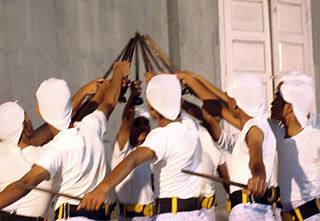
Kolkali is a folk art performed in Malabar region of Kerala, India. The dance performers move in a circle, striking small sticks and keeping rhythm with special steps. The circle expands and contracts as the dance progress. The accompanying music gradually rises in pitch and the dance reaches its climax. Kolkali is now a popular event in Kerala School Kalolsavam, which is considered as the biggest cultural event of Asia. There are two styles of Kolkali: the actual Kolkali and Thekkan Koladi. The actual Kolkali consists of Thacholikali, Rajasooyam etc. The actual kolkali is almost at verge of extinction and Thekkan Koladi is still alive as it is added in state kololsavams.

Oppana is a popular form of social entertainment among the Mappila community of Kerala, South India, prevalent throughout Kerala, especially in Malabar. The term Oppana is believed to be originated from the Arabic word "Affna". Oppana is traditionally used in various important cultural ceremonies, and in particular, is a component of all Mappila weddings. In Kerala, this art form has been revived with much popularity on the performing stages of the Youth Festivals of the student community.

Kerala Kalamandalam, a deemed-to-be-University of Art and Culture by the Government of India, is a major centre for learning Indian performing arts, especially those that developed in the country's southern states, with special emphasis on those from Kerala. The institution, on the banks of the Bharathapuzha river, is situated in the small town of Cheruthuruthi in Thrissur district.
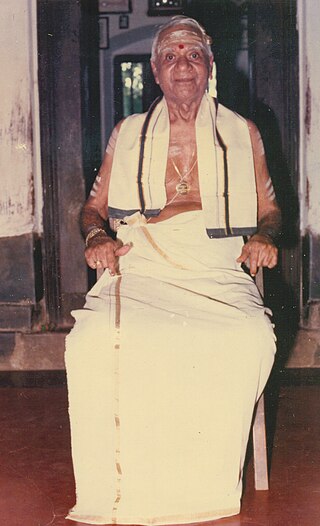
Guru Mani Madhava Chakyar (15 February 1899 – 14 January 1990) was a celebrated master performance artist and Sanskrit scholar from Kerala, India, considered to be the greatest Chakyar Koothu and Koodiyattam artist and authority of modern times. He was considered as the authority of Abhinaya and Nātyaśāstra.

The culture of Kerala has developed over the past millennia, influences from other parts of India and abroad. It is defined by its antiquity and the organic continuity sustained by the Malayali people. Modern Kerala society took shape owing to migrations from different parts of India and abroad throughout Classical Antiquity.

Duffmuttu is an art form prevalent in the Malabar region of the states of Kerala and Karnataka in south India. It derives its name from the duff, a percussion instrument made of wood and ox skin. The word duff is of Arabic origin and is also called a thappitta.
The Indian state Kerala is well known for its diverse forms of performing arts. The various communities in Kerala contribute to its rich and colourful culture. The most important traditional art forms of Kerala are Kathakali, Kalaripayattu,Mayilpeeli Thookkam, Koodiyattam, Theyyam, Mohiniyattam, Thullal, Padayani, Pulikali, Thiruvathirakali, Chakyarkoothu,Chavittunadakam, etc.

Margamkali is an ancient Indian round dance of the St. Thomas Christians community- based in Kerala state, mainly practiced by the endogamous sub-sect known as the Knanaya or Southist Christians. The dance retells the life and missionary work of Thomas the Apostle, based on the 3rd-century apocryphal Acts of Thomas.

Mangalamkali is a dance ritual related to marriage functions as a form of entertainment. Usually mavilas (a tribe in kasaragod and kannur districts Kerala perform this. Certain music instruments too are used like thudi. The dance movement gradually become fast.

Killikkurussimangalam is a village around 8 km from nearby town Ottappalam in Palakkad district of Kerala, south India. The river Nila (Bharatapuzha) flows through the southern border of Lakkidi.
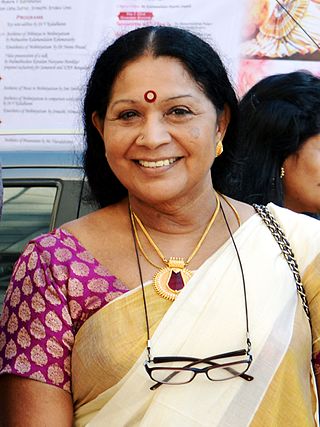
Kalamandalam Kshemavathy is a Mohiniyattam dancer from Thrissur, Kerala. She is an alumna of the Kerala Kalamandalam. She joined the institute when she was ten. After completion of the course, she undertook advanced training in Bharata Natyam under Muthuswamy Pillai and Chitra Visweswaran, and in Kuchipudi under Vempati Chinna Satyam, but chose to remain within the Mohiniyattam tradition.

The Nenmara Vallanghy Vela or Nenmara Vela is one of the most popular annual festival of Kerala celebrated at Nellikulangara Bhagavathy temple in Nenmara, Palakkad district.
Paanivadathilakan P. K. Narayanan Nambiar was an Indian musician, known for his virtuosity in Mizhavu, a traditional percussion instrument and his scholarship in the art of Koodiyattom. He is considered to be one of the masters of Koodiyattom. In 2008, he was awarded Padmashri by Government of India for his services to the art.
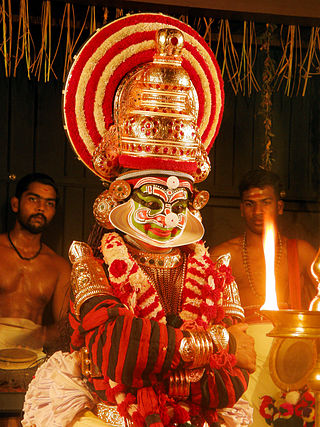
Moozhikkulam Kochukuttan Chakyar (1928–2009) was an exponent of Koodiyattam, a traditional form of Sanskrit theatre from Kerala, which has been recognised by UNESCO as an Oral and Intangible Heritage of Mankind. Born in a family of Koodiyattam performers, in 1928, at Ammannur, a small hamlet near Irinjalakuda, in Thrissur district in the south Indian state of Kerala, Chakyar had his early training in the art form from within his family. Ammannur Madhava Chakyar, a renowned Koodiyattam performer and a Padmabhushan awardee, was his cousin and the two, later, would evolve a new school of performance, popularly known as the Ammannur tradition of Koodiyattam. When Margi, an institution promoting traditional art forms of Kerala, started their Koodiyattam training centre in 1981, he was the first residential guru. The institution imparted training to many aspiring performers which included two sons of Chakyar, Margi Sajeev Narayana Chakiar and Margi Madhu and both of them are known exponents of the art form. In 1998, Chakyar joined Nepathya, a centre for excellence in Kudiyattam, as the Mukhya Acharya, and continued his association with the institution till his last. The Government of India awarded him the fourth highest civilian honour of the Padma Shri, in 2008, for his contributions to Arts. He died in 2009, at the age of 81. He is remembered by an annual festival, Guru Moozhikkulam Kochukuttan Chakyar Memorial Kutiyttam Festival, at Moozhikkulam, a suburb of Kochi where Nepathya is headquartered in, and through orations organised by Nepathya.
Gandharvanpattu is a ritual artform in North Kerala. This ritual is mainly performed by Vannan. There is five theyyams called Rudhirakkali, Varavakkali, Devathe, Mekkkaruvaal, Gandharvan in gandharvanpattu. This ritual is performed for the blessing of bhootam. The ritual is performed in the style of kalam pattu in Kavu. In past times this artform is performed on the houses where pregnant women live to eliminate different kinds of badha(ghost). Pulluvaveena and Pulluvakkudam are also used in Gandharvan Pattu.
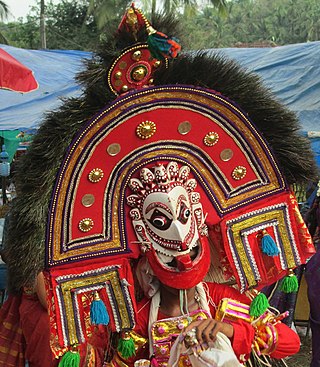
Poothamkali is folk art form in the state of Kerala, India. This art form uses various types of decorations in the costume. It is usually performs in the Bhagavathy temples of Malappuram district. It is based on the myth of Durga and her combat with Darika.


