Related Research Articles
Discussions of race and intelligence – specifically regarding claims of differences in intelligence along racial lines – have appeared in both popular science and academic research since the modern concept of race was first introduced. With the inception of IQ testing in the early 20th century, differences in average test performance between racial groups were observed, though these differences have fluctuated and in many cases steadily decreased over time. Complicating the issue, modern science has concluded that race is a socially constructed phenomenon rather than a biological reality, and there exist various conflicting definitions of intelligence. In particular, the validity of IQ testing as a metric for human intelligence is disputed. Today, the scientific consensus is that genetics does not explain differences in IQ test performance between groups, and that observed differences are environmental in origin.
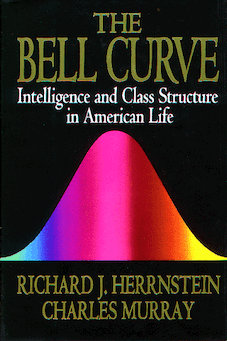
The Bell Curve: Intelligence and Class Structure in American Life is a 1994 book by psychologist Richard J. Herrnstein and political scientist Charles Murray, in which the authors argue that human intelligence is substantially influenced by both inherited and environmental factors and that it is a better predictor of many personal outcomes, including financial income, job performance, birth out of wedlock, and involvement in crime than are an individual's parental socioeconomic status. They also argue that those with high intelligence, the "cognitive elite", are becoming separated from those of average and below-average intelligence, and that this separation is a source of social division within the United States.
Racial discrimination is any discrimination against any individual on the basis of their race, ancestry, ethnicity, and/or skin color and hair texture. Individuals can discriminate by refusing to do business with, socialize with, or share resources with people of a certain group. Governments can discriminate explicitly in law, for example through policies of racial segregation, disparate enforcement of laws, or disproportionate allocation of resources. Some jurisdictions have anti-discrimination laws which prohibit the government or individuals from being discriminated based on race in various circumstances. Some institutions and laws use affirmative action to attempt to overcome or compensate for the effects of racial discrimination. In some cases, this is simply enhanced recruitment of members of underrepresented groups; in other cases, there are firm racial quotas. Opponents of strong remedies like quotas characterize them as reverse discrimination, where members of a dominant or majority group are discriminated against.
Scientific racism, sometimes termed biological racism, is the pseudoscientific belief that the human species can be subdivided into biologically distinct taxa called "races", and that empirical evidence exists to support or justify racism, racial inferiority, or racial superiority. Before the mid-20th century, scientific racism was accepted throughout the scientific community, but it is no longer considered scientific. The division of humankind into biologically separate groups, along with the assignment of particular physical and mental characteristics to these groups through constructing and applying corresponding explanatory models, is referred to as racialism, race realism, or race science by those who support these ideas. Modern scientific consensus rejects this view as being irreconcilable with modern genetic research.
The one-drop rule was a legal principle of racial classification that was prominent in the 20th-century United States. It asserted that any person with even one ancestor of black ancestry is considered black. It is an example of hypodescent, the automatic assignment of children of a mixed union between different socioeconomic or ethnic groups to the group with the lower status, regardless of proportion of ancestry in different groups.
White privilege, or white skin privilege, is the societal privilege that benefits white people over non-white people in some societies, particularly if they are otherwise under the same social, political, or economic circumstances. With roots in European colonialism and imperialism, and the Atlantic slave trade, white privilege has developed in circumstances that have broadly sought to protect white racial privileges, various national citizenships, and other rights or special benefits.
Griggs v. Duke Power Co., 401 U.S. 424 (1971), was a court case argued before the Supreme Court of the United States on December 14, 1970. It concerned employment discrimination and the disparate impact theory, and was decided on March 8, 1971. It is generally considered the first case of its type.
A large body of research indicates that IQ and similar measures vary between individuals and between certain groups, and that they correlate with socially important outcomes such as educational achievement, employment, crime, poverty and socioeconomic status.
In the United States, acting white is a pejorative term, usually applied to Black people, which refers to a person's perceived betrayal of their culture by assuming the social expectations of white society. It can be applied to success in education, though this view is highly debated. In 2020, 93.6% of African-Americans between 25 and 39 had a high school diploma, on par with the national average, though African-Americans have a higher tendency to drop out from college than their white peers.

Stereotypes of African Americans are misleading beliefs about the culture of people with partial or total ancestry from any black racial groups of Africa whose ancestors resided in the United States since before 1865, largely connected to the racism and the discrimination to which African Americans are subjected. These beliefs date back to the slavery of black people during the colonial era and they have evolved within American society.

"Mainstream Science on Intelligence" was a public statement issued by a group of researchers led by psychologist Linda Gottfredson. It was published originally in The Wall Street Journal on December 13, 1994, as a response to criticism of the book The Bell Curve by Richard Herrnstein and Charles Murray, which appeared earlier the same year. The statement defended Herrnstein and Murray's controversial claims about race and intelligence, including the claim that average intelligence quotient (IQ) differences between racial and ethnic groups may be at least partly genetic in origin. This view is now considered discredited by mainstream science.
John Uzo Ogbu was a Nigerian-American anthropologist and professor known for his theories on observed phenomena involving race and intelligence, especially how race and ethnic differences played out in educational and economic achievement. He suggested that being a "caste-like minority" affects motivation and achievement, depressing IQ scores. He also concluded that some students did poorly because high achievement was considered "acting white" among their peers. Ogbu was also involved in the 1996 controversy surrounding the use of African American Vernacular English in public schools in Oakland, California. The 2000 book Eminent Educators: Studies in Intellectual Influence focused on him as one of "four intellectual giants of the 20th century."
The Black Intelligence Test of Cultural Homogeneity, also known as BITCH-100 or The BITCH Test, is an intelligence test created by Robert Williams in 1972 oriented toward the language, attitudes, and life-styles of African Americans.
Aversive racism is a social scientific theory proposed by Samuel L. Gaertner & John F. Dovidio (1986), according to which negative evaluations of racial/ethnic minorities are realized by a persistent avoidance of interaction with other racial and ethnic groups. As opposed to traditional, overt racism, which is characterized by overt hatred for and discrimination against racial/ethnic minorities, aversive racism is characterized by more complex, ambivalent expressions and attitudes nonetheless with prejudicial views towards other races. Aversive racism arises from unconscious personal beliefs taught during childhood. Subtle racist behaviors are usually targeted towards African Americans. Workplace discrimination is one of the best examples of aversive racism. Biased beliefs on how minorities act and think affect how individuals interact with minority members.
Symbolic racism is a coherent belief system that reflects an underlying one-dimensional prejudice towards a racialized ethnicity. These beliefs include the stereotype that black people are morally inferior to white people, and that black people violate traditional White American values such as hard work and independence. However, symbolic racism is more of a general term than it is one specifically related to prejudice towards black people. These beliefs may cause the subject to discriminate against black people and to justify this discrimination. Some people do not view symbolic racism as prejudice since it is not linked directly to race but is indirectly linked through social and political issues.
The history of the race and intelligence controversy concerns the historical development of a debate about possible explanations of group differences encountered in the study of race and intelligence. Since the beginning of IQ testing around the time of World War I, there have been observed differences between the average scores of different population groups, and there have been debates over whether this is mainly due to environmental and cultural factors, or mainly due to some as yet undiscovered genetic factor, or whether such a dichotomy between environmental and genetic factors is the appropriate framing of the debate. Today, the scientific consensus is that genetics does not explain differences in IQ test performance between racial groups.

The sociology of race and ethnic relations is the study of social, political, and economic relations between races and ethnicities at all levels of society. This area encompasses the study of systemic racism, like residential segregation and other complex social processes between different racial and ethnic groups.

Poor White is a sociocultural classification used to describe economically disadvantaged Whites in the English-speaking world, especially White Americans with low incomes.

Bias in Mental Testing is a book by Arthur Jensen about bias in IQ tests.

White people in the United Kingdom are a multi-ethnic group of UK residents who identify as and are perceived to be 'white people'. White people constitute the historical and current majority of the people living in the United Kingdom, with 87.2% of the population identifying as white in the 2011 United Kingdom census.
References
- 1 2 Hoffarth, G. (2006). Education and Religion in Dominant-Minority Relations. In Race, Ethnicity, and Diversity. Retrieved December 5, 2012, from .
- ↑ Kaplan, R., Saccuzzo, D., (2010). Psychological Testing: Principles, Applications, and Issues. Belmont, CA: Wadsworth, Cengage Learning.
- ↑ Dove, A. (1971). The Chitling Test. In Psychlotron. Retrieved December 5, 2012, from http://psychlotron.org.uk/resources/issues/A2_AQA_issues_chitlingtest.pdf.