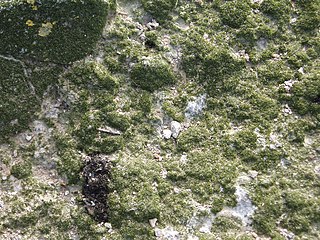
Prasiolales is an order of green algae in the class Trebouxiophyceae. Members of this order are ecologically widespread and are found in freshwater, marine, and terrestrial habitats from the Arctic to the Antarctic.

Botryococcaceae is a family of green algae in the class Trebouxiophyceae.

Selenastraceae is a family of green algae in the order Sphaeropleales. Members of this family are common components of the phytoplankton in freshwater habitats worldwide. A few species have been found in brackish and marine habitats, such as in the Baltic Sea.
Auxenochlorella protothecoides, formerly known as Chlorella protothecoides, is a facultative heterotrophic green alga in the family Chlorellaceae. It is known for its potential application in biofuel production. It was first characterized as a distinct algal species in 1965, and has since been regarded as a separate genus from Chlorella due its need for thiamine for growth. Auxenochlorella species have been found in a wide variety of environments from acidic volcanic soil in Italy to the sap of poplar trees in the forests of Germany. Its use in industrial processes has been studied, as the high lipid content of the alga during heterotrophic growth is promising for biodiesel; its use in wastewater treatment has been investigated, as well.

Choricystis is a genus of green algae in the class Trebouxiophyceae, considered a characteristic picophytoplankton in freshwater ecosystems. Choricystis, especially the type species Choricystis minor, has been proposed as an effective source of fatty acids for biofuels. Choricystis algacultures have been shown to survive on wastewater. In particular, Choricystis has been proposed as a biological water treatment system for industrial waste produced by the processing of dairy goods.

Dictyosphaerium is a genus of green algae, in the family Chlorellaceae. It occurs in freshwater habitats around the world and is planktonic. The name comes from the Greek roots diktyon, meaning "net", and sphaira, meaning "ball", referring to its morphology.

Watanabea is a genus of microscopic green algae in the family Watanabeaceae. It is widespread in terrestrial and freshwater habitats, including as a photobiont within lichens, but is apparently rare.

Crucigenia is a genus of green algae in the class Trebouxiophyceae. It is widespread, but not often abundant, in freshwater habitats around the world.

Tetrastrum is a genus of green algae (Chlorophyta). It is a common component of the phytoplankton of freshwater habitats, particularly eutrophic and alkaline waters.
Symbiochloris reticulata is a species of green alga in the Trebouxiales. It is a known as a photobiont with several lichen species, like Lobaria pulmonaria, but also as a free-living soil alga as well. Phylogenetic analysis of rRNA sequence data revealed that the species shares a sister group relationship with two other green algae that lack motile stages, Chlorella saccharophila and C. luteoviridis.
Chlorella volutis is a species of euryhaline, unicellular microalga in the Division Chlorophyta. It is spherical to oval-shaped, is solitary and lacks a mucilaginous envelope.
Chlorella rotunda is a euryhaline, unicellular microalga in the Division Chlorophyta. It is spherical to oval-shaped, is solitary and lacks a mucilaginous envelope.
Chlorella lewinii is a euryhaline, unicellular microalga in the Division Chlorophyta. It is spherical to oval-shaped, is solitary and lacks a mucilaginous envelope.
Chlorella singularis is a species of euryhaline, unicellular microalgae. It is spherical to oval-shaped and is solitary.
Chlorella pulchelloides is a species of euryhaline, unicellular microalga in the Division Chlorophyta. It is spherical to oval-shaped and is solitary
Chlorella pituita is a species of euryhaline, unicellular microalga in the Division Chlorophyta. It is spherical to oval-shaped and is solitary

Chlorella vulgaris is a species of green microalga in the division Chlorophyta. It is mainly used as a dietary supplement or protein-rich food additive in Japan.
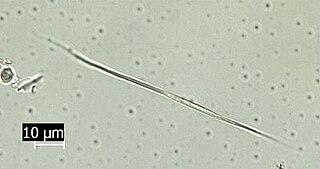
Koliellaceae is a family of green algae in the order Prasiolales.
Elongatocystis is an autotrophic green alga in the Oocystaceae family that is defined by its elongated type cell. This genus was discovered in a rockpool at Belvedere River, Mpumalanga, South Africa and described by Krienitz and Bock in 2011 along with two other strains of Oocystaceae. Its discovery and genetic analysis determined that Oocystis ecballocystiformis should be removed. In its place, the genus Elongatocystis was proposed to more accurately represent the phylogenetic tree.
Asterochloris is a genus of green algae in the family Trebouxiophyceae. It is a common photobiont in lichen, occurring in the thalli of more than 20 lichen genera worldwide. Asterochloris is distinguishable from the morphologically similar genus Trebouxia, primarily due to its deeply lobed chloroplast, the placement of the chloroplast along the cell's periphery before the initiation of zoospore or aplanospore formation, and its tendency to primarily reproduce asexually through the production of aplanospores.

