Related Research Articles
Silly Symphony is an American animated series of 75 musical short films produced by Walt Disney Productions from 1929 to 1939. As the series name implies, the Silly Symphonies were originally intended as whimsical accompaniments to pieces of music. As such, the films usually did not feature continuing characters, unlike the Mickey Mouse shorts produced by Disney at the same time. The series is notable for its innovation with Technicolor and the multiplane motion picture camera, as well as its introduction of the character Donald Duck making his first appearance in the Silly Symphony cartoon The Wise Little Hen in 1934. Seven shorts won the Academy Award for Best Animated Short Film.

Rouben Zachary Mamoulian was an American film and theater director.

King of Jazz is a 1930 American pre-Code color musical film starring Paul Whiteman and his orchestra. The film title refers to Whiteman's popular cultural appellation. At the time the film was made, "jazz", to the general public, meant jazz-influenced syncopated dance music heard on phonograph records, on radio broadcasts, and in dance halls. In the 1920s Whiteman signed and featured white jazz musicians including Joe Venuti and Eddie Lang, Bix Beiderbecke, Frank Trumbauer, and others.
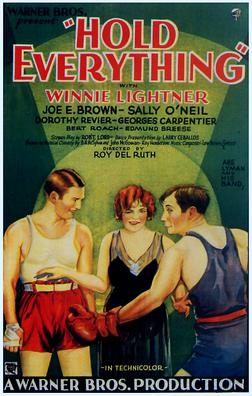
Hold Everything is a 1930 American pre-Code film. This musical comedy film was photographed entirely in early two-color Technicolor. The first all Technicolor musical comedy film was "On With the Show" in 1929. "Hold Everything" was adapted from the DeSylva-Brown-Henderson Broadway musical of the same name that had served as a vehicle for Bert Lahr and starred Winnie Lightner and Joe E. Brown as the comedy duo. The romantic subplot was played by Georges Carpentier and Sally O'Neil. Only three songs from the stage show remained: "You're the Cream in My Coffee", "To Know You Is To Love You", and "Don't Hold Everything". New songs were written for the film by Al Dubin and Joe Burke, including one that became a hit in 1930: "When The Little Red Roses Get The Blues For You". The songs in the film were played by Abe Lyman and his orchestra.

Wanderer of the Wasteland is a 1924 American silent Western film directed by Irvin Willat and starring Jack Holt, Noah Beery, and Billie Dove. It was the second feature film to be photographed entirely in two-color Technicolor.

Paris is a 1929 American pre-Code musical comedy film, featuring Irène Bordoni. It was filmed with Technicolor sequences: four of the film's ten reels were originally photographed in Technicolor.

Lights of Old Broadway is a 1925 American silent drama film directed by Monta Bell, produced by William Randolph Hearst's Cosmopolitan Productions, and released by Metro-Goldwyn-Mayer. The film stars Marion Davies in a dual role and Conrad Nagel, and is an adaptation of the play The Merry Wives of Gotham by Laurence Eyre (USA). The film has color sequences using tinting, Technicolor, and the Handschiegl color process.
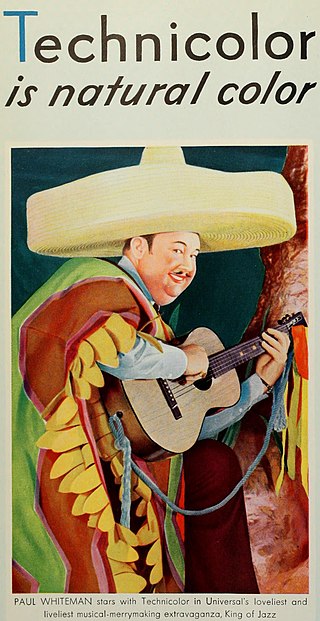
Technicolor is a series of color motion picture processes, the first version dating back to 1916, and followed by improved versions over several decades.
Buffalo Bill's Last Fight is a 1927 MGM silent fictionalized film short in two-color Technicolor. It was the second short film produced as part of Metro-Goldwyn-Mayer's "Great Events" series. As with the first film in the series, The Flag: A Story Inspired by the Tradition of Betsy Ross, this film continued the series' original intent to focus on events from American history. Ultimately, only one other short was shot which stuck to this format; the other films in the series featured historical events with a European or Asian focus.
The Lady of Victories is a 1928 MGM silent fictionalized film short in two-color Technicolor. It was the third short film produced as part of Metro-Goldwyn-Mayer's "Great Events" series.
The Czarina's Secret is a 1928 MGM silent fictionalized film short in two-color Technicolor. It was the fourth film produced as part of Metro-Goldwyn-Mayer's "Great Events" series.
The Virgin Queen is a 1928 MGM silent fictionalized film short in two-color Technicolor. It was the third short film produced as part of Metro-Goldwyn-Mayer's "Great Events" series.
Cleopatra is a 1928 MGM silent fictionalized film, shot in two-color Technicolor. It was the sixth short produced as part of Metro-Goldwyn-Mayer's "Great Events" series.
The Heart of General Robert E. Lee is a 1928 MGM short silent fictionalized film short in two-color Technicolor. It was the seventh film produced as part of Metro-Goldwyn-Mayer's "Great Events" series.
Madame du Barry is a 1928 MGM short silent fictionalized film short in two-color Technicolor. It was the eighth film produced as part of Metro-Goldwyn-Mayer's "Great Events" series, and the last to be released before the new year.
Manchu Love is a 1929 American pre-code Hollywood Metro-Goldwyn-Mayer short silent historical fiction film short in two-color Technicolor. The film features a cast entirely of people of Asian descent and stars Sojin as Su Shun and Etta Lee as Empress Tzu Hsi. It was the ninth film produced as part of Metro-Goldwyn-Mayer's "Great Events" series.
Light of India is a 1929 MGM short silent film short in two-color Technicolor. It was the tenth film produced as part of Metro-Goldwyn-Mayer's "Great Events" series.
A Princess of Destiny is a 1929 MGM short silent film short in two-color Technicolor. It was the eleventh and penultimate film produced as part of Metro-Goldwyn-Mayer's "Great Events" series.
Frontier Romance is a 1929 MGM short silent film short in two-color Technicolor. It was the twelfth and final film produced as part of Metro-Goldwyn-Mayer's "Great Events" series. A romantic historical drama, the film depicts George Rogers Clark and other American colonists as they interact with Native American tribespeople.
References
- ↑ Layton, James and Pierce, David. The Dawn of Technicolor: 1915-1935. Rochester: George Eastman House. p 347-8. ISBN 9780935398281
- ↑ Reid, John Howard. Great Movie Musicals on DVD: A Classic Movie Fan's Guide. p 87. Web. December 3, 2015. ISBN 9781105860447
- ↑ Bradley, Edwin M. The First Hollywood Sound Shorts, 1926-1931. Jefferson, NC: McFarland & Co. p 214. Web. December 3, 2015. ISBN 9780786443192
- ↑ Layton, James and Pierce, David. The Dawn of Technicolor: 1915-1935. Rochester: George Eastman House. p 347. ISBN 9780935398281
